
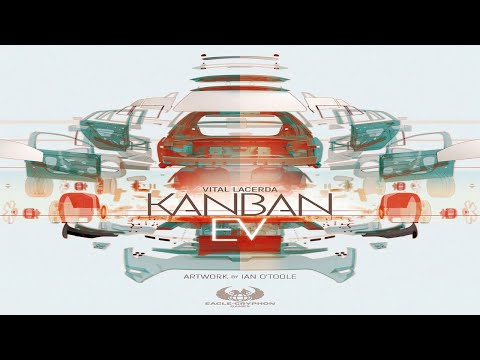
















Kanban Deep Dive
What the Community Thinks About Kanban
Board game reviewers see Kanban as a refined design that delivers on its promise: a tightly interlocking system where every action matters. Across the board game community, there is broad appreciation for how Vital Lacerda engineered the mechanics to reinforce the factory theme. Reviewers consistently praise the design as elegant and efficient, though some find the experience less replayable than other Lacerda titles. The game presents a puzzle where optimization is paramount, and reviewers divide on whether that focus feels rewarding or limiting.
Core Mechanics That Define Kanban
Worker Placement with Cascading Actions
Kanban uses a modified worker placement system where the board layout forces players through multiple connected action spaces. To gather car designs, you must first secure the right parts. To build cars, you need designs. To upgrade them, you need parts. Reviewers note that this interconnected action sequence is central to the game's identity. One reviewer observed that you really have to plan ahead because to go to a certain space you must have gone to another space to get parts or another space to get the design. This cascading logic means players cannot simply focus on one aspect of the factory; the board demands a balanced approach.
Scoring Through Multiple Paths
The game rewards players who can balance certifications (expertise in different car colors), meeting objectives, and pushing out finished cars. Reviewers appreciate that multiple paths to victory exist, yet the mechanics naturally guide players toward a similar rhythm. One reviewer noted that the system works really well, making sense once played. The individual turn actions are clear and deliberate. A reviewer from Allies or Enemies emphasized that the mechanics work well with the scoring that happens with two different parts and then the end game that might come a bit surprisingly.
The Kanban Experience
Tightness and Efficiency
Kanban demands efficiency. Every decision carries weight, and one misstep can ripple through your factory's output. Reviewers describe the game as punishing when mistakes are made, requiring players to be efficient with their actions. This tightness is by design, mirroring real manufacturing optimization. However, this creates a high-stakes experience where the first player to see the optimal sequence gains an advantage. One reviewer appreciated the design's precision, noting that it feels so smooth, like clockwork, and that this really works well for the player experience.
The Puzzle of Planning Ahead
The game presents a spatial and strategic puzzle. Players must mentally map several turns ahead to avoid dead ends. When you place a car or spend resources, you are committing yourself to a particular path. Reviewers describe constantly thinking about gravity and planning ahead, especially when deciding the order in which to execute actions. This mental load is intentional; Lacerda designs games where players feel they are operating within constraints that mirror real systems. The reward comes from finding elegant solutions within those constraints.
What Makes Kanban Stand Out
Thematic Integration of Mechanics
What sets Kanban apart is how thoroughly its mechanics reinforce the factory theme. The board layout mirrors a real production floor. The movement of cars through certifications mirrors real process improvement. One reviewer, who did not like the theme at all, still found that the mechanics are so good. This speaks to Lacerda's signature approach: even players indifferent to automotive manufacturing find themselves engaged by the puzzle. The game does not require thematic buy-in to be satisfying, though the theme enhances the experience for those who embrace it.
Excellent Game Length and Pacing
Reviewers consistently highlight the game's time management. A session of Kanban runs about 60 to 90 minutes, and in that window the game rarely overstays its welcome. One reviewer noted that the game was about hour and 40 minutes, and if it was probably 30 minutes longer they would have been over it. The pace stays brisk because player turns resolve quickly once decisions are made. The game's structure prevents downtime: while one player moves cars through the factory, others are preparing their next actions. This efficiency of play makes Kanban feel well-tuned for its player count.
Potential Drawbacks
Limited Replayability Through Optimization
After players grasp the efficient path to victory, some feel the game offers less novelty on subsequent plays. A reviewer stated that they did not know if they would play it any different, and that it is so streamlined that you could play it a couple times and be like all right I got everything out of it. The game's tight design means that once the optimal strategy is discovered, deviating from it is usually suboptimal. This differs from other Lacerda games, which reward multiple approaches. Players seeking varied strategies may find Kanban's efficiency puzzle solved and familiar on replays.
Top-Decking on Meeting Objectives
A source of friction for some reviewers is the random draw of meeting objective cards. Depending on which cards emerge, players might score significantly more or less. One reviewer expressed strong distaste for the meeting objectives, saying they hate top decking points like they think it is a cheap way to get victory points. This random element adds luck to a game otherwise defined by tight, deterministic planning. Some feel it sits awkwardly within an otherwise precision-engineered system. Others note that multiple paths to score mitigate the impact of unlucky cards, though the variance remains.
If You Enjoy Kanban
Players who love Kanban's tightly integrated design will find similar satisfaction in other Vital Lacerda titles. Those drawn to the rondelle mechanic and multi-use card decisions should explore Great Western Trail and Maracaibo, which share Lacerda's signature style of layered systems. For players who appreciate worker placement that demands forward planning, Agricola offers a comparable puzzle, though with different thematic execution. Fans of the factory optimization theme might investigate Food Chain Magnate, which explores economic systems at a larger scale. Players who appreciate the balance of mechanics and theme should consider CO2, which combines shared incentives with intricate action sequences, and Terraforming Mars, which offers multiple scoring paths and long-term planning satisfaction.
What Reviewers Are Saying
"There isn't one channel to success you really have to balance everything out which I think is a pretty genius design for one of those games where it's kind of like it's definitely obviously a competitive strategy game."
— Board Games UnLocked
"The thing that characterizes this game for me is that it's almost the easiest of them to move the pieces around, and the hardest to explain and understand the scoring. That's the most complicated part."
— Meeple University
"It was another one of those that seemed like a lot when we went to learn and I think the rule book even says sit down with a cup of tea and take your time for it but once we played it we haven't had to really look at the rules again because it all made sense."
— Allies or Enemies