





















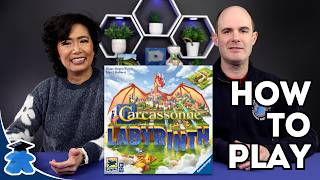




Carcassonne Labyrinth Deep Dive
What the Community Thinks About Carcassonne Labyrinth
Reviewers generally treat Carcassonne Labyrinth as a true fusion of two classics rather than a reskin. The format combines the sliding maze of Labyrinth with the tile-laying and city-building of Carcassonne, and most commentators find the blend more interesting than either parent. The Dice Tower highlights how the labyrinth push and the road network interact, and praises the way players keep their own growing landscape. Meeple University frames the game as a hybrid in which each turn moves through four clear steps, which helps newcomers see how the two halves connect.
Opinions diverge mainly on how much luck the maze introduces. Going Analog describes the labyrinth as a little thinky, but reserves its strongest praise for the end-of-game tower scoring. The Board Game Garden says the game broke their brain, largely because of the labyrinth side, and they want to replay it. Board Game Co is intrigued but expects the experience to be chaotic and says they will reserve judgment until they play. kovray ranked the game second at Gen Con 2026 and sees it as two distinct games sharing one box.
Core Mechanics That Define Carcassonne Labyrinth
Designed by Max Kobbert and Klaus-Jürgen Wrede and published by Ravensburger, the game uses two mechanics that drive nearly every decision. Reviewers consistently return to them when explaining why the game feels different from its predecessors.
End Game Bonuses
Final scoring in Carcassonne Labyrinth rewards long-term collection rather than running points. The game ends at the close of the turn in which the last gray tile leaves the draw stacks. At that point players retrieve their meeples, and the player or players with the most shield tokens swap their meeples for crowns. Each player then builds a stack from every tile they have collected, topping it with a meeple or crown. As Meeple University explains, the tallest stack wins, and ties are shared. Because the stack is only measured once, final standings stay uncertain until the last comparison, which is why several reviewers describe the finale as the most memorable moment of a session.
Tile/Map Shifting
The labyrinth is a sliding grid, and each turn a player inserts a tile at one of eight entry arrows, pushing another tile out. The tile that exits is collected, and any meeple pushed off the board is moved to the road on the opposite edge, regardless of who owns it. Unlike the original Labyrinth, the next player may push from the same side that was just used, which keeps the maze in constant flux. Moving through the maze to land on a matching treasure space lets a player collect the tile in their crown, and that tile then joins their personal landscape. Reviewers note that this shifting layout forces players to react to a moving target instead of planning against fixed geography.
The Carcassonne Labyrinth Experience
Tense Puzzle Pressure
Playing Carcassonne Labyrinth feels like working a puzzle under a clock that is never quite visible. Players are constantly asking which tile they want, whether it will fit their city, and whether a push will open a path to the treasure they need. The Board Game Garden describes the labyrinth as the element that stretches the mind, and that sense of strain is the core emotional draw. The tension rises when a planned route disappears because an opponent's push moved the corridor you were counting on.
Playful Chaos
Beneath the tension sits a lighter, almost silly energy. Reviewers describe moments of pure comedy, such as a crown placed on top of a stack of tiles with a ceremonial flourish, and the table laughter that follows when a plan falls apart. Board Game Co anticipates this chaos before playing, and the enjoyment comes from accepting that not every turn will go as intended. The game rewards players who can laugh at a ruined road and keep building.
What Makes Carcassonne Labyrinth Stand Out
A Genuine Two-Game Hybrid
Reviewers consistently praise the way the designers merged two well-known systems without letting either one dominate. kovray makes this point directly, arguing that the game takes Carcassonne and Labyrinth and reshapes them into something that does not simply feel like either parent. Players no longer place meeples onto a single shared Carcassonne landscape, which changes the social dynamic and makes every landscape a personal project. Carcassonne veterans get familiar tile edges and city logic, while Labyrinth fans get the sliding maze and treasure hunt.
The Stack Finale
The end-of-game stacking ceremony is among the most praised features in reviews. Going Analog singles out the climactic tower scoring as a mechanism that more games should adopt, and The Dice Tower highlights how each extra tile adds height and points to the final stack. Because every collected tile counts toward the same tower, the ending lets players see the whole game in physical form, and the comparison is simple enough to resolve quickly at the table.
Potential Drawbacks
Luck Can Undo Careful Planning
The most frequent criticism concerns randomness. Because the maze shifts with every push, a route that looked secure can vanish before a player's next turn. Reviewers who played on camera describe ending up in a difficult corner while their roads are broken apart, and they note that the order in which tiles emerge can frustrate players who want a specific tile at a specific moment. Some players accept this as part of the game's character, but others find it reduces the sense of control that makes Carcassonne satisfying.
A Dense Road Network
Meeple University points out that the vast majority of tiles carry roads, far more than in standard Carcassonne. This makes the tiles easy to connect but also means many placements feel forced, and the board can become visually busy. Players who prefer the more open farm and city layouts of the original may find the road-heavy tiles limiting, and the density adds to the mental load of each turn.
If You Enjoy Carcassonne Labyrinth
Players who enjoy the tile-laying and city-building in Carcassonne Labyrinth will find the most direct continuation in the original game, where the same landscape logic is applied without the maze. Players who enjoy the sliding labyrinth and treasure hunt will find Labyrinth itself an obvious next step, and reviewers note that the older game is more random but shares the same push-and-react rhythm.
- Carcassonne: Players who enjoy building personal landscapes will find the same tile-matching satisfaction in the original, with farms and cities that reward careful planning.
- Labyrinth: Players who enjoy the sliding maze and treasure chase will recognize the core push mechanic that drives Carcassonne Labyrinth.
- Labyrinth Chronicles: Players who want the maze with shared goals will find a cooperative take on the same sliding concept.
- Miss Carcassonne: Players who enjoy Carcassonne with cooperative play will find a related approach to the same landscape-building theme.
- Tiger Euphrates: Players who enjoy merging cities and competing for a shared structure will recognize the same appeal in the hybrid's connected landscapes.
What Reviewers Are Saying
"It is two different games mashed together. They've taken Carcassonne and they've taken Labyrinth and they've taken the mechanics that are so true to both of those games, combined them, and made a new game."
— kovray
"Every tile you get is an extra point, but surrounding things is half a point if you think of it that way. It just works so well. It's like, how many points you got? Push your stack over. I win."
— The Dice Tower
"A great, great scoring mechanism that more games should do."
— Going Analog