








Sovereign: Shōgun Deep Dive
What the Community Thinks About Sovereign: Shōgun
Sovereign: Shōgun, the second game in Phalanx's Sovereign series after Brettwalda, has drawn warm early reactions, mostly from crowdfunding-era coverage. Zilla Blitz, who played a prototype and posted several videos on it, loves how quickly the game accelerates and how clear the rules are. Alex Radcliffe of BoardGameCo liked it a lot more than expected, crediting its clever action selection, while flagging kingmaking and dice luck as real concerns. Meeple University's overview focuses on the timing puzzle of its rotating actions and the room it leaves for deals and betrayals. The shared view is a brisk, interactive area control game with a satisfying economic engine underneath.
Core Mechanics That Define Sovereign: Shōgun
Rotating Action Selection
The action selection system stands at the heart of Sovereign: Shōgun. Five available actions rotate through a power track, with actions gaining strength as they wait for activation. Each turn, a player selects one action at its current strength level, then all other actions shift left on the track while the chosen action resets to its weakest position. Players face a genuine dilemma every turn: take a weak action now because they need it urgently, or wait and hope they can afford to let others act first. This decision-making pressure starts immediately and never relents, with timing becoming as important as the actions themselves. The mechanic creates a puzzle within each turn, making action selection feel like a tactical challenge rather than a mere formality.
Domain Development and Building
Players build their territories through a three-tier system of mura (villages), machi (towns), and jokamachi (castles). As buildings are placed, they uncover special abilities specific to each province's development. Zilla Blitz notes that this system feels streamlined, tight, and crisp, with each building placement revealing new capabilities that let players customize their economic and military output. The elegance lies in the interdependence between development and harvest actions. Placing buildings unlocks resource bonuses that only activate when players take harvest actions, forcing meaningful choices about which provinces to develop and when to harvest from them. This creates a game-wide puzzle where every province developed becomes a thread in a larger strategic tapestry.
The Sovereign: Shōgun Experience
Escalating Tension and Rapid Climax
Zilla Blitz describes a game that accelerates quickly. What begins as a period of development and positioning quickly transforms into military escalation and conflict. Zilla Blitz compares the sensation to a fight in a phone box, with early strategic positioning suddenly giving way to direct military confrontation. The game's harvest action advances a turn track, so time itself becomes a limited resource. The effect is palpable: players realize they are crossing territorial boundaries, temple zones are being contested, and rival daimyo are within striking distance.
Meaningful Negotiation and Player Interaction
With up to five armies on the map, Meeple University notes that Sovereign: Shōgun lets players negotiate, exchange resources, make promises, gang up and break promises. Zilla Blitz feels the game strikes a really nice balance between negotiating with other players, military actions and building up an economy, without letting the table talk become too much of the game. The theme of rival daimyo vying to become shogun gives every alliance an uneasy edge, since today's partner may be tomorrow's target.
What Makes Sovereign: Shōgun Stand Out
Elegant Mechanical Clarity and Strategic Depth
Zilla Blitz praised the rule set's clarity: every time a rules question came up while reading, the next sentence seemed to answer it, which Zilla Blitz takes as a good sign of a rule set. Alex Radcliffe finds the action selection system very straightforward and very clever, and points to the many ways to upgrade your faction, troops and tableau. You are never going to be able to do it all in one game, so each player has to pick a unique advantage, often shaped by the board state and the pressure from rivals.
Thematic Coherence and Production Value
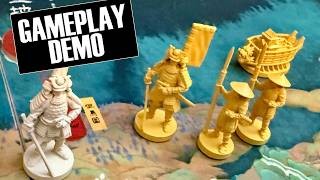
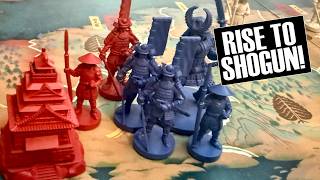
Zilla Blitz calls it an awesome looking game even at the prototype stage, praising miniatures that are crisp, sharp and clean, along with the map and the cards. The setting is rooted in history: the game opens in 1598 with the death of Toyotomi Hideyoshi, and Zilla Blitz notes that Tokugawa Ieyasu, who historically unified Japan in 1603, appears as one of the playable characters. Because the components shown were prototypes, final quality may differ, though Zilla Blitz expects the usual jump in quality for the finished version.
Potential Drawbacks
Player Count Dependency
Alex Radcliffe finds that Sovereign: Shōgun operates best at four to five players, is fine at three, and would not necessarily be recommended at two. Zilla Blitz found it really good at three and four players but had not really tried it at two. Groups that mostly play as a pair should weigh that before backing it.
Dice Variance in Combat
Combat means rolling giant handfuls of dice. There are many ways to roll more dice, but Alex Radcliffe warns that in an otherwise incredibly strategic game, a roll that does not go your way can undo the feeling of having played everything correctly. BoardGameCo also raises kingmaking: a player can reach seven Sakura only to have it taken away before their turn begins, forcing the others to spend energy stopping them while someone else slips in.
If You Enjoy Sovereign: Shōgun
Alex Radcliffe points players who like the rotating action selection toward Sid Meier's Civilization: A New Dawn and Ark Nova, the latter using the same system in a much more Eurogame engine. Meeple University likens the timing of its actions to Civilization and Agricola. Zilla Blitz finds it hard not to compare the game with its series predecessor Sovereign: Brettwalda, describing Shōgun's systems as streamlined and a level simpler, so fans of Brettwalda should find a quicker take on the same family.
What Reviewers Are Saying
"I really like the development combat, the way you're building your daimyo's holdings and lands. The building nature, the three levels of the buildings is really fun. And uncovering the abilities, you know, when you uncover a building, you're getting certain attributes that are going to develop your kingdom in a certain way. It feels streamlined, it feels tight, it feels crisp."
— Zilla Blitz
"The rotating action system is especially interesting because timing matters. A weak move now might save your province. A stronger development later might transform your engine. And waiting for the perfect action is wonderful right up until someone else turns your plan into compost."
— Meeple University
"I like this one a lot more than I thought I would. I really I've always liked this action selection system. Every game I've ever played with this system, I love the puzzle of trying to figure out what's the efficient order of taking one action over another."
— Alex Radcliffe, BoardGameCo