







Treeline Deep Dive
What the Community Thinks About Treeline
Treeline has generated strong enthusiasm across the board gaming community, particularly among reviewers who encountered it at conventions and during playtesting periods. The consensus centers on the game's elegant simplicity paired with genuine strategic depth. Christopher Chan, the game's designer at Kids Table Board Games and Burnt Island Games, presented the game directly to board game media, and their passion for the design clearly resonated. Across multiple review channels, the reaction has been consistently positive about its accessible learning curve combined with meaningful decisions. The game's arrival at Gen Con 2026 generated significant anticipation, with reviewers actively planning to acquire copies on day one. While reviewers universally praised the design, some noted the tension created by limited resources can feel punishing during early plays, though this appears to be seen as a feature rather than a flaw by those who understand the game's balance.
Core Mechanics That Define Treeline
Area Majority
Treeline centers on area control within rows and columns of a grid that transforms as the game progresses. Players place their forest folk into spaces to establish presence within these lines, and whenever a complete row or column is filled, the player with the most folk there claims the castle at that edge as a scoring reward. Unlike simpler majority games, Treeline uses ranked payouts where the player with second-most presence also receives an upgrade to one of their units, making positioning for second place strategically valuable. Upgraded units count as two folk for majority calculations, dramatically shifting the dynamics of future confrontations. Christopher Chan explained during their Gen Con appearance that this creates an interesting tension: players must decide whether to pursue dominant control of a region or strategically place enough influence to claim valuable second-place bonuses while preserving limited resources.
End Game Bonuses via Glades
The game introduces glades, hidden tiles that provide scoring conditions benefiting all players once revealed. When a glade is flipped during regular play, any player with folk placed there can immediately earn bonus points from achievements that have nothing to do with castles. This mechanic serves several purposes: it keeps final scores unpredictable until the very end, rewards long-term planning around unknown possibilities, and ensures that even players trailing in castle control remain invested in future tile reveals. Burnt Island Games and designer Chan described this as allowing players to pursue multiple paths to victory, with castles providing direct scoring but glades offering accessible alternatives that scale based on player engagement.
The Treeline Experience
Strategic Accessibility
One of Treeline's most remarked-upon qualities is how it manages to be both extremely quick to teach and genuinely challenging to play well. Chan demonstrated this at Gen Con, completing a five-minute setup, five-minute teach, and full thirty-minute game in under forty-five minutes of total time. Yet throughout that playtime, no turn is automatic or rote. Players must constantly weigh whether to pursue contested majorities, play defensively to claim second place, or bank resources for future confrontations. The forced placement mechanic, where one player flips two tiles and chooses which to fill while the next player is forced to fill the remaining one, means that every turn presents both opportunity and constraint. Reviewers noted that even experienced players found themselves reconsidering strategy, suggesting the game offers the rewarding experience of quick mastery without sacrificing depth.
Confrontational Tension Without Meanness
Treeline generates the confrontational feeling of area-control games without devolving into kingmaking or excessive player elimination dynamics. The take-that elements are present but codified by strict rules: when a tie occurs for majority, the active player wins but must pay two units to the castle instead of one, turning victory into a resource sacrifice. This creates dramatic moments where claiming a majority victory actually weakens a player's position for future turns. Players described the sensation as an uneasy alliance among forest folk, where temporary cooperation to reclaim the forest from the human town quickly devolves into subtle sabotage and positioning. The game never feels mean-spirited because the confrontation is mechanical and transparent, rather than random or punishing.
What Makes Treeline Stand Out
Scalable Design Across Player Counts
While Treeline plays well at two, three, or four players, the four-player variant introduced the most distinctive feature: true team play where players share points with a partner but do not share influence in individual rows. This creates a unique dynamic absent from the solo or trio experience. Players must win rows independently while setting up their partner to succeed on subsequent turns, requiring both selfish play and cooperative positioning. Christopher Chan identified the four-player game as their favorite variant, describing the discussion and negotiation that emerges between teammates as adding a dimension of player interaction beyond the pure mechanical gameplay.
The Transformation Mechanic as Thematic and Mechanical Anchor
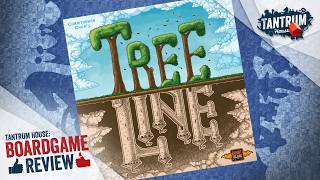
The board begins in what reviewers described as an unappealing Euro beige, with tiles representing a human town built upon the forest. As players flip tiles, they reveal the colorful, forested landscape underneath, transforming the table from monotone to vibrant over the course of the game. This serves a dual purpose: thematically, it communicates the game's narrative of reclamation; mechanically, it provides constant visual feedback of progress while introducing the uncertainty of where the hidden glades will appear. The end-game condition, which triggers when fewer than five unforested spaces remain rather than when the board is fully filled, creates an interesting decision space where unexplored tiles and their scoring potential become strategically relevant until the final moments.
Potential Drawbacks
Severe Resource Pressure in Early Plays
Treeline uses an intentionally limited supply of worker pieces that forces difficult decisions about deployment and recovery. Players cannot simply spread influence everywhere; they must carefully manage how many folk they place and when they retrieve them from the board to reposition elsewhere. Christopher Chan explained that this constraint is deliberate, designed to make every placement consequential. However, this creates a significant learning curve where new players often feel starved for options and may place inefficiently, leading to frustration in a first or second play. The pressure is real enough that some reviewers noted the game rewards planning ahead and punishes reactive play more harshly than many family-weight games.
Forced Placement Can Backfire Against Unprepared Players
The core mechanic of flipping two tiles and forcing the next player to fill the one left behind is elegant but can feel punishing when executed well by an experienced player against a newer one. Skilled players can identify tiles that set up unfavorable choices for opponents, while newer players may not recognize the trap until after the fact. This doesn't break the game, as the mechanic is fully transparent and learnable, but it does mean that Treeline has a notably steeper skill curve than its thirty-minute playtime might suggest. Players who struggle with spatial planning or forward-thinking strategy may experience several plays before the design begins to reveal its elegance.
If You Enjoy Treeline
Reviewers who loved Treeline often cited Night Cage, a previous game by the same designer, as offering a similarly elegant blend of simple rules with emergent depth. Night Cage operates in a different space, a more abstract, maze-like tile placement game, but it shares Treeline's philosophy of making every decision matter and teaching quickly without sacrificing challenge. Players drawn to the forced-placement element and worker-scarcity management will find that Burnt Island Games has designed Treeline specifically to deliver this combination of accessibility and strategic punch in a small, approachable box.
What Reviewers Are Saying
"The mechanics are simple enough that you can learn it quickly. The decisions are still interesting though. It's still strategic. You're not going to just be quickly taking your turn without thinking about what you're doing."
— Christopher Chan, Brains on Games
"In a three-player game, I never felt like I was cooperating with anyone to try and build a forest. I was constantly trying to undercut everyone else. There's some take that actions in this game."
— Brains on Games
"At four players there are alliances. You do share points at the end with your teammate, you do not share influence in the rows. So, you do have to still win rows on your own. And you have to set your teammate up to win whenever possible. That's a really critical element of the four-player game."
— Christopher Chan, Brains on Games