
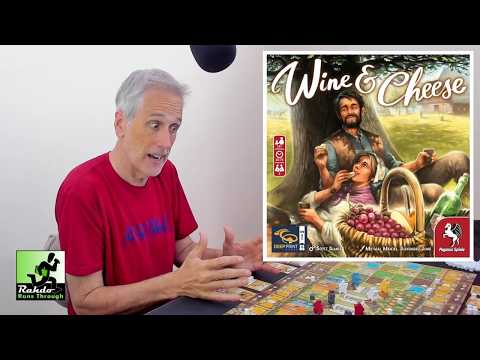










Wine & Cheese Deep Dive
What the Community Thinks About Wine & Cheese
Wine & Cheese arrives as a fascinating and demanding two-player experience that divides even seasoned reviewers. The consensus is clear: this is a brilliant design with exceptional depth, but it demands a particular playstyle sensibility. Reviewers unanimously praise its strategic complexity and interactive nature, yet some express reservation about its punishing, head-to-head structure. Rahdo Runs Through called it one of the most interactive worker placement games ever created, while Before You Play placed it squarely on their most anticipated 2026 list, citing its spiritual connection to designer Scott Almes' earlier work, Beer and Bread, as reason enough to watch closely. The game does not court casual players or those seeking cooperative moments; it courts deep strategists willing to spend mental energy maximizing both personal gain and opponent setback in equal measure.
Core Mechanics That Define Wine & Cheese
Paired Worker Placement and Forced Following
At the heart of Wine & Cheese lies a deceptively elegant worker placement system where every choice cascades. On your turn, you select a colored worker (blue, red, yellow, black) and send it to the harvest grid. Here is where the system's brilliance emerges: your opponent is forced to use the same colored worker on their turn. This mechanic transforms worker placement from a puzzle you solve independently into a chess match where you must simultaneously optimize your position and sabotage theirs. When you place a blue worker at a location with a favorable pattern, you are not only securing resources for yourself; you are also declaring which patterns your opponent must navigate. If you position strategically, you can force them into harvest locations that yield suboptimal results while you've already claimed the rich spots. Rahdo observed that players must constantly think about which worker placement will get you what you need, will get you the biggest yield, but will also in turn force your opponent who has to follow color to not get a prime yield.
Resource Multi-Use and Recipe Fulfillment
Wine and Cheese treats resources as flexible, multi-purpose tools. Milk, grapes (white and red), salt, yeast, and cultures can be used to produce wine and cheese cards according to recipes in your hand, spent as special label actions to trigger powers, or converted at a 3-to-1 ratio into any other resource. This flexibility creates a constant tension between immediate production and long-term flexibility. Each gourmet cheese and wine pairs with specific partners; sell them together and you unlock substantial bonus points. Action cards offer alternative routes to value, triggering special powers when produced. The game constantly asks: do you commit these resources to a specific production line now, or hold them for future flexibility? Perishable resources complicate the calculus further; milk and grapes spoil if not used by the storage phase, forcing aggressive commitment rather than hoarding.
The Wine & Cheese Experience
Intense Puzzle Depth and Crunchy Decision Space
Wine & Cheese feels fundamentally like a puzzle that resists easy solutions. Reviewers consistently used words like "chess-like" and "Go-like" to describe the cognitive load. Rahdo noted with some exasperation during this playthrough that they rarely in their 15-year history of Rahdo Runs Through have struggled to keep everything in their head that they have to do for two players as much as they have done in this game. The puzzle emerges from the intersection of harvest patterns, recipe fulfillment, opponent-watching, and multi-turn planning. Every decision propagates forward and sideways; choosing a worker now determines what your opponent can do, which shapes future rounds, which affects whether your aging wines reach perfection at the right moment. This is not a relaxing experience. This is brain work.
Aggressive Player Interaction and Sabotage
Wine & Cheese demands that you spend substantial mental energy thinking about what your opponent needs and how to deny it to them. This is not accidental; the design actively rewards players who can balance personal optimization with strategic blocking. Rahdo described it this way: every worker they choose directly impacts them and just as powerfully impacts their opponent. Rahdo and Jen are self-described "Care Bears" who prefer to push themselves forward without making the opponent suffer, yet Wine & Cheese structures every turn around exactly this calculation. You must choose a worker knowing it will constrain your opponent as much as serve you. For players who enjoy this dynamic, the game sings. For players who would rather build their own engine without constantly sabotaging someone else's, it can feel oppressive.
What Makes Wine & Cheese Stand Out
Thematic Coherence and Worker Diversity
Deep Print Games and designer Scott Almes embedded thematic logic throughout Wine & Cheese. The paired worker mechanic reflects real harvest constraints; different workers have different patterns reflecting their temperament. Some workers prefer to labor alone and collect more from a single location. Others thrive in groups and bonus for working adjacent to other laborers. Rahdo marveled at how the color of the worker matters, because your choice broadcasts what your opponent must do, turning a mechanical constraint into a lived metaphor of Burgundy farm life. The aging system mirrors real wine production; resources transform over time, and selling at peak age yields maximum value. Paired wines and cheeses reflect genuine culinary practice. This isn't theme bolted on; it's theme baked into every system.
The Interactive Worker Placement Innovation
Wine & Cheese solves a genuine problem in worker placement design: how do you force meaningful interaction without resorting to explicit attack actions? The answer is elegant: make following your opponent's color choice a core rule, not an exception. This forces every player to think about two people's needs simultaneously. Rahdo stated this was perhaps one of the most interactive worker placement games they had ever seen, because every worker they choose directly impacts them and just as powerfully impacts their opponent. The innovation is not bolt-on; it restructures the entire decision tree. There are no turns where you ignore your opponent because ignoring them means they get free placement. You cannot tune out. You cannot optimize solo. Every placement is a dialogue.
Potential Drawbacks
Extremely High Mental Load
Wine & Cheese is not a gateway game or a relaxing evening. The cognitive overhead of tracking multiple recipes, anticipating harvest patterns, managing perishable resources, planning multi-turn production chains, and simultaneously thinking about opponent blocking can be exhausting. Rahdo reported having to film the first playthrough twice because their brain had a complete implosion. Even experienced players note the game requires constant vigilance. If mental fatigue is a liability for your table, Wine & Cheese will expose it mercilessly.
Forced Sabotage Mechanics and Play-Style Misalignment
The game's design actively requires you to choose moves that harm your opponent's position as often as benefit your own. For players who view games as collaborative challenges against systems rather than duels, this can feel fundamentally misaligned. Rahdo and Jen, both accomplished players, found themselves exhausted not by the puzzle but by the constant obligation to think about how to make things worse for their opponent rather than simply better for themselves. They describe this as a Care Bear preference, and it is not a small group. If your table wants to solve a puzzle together or race toward your own finish line without constant tactical blocking, Wine & Cheese will frustrate rather than delight.
If You Enjoy Wine & Cheese
Wine & Cheese sits at a unique intersection: it is a deep euro with exceptional production design paired with the confrontational elegance of Go. If you love head-to-head strategy games where every decision constrains your opponent, explore Beer and Bread, its spiritual predecessor and gentler introduction to designer Scott Almes' philosophy. If you want games where placement decisions have cascading consequences and players must think multiple moves ahead, consider Go itself or Power Grid. For players drawn to the wine and cheese theme specifically or who want a modernist take on two-player worker placement combat, Wine & Cheese is essential. It respects your intelligence and rewards deep play with surprising emergent strategies.
What Reviewers Are Saying
"This is maybe one of the most interactive worker placement games I have ever seen because every worker I choose directly impacts me and just as powerfully impacts you. And as this grid fills up and gets tighter and tighter, that creates opportunities for some workers and it creates bottlenecks for other workers."
— Rahdo Runs Through
"This game, every turn, you are doing your best to come up with a move that scuppers the plans of your opponent. And in all honesty, that's not something Jen and I tend to go for. We like to look, I just want to make my own thing. I don't necessarily want you to suffer."
— Rahdo Runs Through
"It's kind of what seems to be a spiritual successor to another game by the same designer called Beer and Bread. We actually covered that on the channel, so we don't think it probably plays the exact same, but it's in that kind of very heady two-player back and forth kind of style game."
— Before You Play