







Accidental Heroes Deep Dive
What the Community Thinks About Accidental Heroes
Coverage of Accidental Heroes so far falls into two groups: early previews from channels that have not played the game in depth, and one full review from Meeple University that describes how the game actually plays. The previews are curious and cautious. BoardGameCo, hosted by Alex Radcliffe, introduced the game as a cooperative title built around roughly 200 scenarios in a semi app-driven, semi table-top-driven system, and said they had no firm opinion until they could dive in. Tantrum House presented it as a one to four player adventure in which the goal is securing dragon eggs, with each turn generating new adventures from the map and adventure tokens before a companion app brings them to life.
The full review is more enthusiastic, though still measured about the business model. Meeple University describes a light, fun narrative adventure with strong replay variety, and questions whether failure carries enough of a penalty. Reviewers agree on the central promise: the app makes each session feel different. They diverge on whether the game is competitive or cooperative. Meeple University covers a competitive version in which every player is pursuing the same dragon farm retirement plan, while the BoardGameCo preview frames it as cooperative. Until the campaign's rules are public, that discrepancy stays open.
Core Mechanics That Define Accidental Heroes
App-Generated Adventures from Locations and Adventure Tokens
The engine is the pairing of a map with a bag of adventure tokens. On a turn, a player moves zero to two spaces and, if there is no token on the space, draws one from the bag. Meeple University explains that the player then tells the app the location type and the token number, and the combination determines which events are encountered. The same token might produce one story in a forest and something completely different in a castle. Because each play produces a different string of situations and consequences, the reviewer treats the app as the game's storyteller and generator of events. Lucky Duck Games publishes the title. The transcripts do not name a designer, so this article does not attribute one.
Attribute Tests and the Favor of Three Gods
Most decisions resolve through tests. A character has three attributes, Brain, Body, and Combat, starting at two each. The player rolls one die for every point in the relevant attribute plus any bonus dice from items or prayer, and meeting or beating the difficulty passes the test. Meeple University notes that success can bring items, a quest, a shift in favor with a god, or a change in attributes. Favor adds a second layer. The three gods judge the player's behavior, and the reviewer says the player usually has an inkling in advance which god will be pleased by a given choice. Praying before a test buys extra dice at the cost of favor, which turns the decision into a gamble.
The Accidental Heroes Experience
Light, Absurd Storytelling
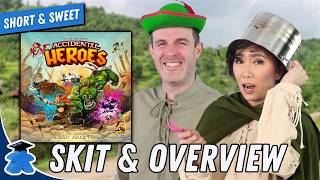
Meeple University returns to tone repeatedly. Its opening sketch sets the mood: a talking tree begs for healing from corruption while the player is busy reading options, and the outcomes are cheerfully ridiculous. The reviewer describes the result as a light, fun narrative adventure in which character building and dice manipulation supply the decisions while the app keeps the story moving. The theme is deliberately silly, with mock-heroic quests and a childhood dream of running a dragon farm as the ultimate goal.
Tension at the Edge of a Failed Test
The second feeling is the sting of a failed roll. A failed test returns two consolation coins, and the reviewer's joke about a troll attack that ends with a payout of two dollars captures the cheeky, slightly cruel tone of the game. The final missions raise the stakes with harder tests tied to a special condition, and a failure there also costs constellation coins. Choosing which test to attempt is itself a decision, since players can pick the one where they are most likely to succeed, the one that favors the right gods, or the one that makes the most entertaining story.
What Makes Accidental Heroes Stand Out
Procedural Variety From the App
Reviewers keep returning to replay variety. Meeple University stresses that many combinations of adventure tokens and locations keep each play distinct, offering a humorous example of a man in tights in a village compared with the same man in tights on a mountain. Variety comes from both the app and the player, because the choice of test and the choice of story are open to the table. That blend is the feature the review praises most consistently.
A Character That Grows Over Time
Meeple University highlights character development as a progression arc. Attributes rise and fall with adventures, items, and divine intervention, so the hero changes from the first session to the last. Items reinforce that sense of growth. The reviewer notes that some missions award epic items and other rewards that make the path to the retirement goal more achievable.
Potential Drawbacks
Failure May Be Too Cheap
The most pointed criticism comes from Meeple University, which suspects that failure could be a business model. The two consolation coins after a failed test soften the stakes, and the review's closing adventure is a playful nudge toward backing the crowdfunding campaign for its deluxe upgrades and extras. The reviewer frames both points as jokes, but the underlying concern is fair: if a setback costs little, the tension that a dice-driven adventure depends on may be blunted.
Limited Hands-On Evidence So Far
The preview coverage is candid about its limits. Alex Radcliffe of BoardGameCo said they had not yet formed thoughts on the game and planned to play it before the campaign. Tantrum House covered it as part of its October lineup without citing playtest results. Claims about the scale of the content and about whether the app-driven system holds up over many sessions therefore rest largely on campaign descriptions and a single full review, and readers should weigh them accordingly.
If You Enjoy Accidental Heroes
None of the preview or review coverage names a direct comparison title for Accidental Heroes, so this overview does not invent one. Players drawn to its app-generated storytelling and character progression can use the mechanics described above, companion-app event generation, attribute tests, and favor with the three gods, as a guide when looking for similar quest-and-build adventure games.
What Reviewers Are Saying
"Some mission let you gain epic items and even more helpful ways to get that retirement. Feels like a light fun narrative adventure game where character building and dice manipulating give you enough mechanical decisions to prepare for the chaos while the app handles the other parts to get the game going smoothly."
— Meeple University
"Accidental Heroes from Lucky Duck Games. It's a one to four player adventure game where you're setting out to secure dragon eggs with each turn generating new adventures through a combination of the map and adventure tokens, which are then brought to life through a companion app."
— Tantrum House
"Accidental Heroes is going to be a cooperative game that's going to give you like 200 scenarios in a semi app-driven, semi table-top-driven game system. I will be diving into this honestly hopefully this weekend, so I don't really have thoughts yet."
— Alex Radcliffe, BoardGameCo