







Gang Wars Deep Dive
What the Community Thinks About Gang Wars
Gang Wars is a standalone area control game from Redzen Games, set in the Prohibition-era Chicago of Scarface 1920. Reviewers and playthrough channels describe it as a quick, confrontational game in which every neighborhood matters, and most agree that its physical production is one of its strongest points. The consensus is less settled on the solo mode and the card system, which several channels describe as promising but still rough in the prototypes they played.
Totally Tabled ran a sponsored solo playthrough that shows how quickly the game can swing. Early on, the bot's associates tear through the host's gang, and the run only settles after a series of mobilize moves and a large late payout, with the final score landing at 151 to 80. One Stop Co-op Shop played a prototype with work-in-progress rules and reached a more measured conclusion. The reviewer finds the core gameplay fun and says the bot is useful for padding out a table, but describes the solo mode as sitting in an awkward middle state that plays fast without yet being especially clean or smart.
A sponsored two-player session from BoardGameCo shows the game working head to head, although its main complaint concerns how little combat is rewarded. Bower's Game Corner approaches Gang Wars from the campaign side, grading the Gamefound offer and the Scarface 1920 reprint an A. That review focuses on presentation, stretch goals, and add-ons rather than gameplay, which makes it a useful complement to the play-focused videos.
Core Mechanics That Define Gang Wars
Plans, Icons, and Action Selection
The most distinctive system in Gang Wars is its card and icon economy. Each turn, a gang commits cards to a plan, and the icons on those cards determine which actions are available. When the icons are missing, the action fails. In the Totally Tabled playthrough, the bot had a feasible action in view but did not hold the icon it needed, so its cards returned to hand and it took a reorganization action instead, drawing four cards. That moment shows how the icon requirement can turn a promising turn into a fallback move.
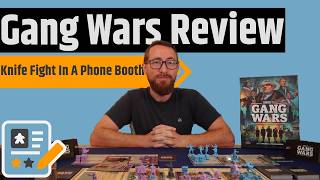
One Stop Co-op Shop calls the system a little more complicated than it needs to be for a game this light and quick, and notes that the rules for which colors and how many cards each action requires are hard to hold in memory without player aids. The same reviewer also acknowledges that limited options are part of the appeal, because a crowded board gives a gang enough cards to act on almost anything. The reviewer expects the finished edition to be easier to learn once the rules are finalized and reference material is added.
Mobilize and Neighborhood Control
Area control sits at the heart of the design. Mobilize lets a gang move thugs and cars into neighboring streets, and a take control action then flips the neighborhoods those pieces reach. One Stop Co-op Shop points out an important constraint: when a gang mobilizes, it plays only a card for the region it is moving from. That makes positioning as important as raw card count, because the origin region determines which cards are usable.
Totally Tabled describes the payoff in similar terms. After moving thugs into several streets, the gang can take control in every neighborhood it reached, and a union leader effect pays influence equal to the number of speakeasies it controls. The result is a game where one well-timed mobilize can flip a board that looked lost a turn earlier, and where the best moves often combine movement with control rather than choosing one or the other.
The Gang Wars Experience
Tense Prison Pressure and Raids
Arrests and raids give Gang Wars a steady undercurrent of pressure. Totally Tabled reports that the raid phase can clear a gang's barrels and sweep its thugs into prison at the same time, and that getting them back out is expensive. Retrieving prisoners requires either matching icons or spending influence for each person, so a gang that loses several thugs at once can find its influence drained for several turns afterward. The feeling is one of managing losses as much as chasing gains, and it gives the late rounds a sense of urgency that reviewers find engaging.
The payout system reinforces that tension. Prisoners cost money at the end of the game, and the reviewed playthroughs show players weighing whether a single thug is worth spending influence to save. The decision feels consequential because the cost is visible and immediate, and it keeps the endgame from becoming a simple count of neighborhoods.
Crowded, Swingy Board Fights
Gang Wars feels crowded by design. One Stop Co-op Shop says the board is very claustrophobic, with everyone fighting over the same stuff, and suggests that this is part of the fun of any area control game. The same reviewer calls the game super swingy, which they describe as not ideal, but adds that it keeps the pace brisk because the right action sometimes comes out and sometimes the wrong one does. The swings are most vivid when a bot's associate cards destroy a gang's pieces in a single round, the kind of moment Totally Tabled describes as a complete reversal of fortune.
What Makes Gang Wars Stand Out
Components and Miniatures
Multiple channels single out the physical production. One Stop Co-op Shop describes the pieces and miniatures as pretty dang amazing, especially for players who add the extra content. That praise matters in a game that uses thugs, cars, barrels, and tokens to show who controls each neighborhood. Clear, distinctive pieces make it easier to read a crowded board at a glance, and the reviewer ties that quality directly to how enjoyable the game is to play.
Campaign Presentation and Stretch Goals
Bower's Game Corner grades the Gamefound campaign for Gang Wars and the Scarface 1920 reprint an A. The reviewer praises the presentation, the stretch goals, and the add-ons, and argues that the add-ons help the campaign reach its stretch goals for the game on offer. The standout extras are the boss rig and a newsletter-style bonus, which the reviewer considers better than the expansions and daily reveals found in most campaigns. The review's central point is that the base game and its price did not appear to suffer because of the generous extras, which the reviewer calls a difficult balance to achieve.
Potential Drawbacks
Limited Faction Differences
One Stop Co-op Shop raises a concern about asymmetry. In the prototype, the starting cards for each faction are basically identical, and the only clear difference between factions comes from three faction powers. The reviewer acknowledges that some factions are more dangerous in combat and that some can draw better cards during deck building, but says the lack of distinct starting decks is not as exciting as it could be. Players who expect factions to play very differently may find this the weakest part of the design at this stage, although the reviewer expects the finished edition to add more variety.
Shootouts Feel Underrewarded
BoardGameCo's two-player playthrough argues that shooting is not strong enough. The reviewer says a kill pays only a small amount compared with the work needed to set it up, and wants shootouts to be rewarded more generously. The concern is that combat can feel like a poor return for the cards it consumes, which weakens one of the most dramatic actions in the game. Shootouts can be costly in cards, and the reviewer's view is that the payout should reflect that cost.
If You Enjoy Gang Wars
Players who enjoy the competitive area control at the center of Gang Wars can look at the related titles reviewers mention alongside it.
- Scarface 1920: BoardGameCo recommends this as the next step for players who want everything Gang Wars does but with a bigger ecosystem, more rules overhead, and more happening on the board.
- Blood Rage: BoardGameCo calls this one of their favorite area control games, with the same close, knife-fight-in-a-phone-booth feeling that defines Gang Wars's neighborhood battles.
- Through the Desert: BoardGameCo describes this as an area control game with less direct conflict, but where every single move still matters, a useful comparison for players who want the positioning without the shootouts.
What Reviewers Are Saying
"I'm going to have a lot of people sent to prison here. And getting them out is going to be tough. I'm going to have to spend a lot of influence."
— Totally Tabled
"The heart of the game play is take that area control. So if you don't like that, you're not going to enjoy this."
— One Stop Co-op Shop
"One of my critiques of the game is I don't think shooting is strong enough. I think shooting should be rewarded a bit more."
— BoardGameCo