My Top Favourite Card Games that are NOT UNO! Vol. 2
Games in This Video
5 games are featured in this video — they unlock as you watch.



Transcript
Are you looking for some really quick, fun card games that you can play on a week night, maybe after work, or maybe after dinner? Well, you've come to the right place, my friends, because today I'm going to be sharing with you five of some of my favorite crafty cool card games in my board game collection. Hi, my name's Danny. I'm an avid modern board gamer from Australia sharing my passion for this hobby with you, my friends, and my family. Come and join me on this journey and don't forget to subscribe for more wholesome board game content. One of my favorite pastimes that I've often like to dabble in is photography. the idea of taking a photograph, capturing a moment, and then I guess um saving that moment and sharing it and revisiting that moment later on. I often like taking pictures of nature and scenery, and I've traveled to places like the Rockies in Canada as well as um scenic places in New Zealand. The idea of taking photographs and capturing those memories feels really personal to me. And so this next card game that I want to talk about is by one of my favorite Japanese game designers called Sashi, whose wife actually does a lot of the
illustrations for his games. If you play games like Come Sella Away, you'll be really familiar with some of the art style that you see in his games. The game I want to talk about used to be called Wine the Film, but the version I've got is called Photograph. Each player is going to have a hand of cards. players are not going to be able to move or reposition the order of the cards that they have in their hand. So, kind of like an old school film strip, you kind of have to work with the little pieces that you've got and in the sequence that you've got them in. On your turn, you're going to be deciding to take one, two, or three cards from the market area, and you'll be able to take cards from either the leftand side or right hand side, and you'll take those into your hand by placing them at the front of your hand. You will then choose one card in your hand to move forward any number of spaces. You can move it right to the front or maybe one card in front and then you'll be playing the same number of cards that you drafted from the back of your hand into your player area. Now, there are a range of different colored film strips which have captured different memories from your travels and you're trying to create a sequence of numbers in either ascending or descending order.
And what's interesting about this game and the constriction to this game is that you can't make the numbers too far apart. If you start at one particular number, you need to be able to uh put cards on future turns by going either in descending or ascending order, whichever way you decide to commit to. And then you need to make sure that they're kind of close apart. you can kind of place a card like with a difference of two uh further apart, but if you go any further than that, you kind of get your film kind of goes out of focus and you have to flip a card over and then you get like a penalty at the end of the game. And so as the game progresses, you're thinking about which colors you're going to start investing in, which colors you've got in your hand, how you going to wind the film to move certain cards forward into your hand, and then which cards you're going to play. Do you take the risk and take three cards you really need now, but then work out how you're going to puzzle playing three cards from your hand that don't really work in this moment? And so this game really gives you that challenge of dealing with sequencing things and playing five little mini tableau out and timing it in a way where you can kind of make everything work. And the funny thrills to this game is that not everything will always go in your favor.
You may have that green card that is a one and then you might also have the 12 green and then you're like, "Okay, what do I do with these two parameters? I'm going to have to take a penalty at some point." Or if you finish your red sequence really early on and there's a lot of red cards in the final round and so you're dealt with these options that you have to contend with and penalties that you have to try and negate. And so it really makes for a very crunchy experience, but be prepared not to be able to do everything that you want cuz this game is all about going, "Okay, I need to give them a little bit of room to breathe on the later round. So I might hold off on a particular color. All those numbers really work together. I might take them into my hand and save them up for the next or up an upcoming turn. Oh, I've got these cards that really work.
Now I might start my green and my blue sequence off and go in descending order." There's some really great thinking moments that really make this a fantastic two-player game, and this is primarily what I play it at. I really love it when a card game has rule set that you can teach in about 2 minutes, but then each and every decision feels weighted and layered. And these are some of the best games that I have in my game collection because they really challenge the way you think, but they also make you think, okay, what's a cool card game that I can play? It really has that shelfworthiness of like being able to take it off and being like, "Hey, we should play this game. I know we're actually going to have a great time." And especially as someone who uh plays a lot of mediumweight Euros, I often want a game that is going to challenge me a little bit. And so trick taking games, there are so many.
There's like hundreds of them out there, but this one has an interesting hook and it's one that I really enjoy at the 3 to four player count. It's called Seas of Strife. And the theme around this game is basically you're sailing around obstacles in the ocean, whether it be a kraken or maybe some like a rugged coastline or some treacherous ocean meter high waves. Caesar Strife is a trick- taking game where you're basically trying to avoid winning tricks. And basically trick taking is usually when a player plays a card of a particular suit which forces all the other players at the table to play cards of the same suit. and whoever has the highest value usually wins that trick. And they do that by taking all the cards and placing it in front of them. In Caesar Strife, you're trying to not be that player that wins the trick.
In fact, you kind of want the other players to take the brunt of some of the damage, and that's going to help you get a little bit of leverage in the game. In Caesar Strife, if you do win a trick, you actually get a point. And getting points is pretty bad. This is kind of like golf. You really want the like the lowest amount of points possible because if you take a trick then you're suffering the penalty of crashing into an obstacle or not getting through to your destination. What's interesting about Caesar Strife is that the best way to play this game is actually using the variant rules which actually come in the game itself. And so basically the game is split into different colored suits which are basically different ranges of numbers uh that appear in like brackets of about 10 to 12 and there is a face value card which is like the highest value of that range number. So for example with and they're usually marked with like a star. So for the red suit 20 is the highest number.
And so in this game, if someone leads a card, let's say with a red 19 and someone else has a red 20, the variant rules state that when you play the face card or the highest value of that particular suit, that cancels that color out for that particular round. So it gives you a little bit more power, a little bit more leverage for shifting the way the tricks play out. So that means if you're thinking, "Oh, okay. I've got this really high value red and someone else I want someone else to cop the penalty of the trick. You can cancel out the reds and if someone you know was forced to play a yellow cuz they didn't have any reds, then that player would take that trick and get the penalty point. And so there's some really cool micro interactions that happens when you're planning which cards that you are going to play. and the fact that the face value cards zero out uh particular colors and I only would play this game using these variant rules which are official in the game because they add just so much strategy um and layering to how and what value cards you're going to pick and which cards you're going to save for later. The next game is a welcome addition to my board game collection. In fact, I've only had it for a short while, but I've really enjoyed the mathematical and analytical nature that it has really provided me.
And it's a quick game to play, but it has an immense level of constriction to the sort of ways you can score in this game, but also maximize the number of points. It has a quirky theme about traveling and journeying through different regions and going on a quest, but then returning home after your quest and calculating your victory points. It's a game called Far Away. And basically what players are going to be doing is you have three cards in your hand. And then you'll basically play a region card, which is like a square colored card. And each region card has a numerical value on it and represents one of the four different types of biomes. There's like, you know, the water biome, there's the desert biome, and then there's the forest biome. And basically what you'll be doing is you'll be playing eight rounds where you play these eight region cards and at the end of the eighth round you'll then resolve the scoring of those cards starting in reverse order going from right all the way back to the beginning. So in some ways you're playing the cards forward but then scoring them in reverse order. And so this creates a little bit of a mind meld when it comes to deciding how you're going to start your game, how you're going to build up in the middle, and how you're going to end your game.
There are different types of uh ways to satisfy the region cards. There's cards that have little quests. So, in order to complete the quest, you need to have particular cards in your line or in your tableau. So it might be having little masks or like a little pineapple symbol and that will satisfy the quest and therefore give you the points that are listed on the region card. And so each card has its own specific requirement and purpose. Some of the cards and this kind of helps to make the game feel a little bit uh more open have little map symbols on them. And so if you ever play a card that's higher than a previously played region card, you can draw these little sanctuary cards. board game sanctuary. Uh, and any other card that you've already played before that has a little map icon, you'll be able to draw additional sanctuary cards from there, too. The sanctuary cards basically give you additional ways to get those icons to satisfy quests, additional like biomes or additional uh things that help to make you satisfy your scoring conditions as you return home. And so what I really love about this game is that if you love these sort of programming level games where you need to sequence things and then trigger things in forward and backward order, this is a game that's really going to play into that realm of yeah, I need to play a blue and oh, I need to collect have these two icons. Oh, I need to be able to draw these sanctuary cards to give me a few more options and play this sanctuary card here. So then when I
come back, I can score off these particular icons. And this creates for some brilliant strategy. And the fact that the cards are numbered and they incre and trying to get them to sequence and increase in order means you can increase the breadth of the options that you can potentially draw from those sanctuary cards. So, I really like the idea of trying to build this sequence forward, but then I guess untangling it as you go in reverse to see whether you fulfilled those dreams that you set out to fulfill on your first quest. But then when you get a card and you're like, "Ooh, the eighth card that goes out, how am I going to fulfill that card? Oh, I'm going to struggle to fulfill that." There's a lot of those little intricacies in the game where you feel like you can never complete everything and so you try and do the best with what you've got. The reason why I've got a big smile on my face is because this next game makes me feel so happy. In fact, this was a game I picked up 2 years ago on my trip to Melbourne and I walked into the shop and I thought, "Wow, that game, there's something about that game that just makes me smile, makes my heart glow."
And so I've always got room in my three or four pockets for pocket-size card games. And this game is called Happy City. Happy City, and you don't have to keep it in this big box. You can actually just take out the deck of cards, is a city tableau building game where you're going to be building a city with 10 different buildings in it. It's a very fast, short, snappy game, and you probably want to play about like five games in a row in order to see who wins, the best of five, which is how I recommend playing this. But basically, you're going to be buying two categories of buildings. Uh there are like the basic buildings, and then there's more advanced and more expensive buildings. And at the end of the game, you're going to be counting up the amount of citizens in your city uh and how many hearts you got in your city. You're going to be multiplying those two values together.
So, you better know your times tables well, and that's it. And you might be thinking, Danny, what are the thrills to this game? What is the hook? What is the thing that's going to get me lured into playing it? Well, basically this game has you drafting from one of three different face up building cards. So, you get to choose which pile you're going to be revealing cards from. So, if you want to try and invest in, you know, some of the cheaper buildings, you might reveal those cards. Or if you want some more higher powered buildings, you might reveal those cards. So, you get to choose which level of cards you're going to be revealing. The market's going to be very, very narrow, so you really have to be decisive with what you're going to take. You can also spend your money which you earn each and every round. So the number of little money icons totaled up each and every round will give you income. You can also buy residential buildings which will increase the value of your uh number of residents in your city which is important for multiplication.
And uh basically if you have a particular combo of residents and commercial buildings, you can then get uh expert or special or advanced buildings with particular scoring powers and abilities that help to strengthen your tableau overall. But basically, you're trying to maximize the number of hearts as well as the number of citizen icons. And there are some cards that kind of like cancel some of those icons out. So you're kind of trying to think, well, do I really need that card? It's going to give me more money, but it's going to lower my scoring value at the end. There's a few of those little micro decisions that really makes this game super fast, but super tense. This is a quick game that you can just play anywhere. Like, it it just has so much variety in the type of special buildings that you can have each game that you're going to find that this game I'm going to try these this combo. Oh, I really want to go for those expert advanced buildings.
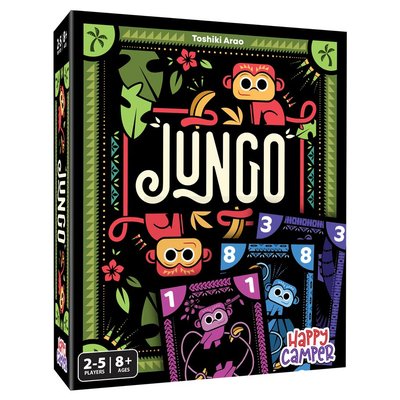
I want to use that one in my tableau. and it has that really short, fast, snappy 15minute pace where you can get a lot of really fun euroy feelings from it as I do uh when I play Happy City. There's a term that I got introduced to recently that I actually didn't realize was like a type of mechanic that card games use and it's called card shedding. And I was like, "Oh, wait a minute. Isn't Uno a card shedding game?" Cuz card shedding basically is when a game tries to get you to try and empty all the cards from your hand. Basically, whoever empties all the cards first will win the game. And so this next game has that Unoesque feel to it. The idea that you've got all these numbers, you're trying to just play them all out before the other players. The game I'm talking about is based on a Japanese uh design, but it's been reimplemented with this jungle theme, and it's called Jungo. Jungo is basically a game where one player is going to start off the round by playing a card with a particular number and the subsequent players are going to try and beat that card by playing higher numbers. And if you play duplicates, that's going to supersede those previously played cards. If you beat um a combination that's already out in the playing area, you can opt to take those cards into your hand, place them anywhere you like, or you can just discard those cards into the discard pile. Why might you want to take cards
into your hand if it is a card shedding game? Well, because the position of all the cards that are in your hand are fixed. So, if you've got a card that, you know, if you've got a sequence of cards that are like seven, eight, and seven, you can't play the two sevens together until you find a way to remove the eight that's kind of wedged in between them. And so, you might think, ooh, uh, the previous player played a double seven. I might be able to put those two sevens next to my single seven and then on a future turn play a triple 7 to remove it from my hand. and you can see where the nuances of this game really apply. There's another cool rule in this game where if you can't beat a combination, you can draw a card from the top of the deck. You can choose to add it anywhere in your hand or you can choose to discard it or you can say jungo and basically you can combine that card with other cards that are adjacent together in your hand and play them out. So if you for example get like you know a five and you've already got two fives in your hand, you can add it to the two fives and make it a triple five to play it out. And so it kind of creates this little weird moment of like, yes, that card helped me. Yes, that card gave me the cards that I needed to get rid of, you know, two cards from my hand. This game plays super fast in about 10 to 15 minutes and you literally will want to play again straight away because the level of interesting interaction this game just makes it so incredibly fastpaced. It's
actually one of those great um if you're hanging out with a group of people on the weekend or you're around at a barbecue, this is a game to get out that will really have people going, "Ah, yeah, let's just play that." you can kind of chat and have a drink and also play Jungo without having to think too much about the social interactions whilst having an enjoyable time as well. And I love small games like this that just really um fit into my life so well. And so it definitely has a warm place in my heart and in my board game collection. So what did you think of these crafty cool card games? Are these the sort of games that you are looking to add to your board game collection? Let me know if you've played some of these games or you're willing to try them out. I also love to know what cool crafty card games uh that are easy to teach that are also in your collection. I'd love to start a conversation with you. Also, thank you once again for Thank you once again for joining me for another Board Game Sanctuary video. If you really want to help my channel grow, uh please consider buying me a coffee a month over at my Patreon page. Otherwise, check out some of my other board game Sanctuary video.
Don't forget this is volume two. Go back and check volume one for more cool board game suggestions. This is Danny Singia. I hope your next card game is a fun one. See you soon.