Top 10 Oldest Games We Love
Games in This Video
7 games are featured in this video — they unlock as you watch.



Transcript
You know what's nice, Nick? What? I feel old some days.
Okay. And so sometimes it's nice to play games that are also old so at least I feel like I'm not alone. Hey
What's up everybody? My name is Nick. I'm Mike. We are the brothers Murf. And that's right. We're going to talk about our 10 games that we love that are the oldest games that we love. One thing that's really nice about board games and one thing why I think board games are a really good investment is the fact that they can sit in a closet for literally like decades and then you can pull them out and you can just play them cuz the rules haven't changed
your house doesn't flood you're fine.
I really think it's wonderful and I think it's it's a great analog thing that's like yeah we've had this game for like 40 50 years and so these would be games that we love that are older games. So games you know uh some are hundreds of years old some are a decade or two old but these are the oldest games that we really really love. Also, we're actively nowadays trying to play a lot of older games because there's a lot of great ones. So, if you have any suggestions, pop them down in the comments below. Um, we don't like chess. Sorry. Um,
chess ain't going to be on this list.
It deserves respect.
It deserves all the respect. But now, let's pop in the comments because we want to find out about great older games. Let's go ahead and get into it. Our number 10 is going to be Quartto. Porto is a really good abstract strategy game. Um I think by Hashette is who has it right now. Um but this is a really interesting game that can be kind of demoralizing in a way because if you lose it's because you gave your opponent the way to beat you basically. So, this is a game. There's a whole bunch of these like Corrier and there's a whole bunch of um different uh games in this kind of Q line, but this was an abstract strategy game where there are a bunch of these different pieces on the board, these big nice wooden pieces, and they all have basically attributes. They have a certain height. They can either be like white pieces or black pieces, and they can have a hole in the top or they could be uh solid. And so, you win the game by getting four of them in the row that all share an attribute. So they could all be black or all the same height or all have a hole or something like that. But the kind of twist around the game is that every round you hand your opponent a piece to place. So it's one of those things where it's like you get to choose what they play. So it's like this really really thinky abstract strategy game because you are just like I need to not give them a piece that allows them to win. And so you're really trying to think like two or three things ahead and also trying to not give them the mode of winning. And the thing is at
one point someone is going to win and that is because they gave you gave your opponent something to beat you. Now sometimes it can be a situation where you didn't have a choice. Hopefully like a lot of abstract strategy games you're setting up multiple things so that your opponent has no choice but to give you something that's going to let you win. But it's really really tough in that way because you're like I just I have to hand the thing to you that's going to allow you to win. It's just oh it's rough. But it's really cool. I really like abstract strategy games that just have like nice wood pieces, very simple looking, you know, kind of like a yinch or the gift series where it's like very simple pieces, but still high quality and wonderful pieces. And Cordo is definitely one of those. But it's a very interesting way to have to think of stuff cuz you're like, "Oh, I had to block this because all of these are the same height. But what you're not looking at is the fact that all of these are the same color and you just gave your opponent the thing to put it down there and win the game." It's very, very interesting. Very thinky, tough little abstract strategy game. It's a good one.
Number nine is categories. I love categories so much. This is a game where you are going to uh get a a a list of of topics, items, and things that you have to name. And you're going to have a a die that you roll that gives you a letter that all of your answers must begin with. They all start with B, for example. And you're going to be coming up with answers that you think fit all of these topics. It might be like a boy's name. So you might want to say Brandon or something like that. But you want to make sure you don't write down something that somebody else has written down. So you really want to think outside the box. Try to think of clever stuff. And of course with certain letters that may be easier or harder to do and you're trying to write down things very very fast. I've just always enjoyed this game. Uh you know well before be kind of diving into the hobby side of board games myself. I played a lot of categories. I used to love trying to put like outlandish answers and try to argue why my answer was legal, like you know, very kind of the best of like what party type games can be. I also like word games and things and trying to like outf fox uh your opponents. And of course, that always inevitably leads to like four people all saying this one random obscure thing that they all think they're so smart and then they all wipe each other out. So, it's just a super fun game. uh you can kind of play it forever because you might have the same card come up uh every so often, but the letter will be very different. So, your answers have to change. It's just a really fun write down stuff quick, think quick uh uh type of party game that just kind of just keeps on going.
Next up is going to be Labyrinth. Choose your own Labyrinth. There's a whole bunch of different versions of Labyrinth. They put a bunch of IPs on it because it's a very simple system that you can kind of put anything you want onto and it's really really fun. We played Labyrinth. I guess it's been a number of years now, but it's again it's one of those kind of older games that we got to try and we're just like, "Oh, I get why this game has like stood the test of time. It's super super simple, but super fun and super just it's just great." This is a game where you're in a labyrinth, you know, so lots of twisting, turning ways and you basically have your little colored piece and what you're going to do is there's this whole grid of tiles and the tiles in the corners are uh glued down to the board so they can't move but all the other tiles can move. And so what you're going to do in your turn is there's always going to be one tile left outside of the board. You know, there's all this stuff filled in. and there's one tile left over and you're going to choose a spot which will be where one of these little arrows are and you will get to push this tile into the board which is going to push all the tiles in that row or in that column one space over and the space the tile at the very end is going to fall off the board and the next player is going to place that tile. And basically what you're trying to do is on this big labyrinth of board because all the tiles have these little just these little pathways, these little kind of tunnels, all that kind of stuff. And they're creating a big labyrinth that you can move your piece through. And so what you're trying to do is within this labyrinth, there's all these different kinds of treasures. There's like crowns and like these cool cats and stuff. And again, depending on which version of Labyrinth you're playing, these can change out, but it's going to be some kind of treasure. And every um player is
going to have a secret thing that they're trying to get their piece to. So maybe you're trying to get your piece to the golden crown. So what you're trying to do is you're trying to take this piece, push it into the labyrinth, which is going to change how all the paths match up. And then hopefully you can get it to the point where your little piece, if you're like the red player, your little piece is then on a path where you can get to the crown so you can gain that treasure. It's really, really simple. It's really, really fun. And and it's just a nice spatial puzzle where you're looking at this whole thing being like, "Oh, oh, if I push this thing up here, then that like T junction connects here to here and oh, I can get over here to the crowd that I need to." It's just a fun way to think about it, but it's a very, very simple game um that's been around for a very long time, and it's just great. Like I said, there's a whole bunch of IPs, there's a whole bunch of different versions of this game. It's one of those games they bring back every few years because it's always popular.
It's one of those kind of older mass market games that's still really, really, really good. Next up is going to be Boulder Dash. I think most people have probably played Boulder Dash. This is a game where you're going to have very obscure words uh that probably most people have not actually heard of or would certainly know the definition of those words. And it's going to be on us to all write down a definition for the word that we think sounds plausible. I think that if I say, you know, this random thing is, of course, it's some tool that would help you get into your shoes back in the cowboy days or whatever it might be, you're going to try to write a definition that you think sounds pretty accurate based on just this random word in front of you, and you're hoping that other people guess your definition. So, you want to make something that sounds plausible, has the right kind of feeling to it and stuff, uh, so that people guess that your definition was the true one because one of them will be true amongst the answers. And so it's just a nice kind of fool your friends game. Uh again, this is something that like I think I played uh you know with a gal I dated a million years ago and it is a perfect um family game that's been in a you know families for a few generations now. Uh and like that was just something that's kind of really cool. What I think makes Boulder Dash fun is that you kind of feel the past as you play it. You know that like a couple generations of people have been playing this. It's kind of a, you know, this old beaten up copy is an heirloom at this point. Uh, something that's been a part of
traditions for families and stuff. So, that's something that really kind of endeared me to Boulder Dash, uh, is that, um, you could kind of get a peak into into tradition and history and feel like you're kind of a part of this bigger tapestry while ultimately playing a silly game where you're making up outlandish definitions for words that none of us really know. And so I guess you get to do a little bit of learning in your game of Boulder Dash as well. But I just always enjoy uh personally trying to come up with if I don't have a good answer, I'm going to try to make a funny one. And that I feel like that kind of has led to uh you know more modern iterations of party games and stuff, Jackbox and things like that. I feel like uh Boulder Dash did a lot of heavy lifting to kind of get us to uh something a little more in the future.
Number six is going to be Talisman. Now granted, I I will admit we didn't play like the original Talisman. We have played the further editions of Talisman. There's like I think four or maybe even five editions now, but nonetheless, it's still the same Talisman. Talisman is a game that we played very early on into our kind of board gaming hobby space. When we first started getting in the hobby, we played Talisman. And this game, I feel like with a lot of people when we first start playing games, what gets us to dive deeper into the hobby is a game that shows us something that we didn't know existed. So my my example is always Carcassone. Like if you've only played like the Monopolies and stuff, games with a board, a game like Carcosone that starts off as a single tile or the river or whatever and then you're building the board as you're going with these tiles is something you've just never seen before. And I think it's really important to kind of foster someone into the board gaming world. And Talisman was one of those games that did that for us because this is a game where you are going around this board. You're basically trying to get to the center of this board. And each kind of like I don't know step in the board is kind of like deeper and deeper getting closer to the center. And you have a specific character like a fantasy character. I always chose the frog when I was because I just thought it was funny there's a frog in the game.
And these characters will all have something they do some kind of little power. I mean, they also have some kind of um uh I guess alignment is the best way of put it. They're kind of good or evil or neutral or something like that. And so you're rolling a dieice and going around the board and we stop on these spots. You will maybe have to roll again or something will happen based off of a lot of times your alignment. Like if you're good, da da d d d d d d d d d d d d d d d d d d d d d d d d d d d d d d d d d d d d d d d d if you're bad. If you're bad dut and then you're basically trying to get to the point where you can move in a level, you can go further into the board and then again you're kind of going around around to you can go further in. you're trying to get to the middle and this concept of the fact that like you got to choose your characters and these characters are different and they do different things and the fact of like an alignment thing like we had never played D and D where alignment is a thing but being able to go to a certain spot and like your alignment of the character you chose whether they're neutral or bad or good or whatever matters and and can kind of change what that spot does blew my mind. I had never seen that before. I thought it was the coolest coolest thing on the planet. And uh there's a again a reason why Talisman's lasted this long, why it's had so many different versions because it's like this is a game particularly for newer gamers. Gosh, gets you in so hard because it just shows you all this stuff that you've never seen before. All these things you never thought was possible in a board game. Nowadays, I feel like board games particularly D and D is more in the general cultural zeitgeist. But when we started, you know, 10, 15 years ago and probably more like 15 years ago now, that was something we' never seen before and it was just so cool. So, Talisman is a game that like I still really love cuz
I have that nostalgia for it for when we first got into board games and it's it's just still good. Now, Nick and I are both big fans of pure push your luck games and Can't Stop is as pure push your luck as it can possibly get. This is a game where you are trying to ascend these columns of all of the possible numerical values of two dicees rolled. So two dices dice rolled. So from two to 12 you have these columns. The twos and twelves are harder to roll. Of course with dice there's only one possible way you could roll those combinations. So they are shorter tracks than your sevens which have many ways you can combine two dice to make the value of seven. So you are trying to ascend these columns in the be the first one to ascend a column because if you get to the top first it blocks out that column for everybody else. No one can uh ascend on that column anymore. You want to be the first one to complete three columns to win. So where this game comes down to push your luck is you're rolling four dice and you're making two combinations of uh dice values amongst those four dice in whatever way you want. And once you are starting, you know, working on three columns, you can only work on three in one turn. So once you're committed to three columns, if you decide to roll again, you have to be able to progress up at least one step on one of the columns you are working on.
So say I've got eight, four, and five. I have to roll a combination that gets to an eight, a four, or a five, at least one to uh kind of continue. If you decide you want to chicken out, uh you can decide to stop and essentially save your progress. So, you're somewhere in the middle of that column and on a future turn, if you start working on that eight again, you'll continue from where you left off. If you roll and you don't get anything that you can ascend, you bust, you lose all current progress on that column and you go tumbling back down uh to try to climb up again on a future turn. I just love that you are on this hot roll. You are on top of the world. You feel like there's no way I'm not rolling a seven. It's literally the most common thing you could possibly roll. And of course, you don't roll the seven and you bust. Uh but you can have these mega turns where you do get on a very lucky roll and you keep it going.
There might be a column that's relatively long that you had not even started on that you get all the way to the top of on one turn. It feels so good and you just start chasing that, you know, that the glory of of this ultimate roll. And so there's nothing else going on. You try to get to the top of those uh columns first and block people out. Uh and it always just comes down to do I do one more roll of the dice or do I not? And that's a beauty just a beautiful thing like beauty and simplicity right there. I don't want to have to get, you know, all these other things focusing on, you know, I'm just just dialing in on do I stop or can I not stop? And of course, you can't stop because that's the name of the game. And it's so fun to have these big feast or famine moments. I will never ever get tired of playing Can't Stop.
Next up is going to be Acquire. Big big shout out to Paula Deming. She's the one who showed me this game uh pretty recently and I again get why this game has been around for so long and why there's always new versions of it is because it is so darn good. This is a Six and Classic uh about hotels kind of acquiring other hotels. uh you have this kind of cool board and you'll be putting out these little plastic um tiles that say some kind of grid number. So like the top I can't remember which which was which but one of the sides of the board is letters, one of the side is numbers. So like two F will be two in and then you know F down basically. So, basically what you're doing is you're going to have um a couple of these building tiles out there and you are going to be putting them out and as you're putting them out as they start kind of grouping together because you know one G is going to be next to 2G that kind of thing. Um you will start to create these hotels and these hotels are begin getting bigger and bigger and bigger and you can buy stock in these hotels. So, on your turn, you have like six tiles, I believe, and you'll be placing one of these out there, and then you can buy stock in um these kind of hotels, and um and you'll draw a new tile. And that's basically the the kind of crux of the game is you're putting out these tiles, growing these um hotels, and buying stocks in these various hotels as well. But kind of where the big kind of part of the game, the big acquire part of the game is actually because these hotels can acquire each other. So basically, if there's like a hotel, the Continental here and like the Tower Hotel here, and there's a little bit of a gap and someone places a piece in that gap,
those two hotels are going to merge together. And whatever is the biggest hotel is going to essentially absorb the smaller hotel into it, which is a big big part of the game. The game will basically end I think when either tiles can't be played or there's one of the hotels get to gets to a certain size, which is like 41 or something like that. But basically, when there's a point where like basically the entire board is like one hotel, that'll end up being a thing. And so when a hotel gets acquired, if you have stock in the hotel that's being acquired, you can sell off that stock, you can just keep it because that hotel can pop up back onto the board or you can essentially trade in that stock for stocks in the new hotel or rather not the new hotel, the hotel that's doing the acquiring. And so in all of that, you're basically trying to get these stocks to trying to gain money. And uh it's really really really fun. It's just like this tactical little game where you're basically trying to like get stocks in a hotel, merge them at the right time, try to have a lot of stock in the really really big hotels.
There is also a point where I think it's when it's like a hotel is like 13 big or something like that where they basically can no longer be acquired. They're too big to kind of fail. They're too big to get absorbed into anything else. So then comes this like weird cat and mouse where like you literally can't place tiles in certain places because it would essentially merge two unacquirable hotels. It's really really interesting. Like I said, there's a whole bunch of different versions of this game. I played a very old version of this game which was really cool, but it's like a new one by Renegade Games and stuff. It's so much fun. Oh my gosh, I really love this game. I played it and I immediately was like, "Oh, so that's a choir." I get why people like this game. It's so good. I really really enjoy our choir. It's just absolute top tier. Um and it's a classic for a reason.
Next up is going to be spades. Uh trick taking of course has been around for a long time. Also you have hearts uh and many other games that are played with a standard 52 uh card deck. And then of course many many many other games that use their own special cards and stuff for trick- takingaking. So, Spades is my introduction to trick taking. Uh, and it's a game where you're playing in partners, two teams of two. Uh, and you and your partner are going to come up with a bid of how many tricks do you think you can win. Basically, you win the trick by playing the highest card amongst all cards played. You want to win that trick and you want to hit your bid exactly. So, without communicating obviously in saying what cards you have, you're trying to communicate with your partner about like how strong you feel like your hand is. Uh and then of course the spade suit is the trump suit which can beat other cards uh of different suits even if you have a lower two of spades will beat a you know king of hearts uh because it's kind of the special souped up suit that you have to break into. So, this was one that was really fun because uh when you know because I was playing on a team, I used to play this at a job. I work security uh and we would play spades kind of at the end of the night and stuff because I worked you know through the middle of the night and um I was able to really kind of jump in and learn about the way you communicate through your card play.
Um because I had a partner I was playing with and I had someone who was very good about like explaining, hey, when I played this card, this is what I was trying to say. I was trying to say, uh, you know, I'm out of hearts here, you know, and I could have played this if I had it, but I didn't. So, this is what I was trying to infer. And I was able to learn a little bit of that kind of beautiful, uh, secondary language of trick taking where I can't tell you what I have, but I can kind of give you an idea by the cards I play or what I'm trying to attempt to do because again, you're trying to hit that magical bid number exactly. Uh, if you take more than you, uh, bid on, you're going to lose points and stuff like that. You want to be really precise if you can. So, spades is one that's awesome. Again, there's a million one card games that can be played with a standard 52 card deck, which is awesome. You know, it sort of represents the uh the immensess of what games can be. A simple card deck of cards can can handle so much. of spades was the one for me that again way before I I was like a board gamer proper. I played this card game uh and then later on was able to discover trick- taking games uh as a category and be like, "Oh, that's that one game I play. I had no idea that was like a larger thing." Uh and so it's a beautiful thing that kind of uh is still a super fun game to play.
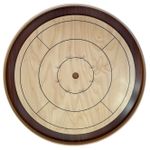
Our number two is going to be Crokinol. I love Croinol. It's the best dexterity game ever. Dang it. Uh this game is very very simple. Been around for a long time cuz it's a big old wooden I almost said sphere disc. It's a big old wooden disc and it's a big wooden board. And this is kind of like shuffle board in to some degree where you are in a big circular board and you are flicking your color discs onto the main board and you're basically trying to get it as far inward as possible and then even trying to get it into like the little hole in the middle. If you do that, you get to take it out and you get a certain amount of points. And this is one of those games again where you're flicking in there and you're basically going to be it scores in a way that uh only the whoever has the most points gets to score. So if both each you and me have something in the 10 area, they're basically going to cancel each other out. So you'll basically count up your scores and then whoever has the most whatever the difference is between the two scores, they're going to score that many points and you're trying to get to like 200 points. So you can have some rounds where you score crazy good, but then you have some rounds where you get just absolutely demolishing. So it's a real back and forth rubber bandandy kind of game. But the tough thing about Crokinol is after your very first basically once you have a disc on the board in that kind of center circle you then any time you are flicking onto you one of your pieces has to touch one piece from an from your opponent. So that could be a piece over here. So you're trying to like hit them and then carine in. But basically if you don't then the d the disc that you just flicked in there comes off the board. You don't get to count it. So, it becomes a thing of trying to like get your pieces into the
center of the board or farther in because the more inwards you get, the more points you get, but also trying to like keep them kind of out of the way so that your opponent has a hard time hitting them because again, if they don't hit them, that disc goes away. It's a classic. I love Crocodile so much. It's in the top 100 games of all time where it should be. It's just the best. I love it. It's just silly fun. You can get really, really strategic. Some people are really, really good at it, but it just doesn't matter. It's just a silly silly time that I absolutely love. There are really, really, really nice croal boards. There's kind of like more budget ones. People can have a croal board that's worth like hundreds and hundreds, maybe thousands of dollars because people make them with really nice wood and stuff. It's just one of those things where you can have all these different levels of this game. And it's just nice to have a Croinol board on the wall because it just looks nice. And I don't know, it's it's both art and a great game. I love Croal so much.
So number one oldest game we love and it's a game that we've loved the longest in our own personal lives is cribage. Uh I feel like a lot of people can probably uh say that cribage has played a part in their life. Uh this is one that we are very lucky to um have been taught by our grandparents. Uh you know they used to have weekly cribage games. they were uh Norwegian immigrants and uh and they would meet up with uh other Norwegian families and stuff and they had like these weekly games of cribage. And so when we were coming up uh when we were young lads, they wanted to impart um this kind of tradition of of playing cribage. Uh and they would teach us and this was something that was really great, really fantastic. Our uncle also taught us a lot of cribage and stuff. uh and use it as a tool to help us, you know, learn basic arithmetic, adding numbers together because, you know, as you're playing cards, uh their value will be kind of what you're adding to the the overall value of all cards played. And so, you had to learn quick addition uh skills, which really sharpened that up for Nick and I. I remember getting better at addition through playing this game, which was something that, you know, I wasn't conscious of of happening at the time in terms of like learning through play, but I had this beautiful opportunity to, uh, learn some skills that I think translated into real life. So, um, cribage is just such a good family game.
You can play it one v one, you can play it three player in teams. Uh, you know, Nick and I play double deck nine card cribage and stuff. There's a million and one iterations because the game's been around for a little while. Um, and I think again, you know, I talked earlier about spades and just something that uses a 52 card deck and the beauty of things that can come from there. You know, the complexity uh of of different types of games and and this is a perfect one that's like casual. Um, you know, there's definitely moments to be clever, but you know, you're ultimately kind of dealing with the hand that you got and kind of doing that. So, it's a great game for socializing with. There's enough game going on that you can kind of focus on stuff. There's not so much going on that you can't have a chat or, you know, a cup of coffee while you play. Um, and again, it was really cool and I feel really honored to have been taught by our grandparents because this was such a kind of important tool for them when they're in a, you know, a country that they're not familiar with, uh, and finding community and stuff and then keeping this game, you know, going for, you know, another 50, 60 years. I mean, it's just mindboggling. I hope that we are still playing some of our modern board games 50, 60 years from now. Um, whether or not we're doing that, I'm pretty sure we'll still be playing Cribage, which is incredible. Just the uh, you know, its ability to endure is uh, really fantastic. And, um, it's just one that in in our hobby and talking with people about board games, there are
so many people that cribage was a part of their upbringing. you know, something from kind of a, you know, their grandparents generation and stuff. And I love seeing it continue. And as someone who's now a father, I can't wait to pass it on to my daughter and kind of keep things moving. So, Cribage still absolutely incredible game.
So, those are 10 games that we really love that are on the older side of things.
I mean, again, the year 2000 was 26 years ago.
I mean, yeah, that's the thing. If anyone thinks, oh, that's just No, that's a
that's multiple decades. Almost three decades ago.
Uh, which is that's not pretty wild. Yeah. Uh that's too that's that that hurts my heart and mind to hear. Uh so get in the comments folks. We want to hear from you. What are some uh games from yester year that you still love playing today? Uh board games are always evolving and stuff which I think is amazing. We've been in this like golden age of uh you know evolution of what games can be, but it doesn't mean that games from the past aren't necessarily still great today. Uh so we want to get some more suggestions as we try to dive back into the past and play games from yester year uh some more. So, give us your favorite yesterday games in the comments below and we'll see you on the next top 10. Bye, everybody.