Hidden Gem Board Games
Games in This Video
6 games are featured in this video — they unlock as you watch.




Transcript
Hey everyone, I hope you're all doing well. Welcome back to the channel for the third episode of Spotlighting Hidden Gems in board games. Today I'll be sharing my thoughts on some board games and card games off the beaten path that I think you might enjoy. I've covered all of these games in more detail over on Board Gamegeeek. So, if you want to dive deeper, be sure to check them out in their corresponding forum pages. So, without further ado, let's get started. To kick things off, let's start with Rhinelander. What if he could take on the role of a medieval duke, vying for control of the Rhineland? Let's explore Rhinelander, a game of cunning, and conquest. Rhinelander is an abstract strategy game with area control, hand management, and enclosure mechanics. Designed by the renowned game designer Riner Kenitzia, it was initially released in 1999 by Hasbro and Parker Brothers. A few years later, in 2005, a new version was published by Face-to-face Games, featuring artwork by William O'Connor.
The game accommodates three to five players, takes around 45 minutes to play, and is suitable for ages 12 and up. In this content, I'll be covering the 2005 release from Faceto-Face Games. In this game, players are transported to medieval Rhineland, where they take on the roles of dukes, vying for control over land by managing duchies along the Ryan River. The goal is to earn the most money by maintaining control of these duchies until the end of the game. Rhinellander is a fantastic abstract strategy game that I truly enjoy playing. I almost exclusively play this game with five players as it maximizes player interaction and confrontation. The game builds tension as players dispatch knights on the board to seize control of the various duchies. The inclusion of landmarks makes the gameplay even more engaging, especially for the player who controls the most churches across different duchies. This player gains control of the ark bishop, granting a special ability known as the conversion power. This power is a gamecher, allowing the ark bishop to replace a knight of the nether cutter on the board with one of their own, provided they play the matching location card. Gameplay in Rhinelander is tense, particularly midway through the game and all the way to the end. It's thrilling to see duchies form and merge into larger ones. Attempting to sneak in a knight for a hostile takeover of another player's duchy is always exciting.
There's nothing quite like replacing a current player's duke with your own. Expanding through the water spaces adds another layer of strategy, and it's fascinating to see players connect various duchies together. Players must carefully manage their hands as the dynamic gameplay means that duchy ownership will constantly shift, especially in head-to-head confrontations. The game builds toward impressive plays and tension, though it can end surprisingly quickly. Personally, I enjoy adding a few more nights to each player in a five-player game to extend the experience and witness more epic interactions. Overall, Rhinelander is a fantastic game that I always enjoy playing. If you appreciate games like Sith Saxon's Acquire and Wolf Gang Kramer's Big Boss, this game is likely to resonate with you, too. On another note, have you heard the great news? Rhinelander is coming back with a new version from 25th Century Games with artwork by Ian Otuli.
Who's excited? Next up, we have Helas. Imagine vibrant cities, marble quaries, and divine statues all on your game board. Welcome to Helis, where your strategic decisions shape the future. Helis is a strategy board game with city building featuring action drafting follow hexagon grid and turn order claim action mechanics. The game is designed by the renowned game designer Stefan Dora illustrated by Dennis Lison and is published by White Goblin Games in 2016. The game accommodates two to four players, takes around 45 to 60 minutes to play, and is suitable for ages 10 and up. Set in 480 BC during the rise of ancient Greek civilization, players create and develop settlements on a beautiful Greek island.
You'll build cities, honor the gods with statues and temples, and gather marble from nearby quaries. The location of your house is crucial since some quaries produce more marble than others. Each round, players choose an action from a display. When one player decides to build something, everyone else can join in. Mining marble benefits not just you, but also your neighbors with houses nearby. However, some actions like building statues or pillars are exclusive to you, but can still earn points for everyone at the end. The game concludes after the third round, and the player with the most victory points wins. Every once in a while, you come across a board game that simply mesmerizes you. One of those games is Stefondor's Helas.
Many of my friends, both at home and in my online gaming community, consider this to be the designer's magnumopus. After playing nearly all of Stefandor's games, I can definitely see why. The game play is incredibly solid, very strategic, dynamic, and a lot of fun. The overall design is smooth and plays incredibly well. The artwork is simply superb with stunning visuals that really capture the atmosphere of the game's theme. The production and components are also topnotch, looking sweet and fabulous. Helis is an outstanding game and one of the best I played in the past decade. I would genuinely love to see it return, allowing more players to discover this gem of a game. Next up, we have infuos in the devil's kitchen. Can he handle the heat in the kitchen of the underworld? So prepare your devils, gather the pots, and let's dive into in the devil's kitchen. Intokuche, which translates to in the devil's kitchen from German, is a family board game featuring roll and move, dice rolling, pick up and deliver, and secret unit deployment mechanics. The game was designed by Alex Randolph in 1993 and is a implementation of Randolph's previous game, Top Secret, published in 1985.
in the devil's kitchen accommodates two to four players, takes around 30 minutes to play, and is suitable for ages 10 and up. In this game, players take on the role of devils in the depths of hell inside a bustling kitchen trying to prepare meals for their greater devil in order to win. Players roll the dice and move around the board, picking up pots of food along the way. They must deliver these pots to their designated kitchen to serve it to the greater devil. Each player starts with four pots of food, which are also scattered around the board. Players determine the contents of each pot by inserting menu cards into their trays with a menu card hidden behind each type of dish. Only the corresponding player knows the contents of their own food tray. There are four pots designed for each player. Three contain point values of either 1, three, or five. The last menu card depicts milk, which is a catastrophe. The greater devil hates milk and cannot tolerate it. If a player serves the greater devil milk, that devil will be banished and removed from the game. To win, a player needs to be the first to bring back 10 or more points worth of pots of food. However, a player's own pots won't be sufficient, so players must steal their opponent's pots and bring them to their corner of the kitchen. And the Devil's Kitchen is a really fun family game that I thoroughly enjoy playing. The gameplay is a blast and full of excitement. If you initially randomize the pot's locations around the board, the gameplay can be exhilarating.
There are many mind games involved in this game. Whenever a devil lands on the same space as another devil, a duel takes place. The dueling involves using the furnace with the greater devil pop-up toy. Players must press a button a certain number of times, one more than the previous player, until the greater devil pops out. The player who releases the greater devil wins the duel and the loser must remove their devil's hat and return to their starting space. If a devil is not wearing a hat when they lose a duel, they are out of the game. Overall, in the devil's kitchen is an amazing game and I highly recommend it. If you enjoy luck based games, this is a super fun game to explore and I can't wait for more players to discover this gem. Next up, we have Vegetable Stock.
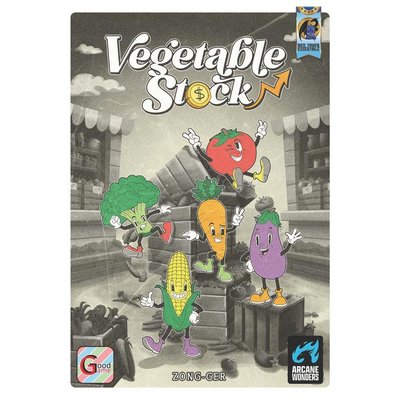
Looking for a fun, fast-paced game to spice up your game nights? Join me as I cover Vegetable Stock, where you'll outsmart your opponents in the race to grow your vegetable empire. Vegetable Stock is a family card game featuring commodity speculation and open drafting mechanics. Designed by Zonger and published by Good Game Studio, this game was initially released in 2019 as Small Farmer and has seen various editions since. Today, we'll focus on the 2022 edition Vegetable Stock, which showcases artwork by Pokechan. The game accommodates two to six players, takes around 15 minutes to play, and is suitable for ages seven and up. It's worth noting that Taiwan board game design is also involved in the distribution of the game. In this game, players assume the roles of farmers and investors, aiming to maximize their profits from vegetables while monitoring current market prices for five different vegetable types. The game is played over six rounds, and the player with the most money at the end is declared the winner.
I really enjoy playing vegetable stock. The game play is both entertaining and fun. Collecting vegetable cards face up adds an exciting layer to the experience, aligning perfectly with my play style compared to face down collections. This open information creates ample opportunities for players to potentially sabotage each other's plans and target specific cards, enhancing the competitive edge and strategic depth. Overall, Vegetable Stock is an awesome filler game that I highly recommend. It's always a blast to play and has the replayability factor that keeps me coming back for more. It packs a lot of fun into a small package and short duration. With delightful artwork to boot, this game shines best with four or more players, making it a perfect choice for gatherings. The compact size also makes it a great travel game. Highly recommended.
Before we move on to the next game, if you've been enjoying these game selections so far, feel free to like and subscribe for more board and card games just like these. Next up, we have Hibachi. Fire up your grill and get ready to gather your ingredients. It's time to cook up some delicious fun in Hibachi. Hibachi is a family-friendly dexterity board game featuring various auction mechanics and sets collection. Designed by Marco Tubner and illustrated by Carrie Atken, it was published by Grail Games in 2021. The game accommodates two to four players, takes around 45 minutes to play, and is suitable for ages 10 and up. In this exciting culinary challenge, players step into the rolls of skilled tanyaki chefs eager to delight hungry diners using their hibachi grill. Each round, players take turns to osing discs similar to poker chips onto the game board. Each player has six chips with values from 100 to 600 visible only on one side, adding an element of mystery.
As players throw their face down chips, the landing spots determine which ingredients can be bought or sold along with any special actions available. As the discs are revealed one by one from various locations, the board comes alive, uncovering hidden values and exciting opportunities. Your objective is to gather the right ingredients to create the requested dishes. The first chef to complete three customer orders claims victory. Hibachi is a fun and exciting game that keeps everyone engaged. The theme immerses players in the lively atmosphere of a habachi and tapanyaki establishment. Players continuously toss chips onto the board, aiming to gather the right ingredients to fulfill three orders first and win the game. The game play is dynamic and engaging, often becoming wild and chaotic as chips fly across the board, adding to the excitement. It's fast-paced and competitive, making it a blast to play with family and friends. Overall, Hibachi is a charming game that's perfect for anyone looking for a light-hearted and enjoyable time. Highly recommended for players who enjoy dexterity games.
Next up, we have Enguard. Prepare for an epic showdown. The fencing competition is here, and it's time to duel. Rhino Kinetsia's Enguard is a family and dueling board game with hand management and tugof-war mechanics. The game accommodates two players only, takes around 20 to 30 minutes to play and is recommended for ages 13 and up. Initially published by Abaka Spiel in 1993, it has seen various editions over the years. The edition I'm covering today is a Ferty edition created by Eagle Griffin Games in 2009 with artwork by Pierre Lalier. In this game, the players take on the role of duelists, going one-on-one in an exciting fencing competition. The aim is to successfully land a hit and touch your opponent in order to win the round. The first player to win five rounds takes home the victory. Endguard is a very entertaining two-player game. There's a lot of back and forth between the two players, and the game play is very dynamic and engaging. It is a simple yet elegant design that offers a lot of strategic depth. There can be a lot of mind games between the players and this is an aspect that I really enjoy about this game. I genuinely believe that this game should beat consistently in print as it's one of my favorites and I really enjoy playing it a lot. Overall, Enguard is an awesome two-player game from Rhino Canitia. I hope that this game comes back again so more players can discover
this gem of a game. Next up, we have Pond. Get ready for a game that's easy to learn by heart to master. Today, we're diving into Pond, one of 2025's hottest abstract strategy games from Taiwan. Pond is an abstract strategy game with various mechanics that's designed and illustrated by Daisy Ching Chen. The game is published by Heyy Gaming. The game accommodates two players only, takes around 15 to 30 minutes to play, and is suitable for ages 10 and up. In Pond, players step into the shoes of hackers, competing to breach and dismantle each other's server. Players strategically place their color discs on a grid, racing to be the first to deploy a piece on their opponent's server. Pond is one of the hottest new abstract strategy games from Taiwan in 2025. And let me tell you, it's a blast. The game play is so much fun. It's strategic and very tactile.
I've really enjoyed trying to infiltrate my opponent's server in order to win the game. This is an easy to learn but hard to master game. I've had a great time playing and trying out different strategies to win. I've particularly enjoyed the zip and unzip actions. I've also enjoyed flanking my opponent to destroy some of their pieces. Additionally, I've had fun sabotaging my opponent by moving one of my pieces with a Trojan explosive between two of their pieces and destroying them. It was a lot of fun. The game play is very dynamic and engaging as well. Overall, I've had an awesome time playing Pond. It's a great game designed by newcomer game designer Daisy Yi Chingchen, and it's the first title from new publisher Hey Gaming. I can't wait to see what they come up with next. If you enjoy fun and thinky abstract strategy games that are easy to learn yet hard to master, then Pawn might be right up your alley.
Next up, we have Trickshot. Get ready to rack up some fun. Today, we're diving into Trickshot, a game that brings the pool hole right to your tabletop. Trickshot is a card game with trick- takingaking mechanics. The game is designed by Master T, illustrated by Mrs. Mommy and is published by Pig's Guild. It is also currently distributed by Ninja Star Games. The game accommodates three to five players, takes around 40 minutes to play, and is suitable for ages 10 and up. In this game, players head to the pool halls, shooting pool, and scoring points. Each player is dealt a specific number of cards as their starting hand depending on the number of players. They then choose one card from their hand as their predictive bet, placing it face down in front of them. This card indicates the type of pool balls they aim to score, either solid or striped balls. Whenever you win a trick, you may choose to score any one available chip that corresponds to any of the cards played. For each chip you collect that matches your predictive bid type, you score one point. If it doesn't match, you lose a point for each. Scores are recorded and players continue playing rounds until one player scores eight points or more in total, winning the game.
Trickshot is an engaging trick taker with unique twists that I thoroughly enjoyed. The standout feature is its pool theme, which I found refreshing. Having never played a game center around pool, my interest was peaked immediately, and I'm glad I picked it up. Overall, Trickshot is a delightful trick taker that I thoroughly enjoyed. Its unique theme and engaging gameplay made it memorable and nostalgic, reminding me of my past experiences shooting pool and of Martin Scorso's film The Color of Money. Given the pool theme, I was drawn to Trick Shot, and I'm pleased with my experience. If you enjoy unique trick takers or are a fan of pool, this game is definitely worth exploring. Next up, we have Space Bureau. Have you ever dreamt of exploring the cosmos while managing your own starship? Well, in Space Bureau, that dream becomes a reality. Space Bureau is a science fiction strategy board game featuring tile placement, tech trees, grid movement, and contracts mechanics.
Designed by Andre Kolov, and illustrated by Neck Girtz, Kolina Kaggina, and Evanji Zubov. It is published by Open Border Studio and Hobbyworld in 2024. The game accommodates one to four players, takes around an hour to play, and is suitable for ages 10 and up. In Space Bureau, players assume the role of captains of alien starships exploring the final frontier, space. Each player manages their own starship, paying attention to fuel and storage capacity while collecting samples of alien products from various planets to earn precious credits. Players can also establish offices on different planets and manage their positions on the bureau track. After all, a good space captain knows the importance of public relations with headquarters. Each turn, players place a single trade agent tile on their spaceship board, ensuring it connects to an existing connector or previously placed tile. After placing a tile, the player executes the action listed on that space, then draws a new trade agent tile from the display to end their turn.
The game ends when there are no more trade agents left in the bag. After that, all players take one final turn. The player with the most credits at the end wins. I was genuinely surprised by how much I enjoyed Spare Sparrow. The gameplay is both strategic and engaging, proving that exploring space can be incredibly fun. I especially appreciated the replay-ability the game offers thanks to the inclusion of the double-sided spaceship boards and captain ability tiles. The strategic depth is impressive. I've had a fantastic time deciding which routes to pursue in hopes of victory. The vastness of space mirrors the numerous strategic options available to players. I particularly enjoyed the puzzle of connecting trade agent tiles on my spaceship board. The sweet combos that emerge when you get the right pieces in place are thrilling.
The game is quite puzzly and strategic, adding depth and excitement. Overall, I've had a great time playing Space Bureau. It's a fun puzzly game that offers strategic depth and higher replayability. I can't wait for more players to discover this fantastic title. Next up, we have Cash a Catch. Think you can keep your fish fresh while out bidding your friends? Let's see if you have what it takes in Cash a Catch. Cash a Catch is a real-time family game featuring auction and set collection mechanics. Designed by Andreas Pelican, it was initially released in 2007 by Queen Games. Over the years, the game has seen many additions. Today, we'll focus on the 2023 English and Korean edition, published by Plate, which showcases artwork by Wanjen Gill and Russio. The game accommodates three to five players, takes around 30 minutes to play, and is suitable for ages eight and up. In this game, players head to the fish market to participate in an auction to buy and sell fish. The player who ends up with the most money wins the game. I really enjoy playing cash a catch. The game play is very entertaining and fun. It's all about making lots and lots of money. However, you must be careful with how many fish you throw into your trash can.
Otherwise, you'll incur harsh penalties based on the fines you'll end up paying. The game play is delightful and I've really enjoyed the inclusion of the bell which reminds me of another game Holly. This is a light auction game with sets collection and the bell gives the game a realtime feel making you feel like you're genuinely in a fish market with the auction. I've had a great time playing this game. The inclusion of the action cards adds to the overall fun and really spiced up the game play. Overall, Cash a Catch is a delightful game that I would gladly play anytime. It's an excellent entry-level auction game that I've truly enjoyed. The compact design of the Plate edition makes it a fantastic choice for travel. If you're a fan of auction games, this one is definitely worth exploring and I highly recommend it.
Next up, we have A Crazy Storyteller and Eels Brook. A Crazy Storyteller is a party game with storytelling and memory mechanics. The game accommodates three to six players and takes around 45 minutes to play. The game is designed by Stefan Dora and Ralph Zerande and is published by Mandu Games and Mobyl in 2024. It is a new and rethemed version of the previous game Donkey. Worth to note that the gameplay is identical in these two games. Both of these two games re-implement an older game from the same game designers called Easel's Brook. Easel Brook was originally released in German by Schmidt Spiel in 2011 for the first edition and 2012 for the second edition. A Chinese edition of the German second edition was later released in 2014 by the Taiwanese publisher Swan Pound Asia. The game never had an official English release. and a crazy storyteller. The players create short memorial stories using randomly drawn keyword tiles, then try to recall the details of the stories told by the other players. Donkey bridge and a crazy storyteller are much more streamlined compared to Uzel's bouquet and more interactive with the joint storytelling as a group. What I enjoyed about Easel's Brook is that once it's your turn, you really should try to tell an unforgettable story with the keyword tiles you have in your hand in hopes of getting a blocker tile to protect your score pile. Although this is much harder
said than done, and when you guess incorrectly in that game, you get severely punished by losing many tiles and points from your score pile. Another aspect that I've enjoyed is that because the keyword tiles are in a foreign language, you can really go crazy with some of the tiles. Remember, a picture is worth a thousand words. So, it's always a lot of fun to see what kind of stories or words the different players may use with those tiles. The game also takes much longer to play compared to Donkey Bridge and a crazy storyteller. Donkey bridge and a crazy storyteller are great options to play with family and children, while Isel's bouquet is a fun option to play with hobbyists. I'm so glad to see donkey bridge and a crazy storyteller being available as they are a new reimplemented version of Isles Brook. Now with these two versions, English is available and players have the opportunity to experience this fun storytelling game.
Next up, we have Line and Loss. Are you ready to set sail on a challenging marine race course? Today, we're diving into Alex Randolph's Line and Lost, a game that combines dexterity and racing in a delightfully chaotic boat race. Line of Loss is a children's dexterity and racing game with real-time mechanics. The game was initially published by Haba in 1997 with a newer release from Zach Verlog in 2017. It accommodates two to four players, takes around 20 minutes to play, and is suitable for ages six and up. This version I'm covering today is from Zach Ferlock, and is illustrated by Matias Hollander. In this game, players find themselves in a boat race where they need to maneuver and navigate their own boats around the marine race cars to finish one lap in order to win. Players start at the port and each player controls their own boat which is equipped with a motor that makes movement somewhat challenging. The players decide whether to play on the yellow track easy or on the red track more challenging.
The player holding the double ballard will time all other players until their turn comes. This player must quickly wind the rope while the active player pushes their boat with their finger across the course. Once the rope has been wound, the active player stops moving their boat and the next player in clockwise order takes their turn. There are many obstacles and challenges that players might face while navigating their boats, such as the bio scatters around the course and the dark sharkinfested waters. This continues until the first player manages to finish the course and makes it back to the port, winning the game. Line of Loss is a fun children's dexterity and racing game that I have thoroughly enjoyed. Moving your boat can prove to be difficult and challenging due to the motor attachment, which adds to the excitement. Navigating your boat and trying to avoid the obstacles was a fun experience. I loved how the boats move, and you can create your own course anywhere with a flat surface. Winding the rope was also an enjoyable aspect, and I appreciated how it was used as a timer for the active player. Overall, Line of Loss is a wonderful game that I have enjoyed. If you like other dexterity racing games like Pitch Car, this game might resonate with you as well.
Next up, we have Castle Razor. Are you ready to defend your castle against a relentless horde of wolves? Today, we're diving into Castle Raisers, a game that's not just about building, but also about survival against the odds, all while being thinky and puzzly. If you enjoy tower defense games, then stick around. You're in for a real treat. Castle Razor is an abstract strategy game with tile placement and stacking and balancing mechanics. The game is designed by Lee Monos Eran and Anthony Peron, illustrated by Zing Ko Kong and Juan Mulco. The game is published by Wonderful World Board Games in 2025. The game accommodates one to four players, takes around 45 minutes to play, and is suitable for ages 10 and up. This game draws inspiration from the classic children's story, The Three Little Pigs.
In this reimagined theme of the story, the players find themselves taking on the role of the little pigs. But instead of one big bad wolf, the little pigs face an army and horde of wolves. Instead of the pigs building houses of straw, sticks, and bricks, they find themselves building castles to defend against the swarm of wolves that are about to siege and attack. The game features two distinct modes. the competitive game mode for two to four players and the cooperative game mode for one to four players. The game is played over three ages and each age consists of four rounds. In each round, the players will draft wall tiles to construct their own separate castle, possibly recruiting villagers and triggering abilities. At the end of each age, the players may have the chance to pour cauldrons of boiling soup on the wolves. And right after that, the wolf archers fire and release their arrows, attacking each player's castle. The game concludes after the third and final age, and scoring takes place. Players may lose points for each of the three regions if they have the most wolves in those sections. Players also lose points for each arrow they have been hit with.
Players gain prestige points from collected prestige tokens and attack tokens. They also acquire a certain amount of prestige points for their highest portion of their castle wall, and they might also gain prestige points from the villagers they have recruited within their castle. The player with the most prestige points at the end of the game will be the winner. Castle Razor is one of the best medium light games I played in 2025 so far. You'll definitely see this game in my top 30 games of the year and probably in the top 20. The gameplay is incredibly thinky, fun, and engaging. I've thoroughly enjoyed the competitive game mode at all player counts. The competitive edge it offers along with the various abilities players can trigger creates numerous strategic opportunities that I find really engaging. If you enjoy abstract strategy games that are thinky, puzzly, and have a competitive edge. You'll find various strategic opportunities in this game.
Additionally, if you like tower defense games, Castle Razers is a great option for you. Highly recommended. Well, that's it for today. I hope you enjoyed the video. Thank you so much for watching. If you've played any of these games, let me know in the comments which ones you enjoyed or which game you're planning to try next. Don't forget to like and subscribe for more content, and see you next time.