Top 100 Board Games of All Time (2025) | #70–61 From Dice Duels to Deep Strategy
Games in This Video
10 games are featured in this video — they unlock as you watch.




Transcript
All right, Brew Crew. Welcome back to my top 100 board games of all time. And if you've been following along so far, we are officially in that part of the list where things start to get interesting. These are games that have earned their place here because they stick. Games that I still think about after the box is back up on the shelf. Uh games that I will happily pull out and play whenever we have the right group at the table and games that depending on the day could honestly have ended up even higher. This stretch of the list is also where you really start to see my personal taste start to come through. Uh, there's a mix of heavy euros, thematic experiences, head-to-head games, and a little bit of chaos thrown in for good measure. Some of these reward careful planning and long-term strategy, while others are all about energy, interaction, and memorable moments, and that's kind of the point of this list. It's not about what's objectively best or what's the highest rating somewhere online. It's about the games that have meant something to me over time. Games that keep finding their way back to the table even as new releases come and go. So, as we move into numbers 70 through 61, expect variety, expect strong themes, interesting mechanisms, and a few games that might surprise you by how high or how low they land. All right, let's get
to it. 70.
Number 70 is Marvel Dice Throne. Designed by Nate Chatalier, Manny Trembley, and Gavin Brown, and published by Roxley Games. Marvel Dice Throne is a dice driven combat game where each player takes on the role of a Marvel hero. And what really makes it special is just how asymmetrical it is. Every character has their own player board with unique abilities tied to specific dice combinations. And on your turn, you are rolling dice up to three times yatsi style, trying to trigger your best attack or your best defense. But it's not just about luck. Uh cards are also going to let you manipulate the dice, uh upgrade your powers, or react during an opponent's turn.
The theme really shines through in just how different each hero plays. Thor feels explosive and powerful. Scarlet Witch bends probabilities. Spider-Man dodges and disrupts. And Loki is just very unpredictable. It's dramatic. It's very tactical. Uh especially for a game that is this accessible.
69. Number 69 is Brussels 1893. Brussels 1893 is a strategic euro set during the art noo movement. And while it's not particularly strong, the theme comes through in its focus on building influence and prestige in the city. Mechanically, this is a worker placement game with two distinct areas, the city board and your personal architecture board. When you place workers in the city, you are competing for resources, money, and influence. But the order in which the spaces are taken really matters. Um, and what's especially interesting is that the first player for the round determines what spaces will be available by essentially cutting off a portion of the board from play. There's also an area majority aspect that goes along with the worker placement. So, every turn, there are multiple things to consider.
Um, on your personal board, you are constructing buildings and artworks that will score in different ways depending on how and when you built them. You're also collecting cards depicting prominent architects of that era that will provide you with special bonuses or abilities. Just make sure that you can pay them. It's thoughtful, it's interactive, and it rewards careful timing more than flashy plays.
68.
Number 68 is Revive. Revive is a post-apocalyptic Euro where humanity is rebuilding civilization and the mechanics really reflect that sense of rediscovery and growth. At its core, this is an engine building game that is largely driven by cards. Um, each card represents an action or valuable resources. Uh, you'll be using these resources and actions to explore a modular map, settling new areas, and unlocking technologies on your player board that help you shape a long-term strategy. There are also different free actions that you can do at any time during your turn, which create these amazing combo moments. Couple that with the faction abilities, and everyone's strategies can differ quite a bit.
That's really what I love most about this game, the chain reactions that everyone can create. Uh, even when they don't happen to me, I enjoy watching other players put together an impressive turn. Of course, I'm cursing them out loud, but silently I'm enjoying the great play. Uh, something else that makes Revive especially interesting is how flexible it feels. There's no fixed victory path, at least not that we've found yet. Um, you're rewarded for adapting to the map, your faction's abilities, and the different opportunities that might emerge.
67.
Number 67 is Rockhard 1977, designed by Jackie Fox and published by Dvere Games. Rockard 1977 is a worker placement game about being in a rock band and it leans fully into the chaos of that lifestyle. Each turn you are taking actions like rehearsing, recording demo tapes or albums and hopefully playing gigs. Uh time is limited and pushing too hard can lead to burnout which is very much a part of the design. Uh, but you can get around that by using a little candy to give you a boost, but that obviously comes with a risk. Mechanically, it's about prioritization, as any good worker placement game would be. You can chase fame, money, or creative success, but you can't do everything. Uh, the theme really shines because the systems reinforce the story and the narrative that develops around your rise to stardom is an absolute riot. It really is the theme that sells this one for me. The worker placement is solid and the mechanics are functional and welldesigned, but the theme is so good. Uh, honestly, I was a little surprised that this one didn't end up higher on my list. Um, I think that for my personal preferences, I wish that it had just a little bit more meat on its bones. If it did, I could see this one skyrocketing up my list, possibly even
reaching top 10 territory. And I am incredibly excited to try out the ear candy expansion that is supposed to be coming out in 2026.
66. Number 66 is Marrakesh. Designed by Stfan Feld and published by Queen Games, Marrakesh is a dense strategic euro that combines worker placement with area influence and long-term planning, and it uses a cube tower. Okay, I guess you're not technically dropping cubes, but the concept is the same. Each round, everyone chooses three different colored pieces, all of which will be dropped into the tower at the same time. Uh, you place your workers on the matching colored market spaces on your board, and then you take turns drafting pieces and placing them in the matching market spaces on your player board. These pieces make that action more effective or more efficient for you. And then you will activate the spaces where you actually placed your workers. Typically, you'll hope to improve the actions that you'll be taking that round, but that may not always be the case. And that's really what I love about Marrakesh. There are some very tense, difficult decisions to make sometimes when you really hoped for a certain action and maybe none of that color dropped from the tower. Or maybe you are so close to finishing a Marcus stall and do you take those pieces rather than taking the pieces for the space you activated this round as Feld tends to do. This game is all about
tough choices and how do I make do with what I've been given this round. It's all about efficiency and timing and every decision ripples forward. This is a game that definitely rewards mastery and repeated plays. 65.
Number 65 is Food Chain Magnate designed by Jerome Dolman and Joris Versigga and published by Splatter. Food Chain Magnate is a brutally pure economic simulation about building a fast food empire. The core mechanic is employee management. You are hiring staff, organizing your corporate structure, and unlocking powerful abilities that permanently shape how your company operates. In essence, you are creating an org chart by hiring different employees that are represented by cards. At the same time, you are competing over a shared map, placing restaurants and advertising to influence customer demand.
The theme is really inseparable from the mechanics. Marketing creates demand. Pricing affects profit. And poor planning can lock you into a losing strategy. There's no randomness to hide behind. Success comes entirely from reading the table and executing better than your opponents. It's punishing, brilliant, and endlessly fascinating. I know some folks hate how the game looks, but really it doesn't bother me. Uh, admittedly, I was tempted to get the new deluxe edition, but I am perfectly happy with my plain old boring regular edition. That was still probably more expensive than I'd normally pay for a game that looks like that.
64.
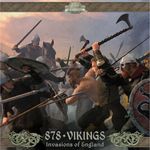
Number 64 is 878 Vikings: Invasions of England. A78 Vikings is a 1v one or team-based area control game set during the Viking invasions of England. It's designed to be fast, tense, and pretty accessible. Each side has different objectives and abilities which create immediate asymmetry. Um, the Vikings want to conquer and spread while the English aim to defend and reclaim territory. Battles are resolved with custom dice which keeps things moving quickly and the game constantly shifts momentum. The theme comes through in the uncertainty and the chaos of conflict.
No plan survives first contact with the enemy. Waves of new Viking invaders land on the shores and spread across England. These armies can look very intimidating, but the English armies are no slouches. And before long, the Viking forces can find themselves spread a little too thin if they aren't careful. No side really has an opportunity to feel safe within the game, and very often the game can come down to a very important die roll, which is incredibly exciting.
63.
Number 63 is Suburbia, designed by Ted Alspach and published by Bezier Games. Suburbia is a citybuilding game where every placement decision matters. You are drafting tiles that represent different types of development and placing them in your suburb to create synergies or avoid penalties. Residential areas want certain neighbors. Industries affect income and reputation can be just as important as cash flow. The theme works because growth feels organic. Your city expands, problems emerge, and early decisions have long-term consequences.
It's simple to learn, but deeply strategic once you understand how the systems interact. This game is very much about balance. Uh you also need to pay close attention to what other players are building in their suburbs because it may affect how your tiles are activated. And the ability to build a comboic suburb is really what put this one as one of my favorite tile laying citybuilding games.
62.
Number 62 is Ready Set Bet. Designed by John Dclair and published by AEG. Ready Set Bet is real time horse race betting and the theme absolutely carries the experience. One player acts as the announcer rolling dice and calling out the race as it happens. Or if you prefer, uh, which I personally do, you can use the wonderfully designed app to handle all of that for you so everyone can participate in the chaos of betting. Everyone is frantically placing bets, trying to read the board and predict the outcomes of the races before it's too late. Mechanically, it's a betting game, but emotionally it is pure chaos. People yell, cheer, groan, lean over the table, watching tiny wooden horses inch forward. In fact, in most games that I have played, no one is sitting down.
Everyone is standing up around the table watching the action unfold and seeing if they can get that one last big bet in before someone else takes that space or cheering on their horse to victory. It's incredibly energetic, which is something that you can't say about too many board games, which makes it incredibly memorable.
61. And finally, number 61 is Beer and Bread. Designed by Scott Olms and published by Deep Print Games, Beer and Bread is a two-player game all about balance, and that theme is baked directly into the mechanics.
Each round represents a year of either abundance or scarcity. Uh changing what resources are available and how valuable they are. You are gaining cards to produce goods, improve your farm, and fulfill recipes to score points. But focusing too heavily on one strategy can leave you vulnerable later. You'll either be fulfilling beer recipes or bread recipes, but you need to pay attention to how much of each you're scoring because at the end of the game, whichever of the two you have scored the lowest of, that will be your final score for the game. The interaction is subtle but constant, and the tension comes from timing. Knowing when to commit, when to pivot, and when to deny your opponents is key. I also love the fact that whenever you take more resources than what you can store, you must first offer any leftover resources to your opponent before discarding it. This really helps keep the tension high throughout the entire game. It's elegant, it's compact, and it's deeply satisfying. Plus, it has multi-use cards. All right, folks.
That's number 70 through 61. As always, I would love to hear your thoughts. What game is your favorite from this 10? What would you move higher? Or what would you cut out entirely? Also, make sure to stay tuned to the channel for my best of 2025 video, which should be going up later this week. Thanks for watching. I'll see you in the next one, and until then, let's get another round for the table.
Hey, hey, hey, hey, hey, hey, hey, hey, hey, hey, hey, hey, hey.