6 Games We Refuse to Play Without House Rules
Games in This Video
6 games are featured in this video — they unlock as you watch.




Transcript
We need to talk about something that's completely changed how we play board games. There are six games we absolutely refuse to play without house rules anymore. Not because we're inventing weird variants or misunderstanding the official rules, but because the official rules are genuinely broken in ways that undermine the entire experience. We've discovered fixes that transform these games from frustrating and feel bad to incredible and beloved. We won't go back.
Yeah. And the thing is, we're not alone. Thousands of other players have figured out the exact same fixes independently. These aren't fringe modifications created by casual players who don't understand game design. These are essential changes that unlock what the designers actually intended. Once you implement them, you realize you can literally never go back to official rules again. The difference is that dramatic.
Exactly. We've played these games with official rules. We've felt the frustration firsthand. We've identified the specific problem. We've researched what other players discovered. We've implemented the fix. And now we refuse to play any other way. These games go from okay but frustrating to absolutely favorite. So, let's talk about the six games we literally will not play without house rules anymore.
And we're starting with Wingspan because that bonus card mechanic completely ruins an otherwise brilliant game. It makes you question whether the designers actually play tested this or if something went wrong in production.
Wingspan is gorgeous. Absolutely beautiful presentation. The art is absolutely stunning. The engine building is fantastic and rewarding. The bird facts are actually fun and educational. The core mechanics are solid and interesting, but the setup contains a devastating trap that completely ruins the strategic experience. You're dealt five bird cards and two random bonus cards. The official rule says you keep up to five birds, paying one food per bird, and you must choose one bonus card to keep. Then you permanently discard the other one forever. You're making this crucial choice before the game even starts, before you know anything about how the game will develop or what birds appear in the market over four rounds. And bonus cards are worth anywhere from 0 to 10 victory points depending on whether you can fulfill them during game play. So imagine this exact scenario that happens regularly to players. You're dealt two bonus cards.
Three points for every cavity neester bird you attract and two points for every wetlands bird you attract. You look at your starting hand and you have exactly one cavity neester and four grassland birds. You must pick one bonus card. Now, you're forced to make this choice blindly without any information whatsoever.
If you pick cavity nest, you're betting that cavity nesters will appear in the bird market over four rounds. If they don't appear or barely appear, you've locked yourself into a zero point bonus card that you carried with you through the entire game. Meanwhile, your opponent was dealt eggs on ground nest birds. They happen to draw some ground nesting birds in the market. They score 10 points. You score zero. They win by eight points. The entire game was decided not by strategic skill or clever engine building. It was decided by a bonus card lottery at setup.
That's when we absolutely said, "We're never playing Wingspan without fixing this again. We refused to accept that experience one more time. The house rule fix is beautifully simple. Keep both bonus cards. You don't pick one and discard one. You keep both bonus cards. activate both throughout the game and score both at the end. And suddenly the entire game transforms completely.
Now you're actually rewarded for building good engines instead of hoping for lucky bonus card compatibility. If you attract cavity nesters during the game, that bonus pays off. If you pivot to wetlands because the market forced you that direction, that bonus pays off, too. It becomes about strategic engine building decisions and adaptation instead of random bonus card lottery luck at setup. The difference is night and day.
Once we implemented that house rule, Wingspan went from a game we were seriously considering trading away to a game we pull off the shelf constantly. People ask us to play it. We recommend it enthusiastically to friends. It's the difference between frustrating luck-based game that feels unfair and strategic engine builder where your decisions actually matter. That's the power of implementing the right house rule. That's why we refuse to play without it. Now,
moving to Ark Nova, which is this incredibly complex, heavy Euro game about building and managing modern scientifically managed zoos. The mechanics are brilliant and intricate. deep strategic decisions, interesting card combinations and synergies, meaningful long-term planning and development. But there's a problem that made us refuse to keep playing without fixing it. Map imbalance creates insurmountable luck factors. You randomly assign maps at the start of the game, and certain maps are objectively worth 5 to 10 victory points more than others just by their starting bonuses, kiosk placements, and board layouts. It's not subtle. It's noticeable immediately and game deciding immediately. One specific map called Silver Lake is so overpowered that you basically can't win if you're unlucky and don't draw it while your opponent does. You can play strategically and skillfully and still lose because of map assignment randomness.
We played Ark Nova three times with official rules. In two of those three games, the player with the better map won regardless of actual strategy or decision quality. After the third game where map luck decided the outcome before we even started playing, we collectively said, "That's it. We're not playing Ark Nova without fixing this." We refused to accept another game where randomness decides the winner at setup. So, we implemented an esports style selection system for two-player games. Each player takes turns banning maps until both players have four maps available to them. Then, the opponent chooses which one you'll actually play on. This creates a symmetry. Someone makes the final choice, but both players know in advance what the available options are and can strategically plan accordingly.
Now, when we play Arknova, the winner is the player who made better strategic decisions about zoo development and resource management, not the player who got lucky with map assignment. We went from map decided the game before we even started to we lost because we played worse. That's exactly what we wanted. That's why we absolutely refuse to play without this house rule. Now the game is now about skill, not luck.
Dune Imperium is another game we refuse to play without house rules. Beautiful deck building worker placement game, deep card interactions, meaningful conflict resolution mechanics, great thematic integration. But the Imperium Row, the five card market, where you buy cards to build your deck, can stagnate for entire consecutive turns, completely freezing player agency, and making the game feel dead.
If nobody wants to buy cards from the market, nobody purchases anything, which means the road doesn't refresh. You're stuck looking at expensive cards or faction specific cards nobody wants. The market becomes completely dead. This is not a rare edge case. This happened repeatedly in our play tests. We played a game where the Imperium row was completely frozen for four consecutive turns. Four turns where we couldn't buy anything meaningful. The market was absolutely dead. Cards just sat there doing nothing. We were all stuck buying from the reserve deck instead of getting strategic market options with interesting choices. We just said never again and immediately implemented a house rule. If nobody buys from the Imperium row after a full turn cycle, the entire row gets nuked and replaced with new cards from the respective deck.
Now the market stays alive and dynamic. Cards cycle through the market regularly. You're not stuck waiting forever for decent options to appear. The deck building actually feels like meaningful deck building instead of waiting and watching the market die completely. The experience is completely transformed.
Lost Ruins of Arno had a similar frustration problem with market stagnation. The official rule exiles only two cards per round from the sixcard market. That means four cards stay in the market every round. In two-player games, you're waiting forever to see the specific artifact you need for your strategy. Good artifacts get buried behind unwanted items and take three rounds just to cycle out. We played through one game where the exact artifact we needed was buried and didn't appear until round four out of five. We couldn't execute our strategy because the game mechanics prevented us from accessing the cards we needed. We refused to accept that experience again.
We use the red moon staff variant from the expansion now. It exiles four cards instead of two. Market churn is instant. Cards cycle quickly through the market. You're not stuck waiting forever for the artifact you need. The exploration actually feels rewarding because artifacts actually appear when you need them instead of being locked behind a wall of unwanted cards.
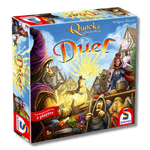
Quacks of Quedlingberg is interesting because the problem is smaller and more subtle than the other games, but it's still genuinely frustrating and creates consistent feel moments. The flask refill costs two rubies. Rubies are the currency in the game and they're rare. You earn about three per round if you're doing well. So, if you spend two rubies to refill the flask for protection, you have one ruby left. You just spent precious currency. Then, on the very next turn, you draw a white chip immediately. Use the flask to protect yourself from that single chip draw and feel like you completely wasted two rubies on a single moment of protection. It happens frequently, and it feels terrible. After playing several games with this exact frustrating moment happening repeatedly, we said, "We're not playing quacks without fixing this.
The house rule is simple and elegant. One ruby instead of two. Now refilling the flask cost one ruby instead of two. Now it's a real choice, but not catastrophically expensive. You can refill the flask and still buy a decent ingredient that same turn." The tension and difficult decision remains, but the feel-b moments of wasted resources disappear completely. Now you're making interesting trade-offs instead of feeling punished by the game's economy system.
And finally, Carcassone is fascinating because this house rule is so important that it's actually become the standard rule set used in world championships and competitive tournaments worldwide. Official rule, draw a tile at the start of your turn. House rule, draw a tile at the end of your turn. That's the entire fix needed.
Official rules. You draw a tile, then you need to analyze where it goes. Does it connect here? Does it block that player's expansion? Does it complete this city? You spend 2 to 3 minutes analyzing while everyone else scrolls their phones or checks their watches. By the time you finally place the tile, 10 minutes have passed for your single turn. House rule. You drew your tile at the end of your last turn. So, you've had 3 to four minutes during other players turns to think about placement and strategy. Your turn arrives. You immediately place the tile, place your mele, if applicable, score anything that completed, and draw the next tile. 15 seconds total. The difference is night and day.
We played Carazone with official rules once. The game took 3 and 1/2 hours because of constant analysis paralysis and everyone waiting around. We played with the house rule the next week. The game took 45 minutes and was actually engaging and fun. We literally said as a group, "We will never play Carcazone official rules again." We refuse to suffer through that experience.
And here's the most important thing about all six of these games. They're all genuinely brilliant games with fantastic core mechanics. The designers clearly know what they're doing. The games have soul, but somewhere between design and publication, a rough edge slips through. one mechanic that creates randomness or frustration that undermines the entire strategic experience.
Once you file down that edge, once you implement the house rule, these games transform. They go from frustrating and feel bad to incredible and beloved games that went from maybe we should trade this to we pull this off the shelf constantly. That's a complete transformation.
That's why we refuse to play without these house rules. We get the games we actually wanted. We get games we genuinely love. We get games worth keeping and recommending instead of trading away. That's the payoff of refusing to play without house rules. Thanks for hanging with us.
The bottom line, if you're going to buy these games, implement the house rule on day one. Don't suffer through the official rules. Play the games the way they should be played. Thanks for listening.