







Bargain Quest Deep Dive
What the Community Thinks About Bargain Quest
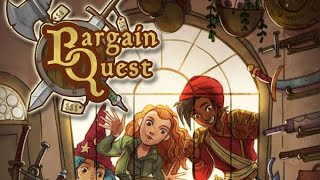
The reviews keep returning to one idea: Bargain Quest puts you behind the counter of a shop instead of in the armor of a hero. Players run competing shops in an adventuring town that is overrun with monsters, and the heroes who walk in are the customers their business depends on. Before You Play called the theme one of their favorites of the year, and Board Games UnLocked described the appeal as playing the little people who normally sit in the background of an adventure movie.
Praise is not limited to theme. Reviewers single out the artwork and components, and they describe the rules as light enough to teach quickly. The game is generally treated as a family-weight card-drafting title with a strong identity. Criticism concentrates on randomness and on how much a turn depends on what happens to be in your hand, rather than on the rules themselves.
Core Mechanics That Define Bargain Quest
The Display Window and Hearts
Each shopkeeper drafts items from a shared pool and then secretly places some of them face down in the shop window to attract a hero. Every display item carries a heart value that measures its appeal. The player with the highest heart total gets first choice of the heroes in the street, which turns the opening of each round into a tug of war. Board Games UnLocked explained the tension well: what you choose to display decides who you can sell to, and if your display is weak, a visitor may arrive with nothing you can offer. That can leave you holding an item that is useless to the hero in front of you.
Class Icons, Affordability, and Combat
Heroes and items both carry class icons, and a shopkeeper can only sell to a hero, or use the hero's services, when the symbols match. Meeple University walks through this with a barbarian example and shows how a hero's purse limits what they can buy, since the money comes from the hero's own funds. Once a hero is equipped, the hero goes out to fight a monster. Attack is compared against the monster's toughness and defense against its strength, and adventure cards add random modifiers to each fight. A monster falls when it takes wounds equal to the number of players, with at least two wounds needed at five or six players. Heroes who survive collect reward money from the treasure chest, and that money feeds the shopkeeper's score.
The Bargain Quest Experience
A Light Shop Sim With Real Tension
Before You Play called the game easy to teach and easy to play, and the discussion placed it firmly in family-weight territory. The rhythm is quick: draft, display, sell, watch the heroes fight, collect the payout, and repeat. Board Games UnLocked recounted a session where a shopkeeper could only offer a leaf to a hero who had no use for it, and the hero then went out and died. The reviewer found that moment funny, and the same mix of comedy and bad luck recurs throughout the discussions.
The upgrade phase adds a second layer of decisions. Shopkeepers can hire employees and storage upgrades that expand what they can keep in the window. Board Games UnLocked noted that an employee such as a shop cat or shop dog grants an extra heart, but a shop can only have one such helper. One employee lets you sell what is already in your display, which led to a sudden turn of fortune in one reviewer's game. Scoring is straightforward at the end. Prestige and money are the core, with a point for every ten money and ties broken by money.
Tension Between Shops
Because every shop is competing for the same heroes, the best outcomes come from reading the table. Rolling Dice & Taking Names described the first-pick fight as the center of the game, where a single heart can decide who gets the best hero. The same channel found the iconography harder to read than it should be, since several icons look alike at a glance. The result is a game that rewards careful attention to what other players are displaying.
What Makes Bargain Quest Stand Out
The Shopkeeper Perspective
Board Games UnLocked argues that the theme is unusual because the players are not the warriors at all. They are the merchants who sell to the warriors, and that inversion gives the game its personality. The same channel compared the loop to Alchemists and Forgewar, both of which also turn trade into an adventure. Bargain Quest stands apart because the shop already exists and the player drafts items to stock it, which makes the experience feel more whimsical and less like a production line.
Expansion and Solo Play
Before You Play described the Sunk Cost expansion, in which ships replace part of the draft. The channel said the expansion is more useful at higher player counts, when the extra options matter most. Board Games UnLocked also highlighted the solo variant as a reason to return to the game, since it lets a single player test their shop without waiting for a full table.
Potential Drawbacks
Randomness and the Draw
Randomness is the most repeated criticism. The adventure cards add swings that a careful shopkeeper cannot fully control, and the hero who arrives depends on the draw. Rolling Dice & Taking Names said that a random card can strand a shopkeeper with nothing to sell to the adventurer in front of them, and that this luck is hard to shake off. Board Games UnLocked's ranking video also criticized the box as too small for the components and described the game as heavier than its footprint suggests.
The Harsh Verdict From BoardGameBollocks
BoardGameBollocks gave Bargain Quest a three out of five and concluded that the reviewer could not recommend it. The objections are specific. The card backs look too similar, the core loop feels like matching symbols, and a hero draw with no real recovery makes bad luck hard to escape. The adventure cards were described as tacked on rather than integrated, and the shopkeeper theme felt disconnected from what players actually do. The verdict was that the game is all fluff with style over substance. That view is worth weighing because it targets the exact features that other reviewers praise, and it argues that the theme does not carry the mechanics.
If You Enjoy Bargain Quest
Players who enjoy the shop-and-adventurer loop should look at Alchemists, where potions are sold to adventurers, and at Forgewar, which shares the same trade-driven fantasy. Both reward the kind of planning that makes Bargain Quest feel like running a business. Players who want a sharper strategic game with a similar drafting appeal might prefer Catan or Cutthroat Caverns, which BoardGameBollocks named when explaining why Bargain Quest did not win them over. Each choice depends on whether you want a theme-driven shop or a more direct contest of planning.
What Reviewers Are Saying
"this is one of my favorite themes that i've seen in a game this year"
— Before You Play
"what makes bargain quest really good is that you essentially win if your guy does well"
— Board Games UnLocked
"a lot of randomness to it cuz even though you're drafting cards"
— Rolling Dice & Taking Names