/pic2039033.jpg)
/pic2555219.jpg)
/pic3647842.jpg)
BattleCON is a fast-paced head to head card game for 2 players, based loosely around the mechanics and tactics present in 2D fighting games. In BattleCON, players choose characters with unique abilities and powers to test against one another in a battle of tactics, strategy, and intuition.
BattleCON: War of Indines is a standalone dueling card game designed for head-to-head play. Each player selects a character who uses a unique gameplay mechanism to give them an edge in combat. Take control of 18 different characters, from a fire elemental, an ocean guardian and her panda familiar, a space-bending trapper, a shadowy assassin, and more! Each character's play style requires new strategies, but uses the same foundational tactics, making a new character easy to learn, but challenging to master.
Players move along a seven-space-long board, trading blows and attempting to strike the opponent, using attacks formed by combining a character's unique styles and abilities with a set of basic cards that all characters share. There is no hidden information: you always know exactly what cards the opponent holds, just not the ones they'll choose! The last player standing wins!
BattleCON: War of Indines can be played on its own or combined with other BattleCON sets to create an even greater pool of characters and play variants.
______________________________________________________________________________
BattleCON: War of Indines has two versions, now dubbed "Classic" and "Remastered." The "Classic" version contained multiple art styles, as different fighters were drawn by different artists. This version contains multiple errors and outdated cards, and is now permanently out of print.
The new "Remastered" version features the same 18 fighters, but updated to match the uniform art style of Devastation of Indines. It also includes balance changes to a few fighters, new double-sided finishers, updated art and components, and a streamlined version of the rulebook that focuses on standard 2-player duels. The variants included with "Classic" that were removed in "Remastered" are still present in the Devastation rulebook and other expansions.
This page includes videos and mentions from the whole BattleCON family. Drill into a specific game below.
/pic2039033.jpg)
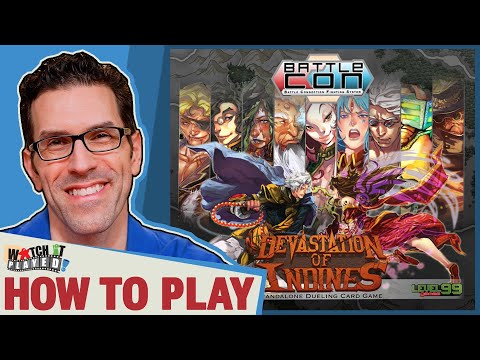
BattleCON - How To Play

BattleCON - Game Play 1

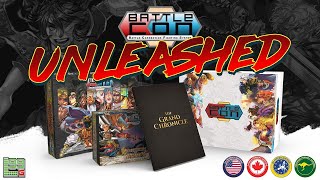
- New storage solution is better than the old way.
- The ultimate edition is a significant upgrade and storage solution.
- New play mats are considered cool and well-designed.
- The game has a strong lore and world-building.
- Updated terminology and rules for fourth edition are clearer.
- The addition of new bases for each character is a positive change.
- The game's updated components and organization are appreciated.
- The organized reboxing makes the game look nicer.
- The grand chronicle and some other components were delayed.
- The initial unboxing reveals a lot of components and potential for a long organizing process.
- The game has become larger and more complex with the ultimate edition.
- Some older components are obsolete with the new rules (e.g., dials, old cards).
- Certain older promo cards and their associated components are no longer usable due to rule changes.
- Three characters (Jain, Majorum Alexian, Ruridy Sicar) do not have upgraded cards and are essentially unusable with the new rules.
- The alternate art, while present for some characters, is not for all and some abilities remain the same, making it less impactful for some.
- The host dislikes the art style of some alternate art cards.
- Indines world
- Empyreal, Spells and Steam
- Exceed
- Pixel Tactics
- Summoner Wars
- Mage Wars
- Red Horizon's
- Millennium Blades
Mechanics (from transcript analysis)
- card combat — The game involves characters with unique fighting styles, suggesting a focus on direct combat between players.
- Card Play — The extensive discussion of cards, including special ability cards and reference cards, highlights card play as a core mechanic.
- character-specific abilities — The mention of various character classes like slugger, tactician, mage, brawler, and tinkerer indicates unique abilities tied to each fighter.
- token management — The introduction of new force and life tokens, as well as ante tiles, suggests a system of managing tokens during gameplay.
- Variable player powers — The description of characters having distinct fighting styles and abilities points to variable powers for each player.
Video topics + discussion points
Quotes (from this video)
- I'm finally doing an unboxing. I know, I know, if you watched my channel update, I said I wasn't going to do any more unboxings, but this is going to be a little bit different because this is going to be an unboxing for the new Battle Con stuff, the Devastation of Indines or Wanderers of Indines, the Ultimate Collection.
- So, yeah. So, we have those. Yeah, the fighting styles are now slugger, technician, mate, disruptor, brawler, and tinkerer.
- So, yeah. So, the story so far. It's pretty cool. And then it tells shows you the the fighters and uh something about them.
- So, yeah. So, that's all that comes in Wanderers. I'm just going to leave these in here until I am ready to start sleeving and crying.
- So, yeah. Well, so far everything's coming uh not all [ ] up, which is nice.
- So, you have your Armory, the Bakugan Armory.
- The game came with these 12 arenas.
- Well, okay, one, two, and three. Here's the advanced fighters and then intermediate and basic, so I'm not going to keep it.
- The appeal of the game's values, sportsmanship, inclusiveness, personal expression, and the pursuit of mastery are timeless.
- I've poured endless hours of sweat, blood, and tears into making BattleCON 4th Edition the best it can possibly be, and we hope to hear that you love it.
References (from this video)
- Anya's theme song is catchy and memorable.
- The core mechanics of flying/grounded forms offer strategic choices.
- Ryxin's curse mechanic adds a unique risk/reward element.
- The flying form for Anya is described as a detriment, with no guard and armor, making her vulnerable.
- Anya's grounded form makes her weaker.
- The game can become overly complex and lead to overthinking.
- Clashes, where both players play a card that negates each other, are frustrating.
- The fight length can drag on, especially with slower characters.
Mechanics (from transcript analysis)
- Advance/Retreat — Anya can advance or retreat a certain number of spaces when changing forms.
- Alternate Art Cards — The characters discussed have alternate art versions with separate cards, but they play the same.
- curse tokens — Ryxin gains curse tokens when hit, which opponents must ante and suffer effects from, or risk empowering Ryxin's attacks. Holding too many curses can lead to elimination.
- Priority system — Players have priority values that determine turn order, which can be affected by curses.
- Range Modification — Ryxin's maximum range can be reduced, but not below a minimum range. Anya's range is also discussed.
- Stun/Damage Interaction — When Anya is stunned, she becomes grounded. Opponent's range is reduced while she's flying, and her guard/armor is ignored.
- Switching forms — Anya can switch between flying and grounded forms, with different benefits and drawbacks for each.
Video topics + discussion points
Quotes (from this video)
- I don't give a [ __ ] about any of that singing the whole time and I'm singing the whole time
- My curse will consume you they also take three damage per health curse so you'll take nine damage and then you'll immediately lose
- I love hate this game
- you're just not doing it today huh
- I don't know what to do I'm overthinking I'm frozen
- I just eat I'm just going to eat a big old chunky big old chunky fat wine
- her flying is such a detriment that you almost never want to be in it
References (from this video)
- Elegor has startling depth in his abilities.
- Jaeger is a favorite character with versatile ultimate moves.
- The game is well-balanced, with close matches even with perceived counter-picks.
- Jaeger's signature moves can be weak if not properly utilized.
- The personal nature of the competition can make losing feel particularly bad.
- Anime characters with brooding backstories and a cursed lineage.
- Demon Slayer
- Red Rising
- Hunger Games
Mechanics (from transcript analysis)
- Active Player — The concept of an 'active player' determines who goes first in a beat, with priority checks influencing turn order.
- Advance/Retreat — Several moves involve advancing or retreating a certain number of spaces, sometimes with effects if passing the opponent.
- Aegis — A powerful shield ability that can be used situationally.
- Armor Ignore — Some attacks ignore armor.
- Dodge — Dodge mechanics allow players to avoid attacks, sometimes by retreating.
- Dodge Immunity — Certain moves can be dodged, and some abilities prevent dodging.
- Finisher/Ultimate Moves — Characters have unique finisher moves, such as Jaeger's 'Sign of the Wolf' which allows recovery and replacement of signature moves.
- Force — A resource used to power up attacks or other actions.
- Guard Immunity — Certain abilities grant immunity to guard.
- Guard/Armor — Elegor has guard abilities, and the game mechanics include armor, which can be ignored by certain attacks.
- Miss — Players can intentionally miss attacks or miss due to range or positioning.
- Power-up — Players can spend resources ('force') to power up their attacks, increasing power or priority.
- Push/Pull Immunity — A card is mentioned that prevents the player from being pushed or pulled.
- signature moves — Characters have signature moves that can be played face down and executed instead of the attack pair.
- Speed-up — Players can spend resources to speed up their actions, affecting turns.
- Stun Guard — Elegor can ante vengeance tokens to gain stun guard, and gets stun immunity if all five are ante'd.
- Stun immunity — Abilities can grant stun immunity.
- Tiebreaker — Priority checks can result in ties, which are resolved by a tiebreaker mechanism.
- Uniques — Unique base cards or abilities are mentioned as being powerful and often one-time use.
- Vengeance tokens — Elegor gains vengeance tokens when taking damage, used to increase guard, retaliate, or land powerful attacks.
- Whiff — An attack can 'whiff' if the target dodges or the range is incorrect.
Video topics + discussion points
Quotes (from this video)
- each character in edge lord in some way
- Elegor, Larrington, successor to Saint Calibran. Slugger slash novice. Each day is a destiny to be grasped.
- It is in the face of impossible that true myths are made.
- I hate when when you know writers do that
- We could have ended there but no there's another paragraph
- The fact that you can swap in any of them like so it's like oh he did this well i'll just do this then
- I think in this game I'd rather win or lose by a landslide than by one hp or something.
- it's always been 5 hp or less to zero
References (from this video)
- Attacks become stronger while insects remain depleted.
- Avoids all attacks two spaces away.
- Can regain all insects from discard pile to chip damage.
- Annoying to track her insect mechanics.
- Her avoidance can be less effective against all-range opponents.
- Green Guardian
Mechanics (from transcript analysis)
- Area denial — Kajia can create zones of avoidance that affect opponents' attacks.
- Damage over Time — She inflicts chip damage as her insects return and engage.
- Discard Pile Cycling — Her insects cycle through discard piles and return, strengthening her attacks.
- Insect Counters — Kajia has seven insect counters that are depleted when opponents move past her, affecting her attack strength.
Video topics + discussion points
Quotes (from this video)
- she has seven insect counters which she depletes when moving opponents past her.
- vehicle serves the voice of malphase out of both duty and love one of the few remaining souls that knew her during her human life centuries ago he has remained devoted despite her corruption and his own death still he is by no means blind to what he has become over the centuries regrets haunt him and he is tormented by the corruption that has consumed both him and his mistress darjean.
- the difference is with this one and even with him is because it's considered chip damage we don't take it as seriously because they can't kill you.
- he's a very in between you know he was mobile he could do good damage solid range he's a very you know right in the middle he's a well-balanced jack of all trades.
- because the chips can't kill.
- it's like i'm driving and you're just like oh man but i'm gonna get to stay away but then the bugs are like that they're on you are pulling you and you're like oh god why can't i move.
- all right eat my punani
References (from this video)
- Cool mechanics with the clone
- Interesting technique provides variability
- Good trade-off in his mechanics
- Can attack from two avenues
- Can be stunned if his clone is hit
- The clone can be targeted
- Eating through bases if he relies on the clone for attacks
- A doppelganger and herald of destruction, who wipes out cultures and knowledge, seeing destruction as peace.
- Across the lands
- Lore is read aloud, detailing his destructive past and nihilistic philosophy.
Mechanics (from transcript analysis)
- Clone marker — A clone can be placed in the furthest space and can perform additional attacks. It becomes an allied fighter that executes the attack pair on the duplicated card.
- Duplicated card — This card activates the clone, allowing it to perform attacks. It is targetable when active and cycles like other cards.
- Inception (Ultimate) — Range one, power five, priority eight. On reveal, the clone copies this attack instead of performing its own attack pair.
- No dodge base — Gaspar's kit does not include a dodge base; he has warp instead.
- Stun vulnerability — If the clone is hit, Gaspar is immediately stunned and takes guaranteed chip damage. Damage taken by the clone will stun it unless it has stun immunity.
- Warp — A unique dodge-like ability that allows teleportation to the clone space.
Video topics + discussion points
Quotes (from this video)
- The world will thank me someday
- Gadon is a doppelganger who sees himself as the herald of this world's ultimate and inevitable destruction
- byron is busted he's tough
- well i think he does all his he's like he you know in like say the anime yeah he's the guy he's always helping the protagonist but like off screen he's just doing terrible stuff right he's just doing terrible scenes basically so you still kind of like him right um but he is evil yeah he's he's loki yeah
- This is a bad matchup man this is gonna be weird
- poor calculations on my part
- son of a [ __ ]
- Byron Crane the immortal bound
- Gaspar's just like i don't care your world will end
- yeah and it's like i feel like he's like you know as i said earlier um he's just such a powerhouse like you have to play around him with anyone else
- The fact that you can throw out a [ __ ] strike at range four is pretty disgusting
- It's like, oh [ __ ] you're far away this guy's gonna whoop your ass
- his field controls almost it's equivalent to lexians almost
References (from this video)
- Cool finisher that ended the campaign.
- Oryax is cool and not a strain to play.
- Oryax's desperation mechanic is interesting and advances him over other characters like Jaeger.
- The tournament format provided an interesting and nerve-wracking finale.
- The final move was not as close as it could have been.
- Mistakes were made due to getting in one's own head or not thinking to the next level.
Mechanics (from transcript analysis)
- ante — Players can 'ante' to gain advantages or activate certain abilities.
- Armor and Guard — These mechanics are discussed as ways to mitigate damage, with a desire for more of them on certain character types.
- Clash resolution — The interaction and resolution of clashes, especially in ties, is a point of discussion and strategic consideration.
- Deity cards — Oryax uses six distinct deity cards that offer varied benefits and are trashed after use. His final three deities provide more powerful effects.
- Desperation mechanic — Oryax has a desperation mechanic that activates when he has three or fewer deities, offering enhanced effects.
- Familiar summoning — Lisandra can spend blood or health to summon familiars that provide various permanent buffs.
- Priority — Priority determines the order of actions, with different characters and abilities affecting it.
Video topics + discussion points
Quotes (from this video)
- that was probably the best finisher in this uh campaign so far
- he didn't feel like a strain to play like i didn't have to like over like ascend to the stars to understand how he works
- very simple i mean i can throw down this buff you've only got so many so like don't hold on to them the fights are short
- i got in my own hand that's good that's still good i'm not angry at all
References (from this video)

- easy to get to the table
- played often
Mechanics (from transcript analysis)
Video topics + discussion points
Quotes (from this video)
- the more expensive a game is the more I feel I need to play it in order to justify its cost likewise the cheaper something is I don't feel like I have to play it as often
- it's not quantity it's quality
- you kind of forget when you're a member of The Cult of the new as I sometimes tend to be just what it's like to sit down and not have to teach the game again not have to try to remember the rules for other people and everyone can just sit down and just focus on playing the game rather than learning to play the game
- the game that I really want to try and exhaust for me is Star Trek Fleet captains because it's the only one I know of that includes all three of these elements but I can also use it for the fourth one as a Sandbox to explore and experiment with
- you know you might think well 10 plays of a game that's not so much well it's 10 by 10 so you're looking at 100 plays of your year
- it's possible as you play a game more often as Sarah comments you'll find things in it you don't like and as you play it more that could get accentuated
- the biggest thing that really brought me back into the same game like Warhammer or 40K all the time was creating these campaign Maps
- I can forgive a game several perceived design flaws if out of the experience it creates a memorable moment that makes me smile to think about or makes me want to retell it
- it just depends on how you look at it you can justify anything the important thing is that you enjoy the game you're playing if you don't enjoy then you certainly have not gotten your money's worth out of it
- I don't often consider how much gaming time do I really have to work with here
References (from this video)
- Fun character mechanics (Karen Brandt's werewolf twin brother)
- Multi-attack is great for clearing groups of enemies
- The solo dungeon crawl mode is accessible and enjoyable
- Good variety of game modes available for different player counts
- The game doesn't include tokens for many elements, requiring pen and paper
- Some specific attacks might not be useful against bosses or larger monsters
- Retrieving a diary from Baroness and Cella's crypt
- Reor
- Exceed
Mechanics (from transcript analysis)
- Ante Phase — A phase where players can spend 'force' to activate buffs like speed up, power up, or defense up.
- Card Play — Players select one base card and one style card each turn to form attacks and combos.
- character abilities — Each character has unique bases, styles, and special abilities that impact gameplay.
- Combo System — Attacks are determined by combining a base card and a style card, with their stats influencing the outcome.
- Dungeon Crawl — The reviewed mode involves progressing through a series of floors with enemies and objectives.
- Hand Management — Players manage a hand of cards to choose their base and style for each attack.
- Multi-attack — Some attacks can hit multiple enemies within range, useful for clearing groups of weaker foes.
- Positioning — Movement and positioning on the board are crucial, especially for characters with abilities tied to adjacent spaces or specific formations.
- Resource Management (Force) — Players utilize 'force' for special actions in the ante-phase, such as speed, power, or defense buffs.
- Stun — If an opponent's attack power exceeds the defender's guard, the defender becomes stunned, potentially canceling their own attack.
Video topics + discussion points
Quotes (from this video)
- So, Devastation of Indians comes with a whole bunch of extra modes. And one of the coolest ones that I have somehow never covered on the channel before because when I initially covered the game, I just focused on my own uh variant solo mode, unofficial solo mode, uh is this battle quest dungeons mode for solo and multiplayer.
- Because the key thing of this mode is that you're generally not going to get to heal much. Like each uh combat you do is just going to whittle down your life.
- If you haven't seen BattleCon in action before, this is a 1v1 fighter in its main play. Again, not counting this mode I'm playing.
- Because usually when you do an attack uh that could it theoretically include multiple people, only the first one in range gets hit. But here I could like blast a bunch of these zombies on the first floor altogether.
- And just to keep things simpler, instead of using the life tokens, I borrowed a dice thrones spinner. So I've got 40 health right there.
- This is the easiest dungeon of all with using all the gold because they said to make this one harder, don't use as much gold.
- This is only in Devastation, although you can use characters from other sets. And then here's a two fighter. I'll just kind of show you the other options. You got a two fighter tag team thing where you switch between two characters. This one's a three fighter tag team where you switch between three and then eventually they like split up and it's a lot more complicated.
References (from this video)

- Characters from earlier flights are recommended for new players due to more straightforward abilities.
- The rulebook summarizes cards and tokens, and sleeves are provided for storage.
- The board has printed steps for conducting actions, which helps players remember.
- The game offers alternative versions of characters for different playstyles.
- Solo, cooperative, and team play options are available.
- For the first few games, it may be advisable to leave out the special action card until comfortable with the rules.
- The reviewer recommends leaving out the special action card for the first few games.
- It's recommended not to play with the special action card for the first couple of games.
Mechanics (from transcript analysis)
- Area Movement — The game involves moving figures along spaces on a battle line, with mechanics like advance, retreat, push, and pull.
- card-driven — The game is described as card-riven, implying mechanics are driven by cards.
- Combat — The core of the game involves duels with attacks, damage, and defense.
- Deck Building — Players build their deck from character-specific cards and generic cards.
- Hand Management — Players keep cards in their hand and choose which to discard.
- Set Collection — Players collect tokens, such as vengeance tokens or chivalry tokens.
- Simultaneous action selection — Players secretly and simultaneously choose cards to discard or play their attack pairs.
- Take That — Some effects, like the cancel ability, directly interfere with the opponent's actions.
- Variable player powers — Each character has unique abilities and a specific set of cards.
Video topics + discussion points
Quotes (from this video)
- In this video, we're going to learn the battle con system using Devastation of Indians by D. Brad Tolton Jr. and published by Level 99 Games.
- So, join me at the table and let's learn how to play.
- The goal of the game is to win matches.
- But during a beat, both players are actively doing things. So there's not really a strict breakdown into player turns.
- If a legal move cannot be made, then the entire move is ignored.
- And that's everything you need to know to play a one-on-one BattleCON duel.
References (from this video)

- Engaging combat system with strategic depth.
- Interesting character abilities and token mechanics.
- The 'clash' mechanic adds an element of surprise and forces adaptation.
- Can be complex with many interacting effects.
- Forgetting to gain tokens can put a player at a disadvantage.
- Fantasy combat
Mechanics (from transcript analysis)
- Area Movement — Characters can advance or retreat spaces on the board, affecting engagement range.
- Clash resolution — When players pick the same base card, it results in a 'clash' requiring new base card selections.
- Combat — Players engage in direct conflict, with mechanics for range, power, damage, soaking, and stunning.
- Hand Management — Players select cards from their hand to form attack pairs each round.
- Priority system — Determines the order of actions within a beat, with higher priority allowing earlier effects.
- token management — Vengeance tokens and Concentration counters are used to power up abilities, grant stun guard, or adjust attack ranges.
Video topics + discussion points
Quotes (from this video)
- So basically as I'm hitting you I'm powering you up correct?
- So you're powered up again which isn't so great
- The other one though lets me Retreat one space and I do want to do this so I'm going to move back one space.
- I was really hoping you were going to hit me so I could use some retribution here but uh it's not going to do anything for me.
- Well I did play kind of aggressively in that first turn. Maral is kind of a sit back and wait character so I don't know I felt like maybe it was time for me to just take it down a notch before I started hitting again.
- I'm going to gain a concentration counter so I'm starting to load up here as well.
- I think for once you've got the priority.
- I need to clear out of here I am going to retreat I'm going to retreat the full three spaces I can go.
- I get three Vengeance tokens.
- I feel like we were pretty quick both of us in picking our attack pairs I don't know if that means we both really know what we're doing or we just kind of flattering at this point.
- I'm going to discard all three of these to pull you three spaces closer.