































Burgle Bros. Deep Dive
What the Community Thinks About Burgle Bros.
Reviewers broadly agree that Burgle Bros. is a compact cooperative heist game that is quick to teach and tense to play. The series has a loyal following, and many reviewers judge each new entry against the originals. BoardGameCo calls the third game a solid solo and cooperative experience, though it rates it four out of five and says it works best at one or two players. Meeple University is more upbeat about the group experience, describing the game as a good party-style title because its theme is fun and its play time stays short.
Where the community tends to diverge is on how much strategy the game really offers compared with luck. Reviewers who value planning point to the way the guards and tiles reward careful reading of the board. Others say that the randomness of the room layout can make one session easy and the next punishing. Meeple University describes the layout variance as "a little bit swingy," and BoardGameCo admits that a bad first turn can end a game before it really begins.
Core Mechanics That Define Burgle Bros.
Cooperative Game
Every crew member shares a single outcome. Burgle Bros. is built so that the team either pulls off the heist together or fails together, and the clearest example comes from the way a single caught player ends the run for everyone. Reviewers see this as the heart of the design. BoardGameCo frames the experience as a balance between knowing what the enemy will do and accepting the risk that comes with it, and that tension only works because the players must coordinate their actions. The series was designed by Tim Fowers and published by Fowers Games, and reviewers consistently describe the cooperative structure as the reason the games feel more like a crew effort than a race.
Tile Placement
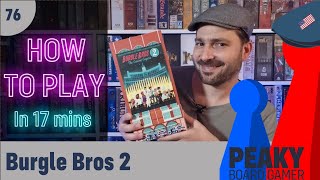
The building is assembled from face-down room tiles, and each one reveals a new effect or threat when a player steps onto it or peeks at it. Board Game Hangover highlights this as the source of the replayability, since the rooms that appear change from game to game. Stonemaier Games points to the same design when it praises the series for making every floor feel like a fresh set of obstacles. Peaky Boardgamer shows how much rule detail sits behind these tiles in the sequel, with alarms, bouncers, and destination markers all tied to what the crew uncovers. Reviewers do note that the tiles can make the early game feel slow, since the crew needs to explore before it can plan.
The Burgle Bros. Experience
Tension Under a Ticking Guard
Almost every reviewer describes a constant sense of pressure. The guards speed up as alarms go off and as the crew climbs to higher floors, so the margin for error shrinks steadily. cardboardrhino describes the result as an adrenaline rush when sneaking in and out of rooms, and says the rising guard speed makes every floor more exciting. BoardGameCo adds that even a careful player can be caught by a bad draw, which keeps the tension high in the closing turns. The feeling is less about one dramatic moment and more about a steady, mounting unease that the crew has to manage together.
A Heist Movie at the Table
Many reviewers say the game captures the feel of a heist film, with the crew planning ahead, scouting the building, and then watching the plan fall apart as the guards react. Board Game Hangover says the thrill comes from planning ahead and failing in spectacular ways, which makes the eventual escape feel earned. Stonemaier Games is especially enthusiastic about this, arguing that the series captures the core beats of a heist movie more faithfully than many other tabletop titles. The theme lands because the mechanics reward the same kind of improvisation that a heist story depends on.
What Makes Burgle Bros. Stand Out
Dice Rolls That Crack the Safe
The safe-cracking system is one of the features reviewers return to most often. In the second game, a player places dice in the owner's office and then rolls them against the safe, with each result matching a number printed on tiles in the same row and column. Peaky Boardgamer walks through this process in detail, and Board Game Hangover simply calls the rolls great. The appeal is that the dice create a clear, visible goal that the crew can work toward, while the uncertainty of each roll keeps the outcome open until the final number lands.
Replayability From Changing Tiles
The changing room layout and the variety of characters give the series a long shelf life. Board Game Hangover praises how each session feels different because the rooms and loot vary. BoardGameCo makes a similar point, noting that the board layouts and the different enemies and main frames keep the objective fresh. Meeple University adds that the player powers and tile arrangements shape a different strategy each time, so the game rewards players who return to it.
Potential Drawbacks
Busy Work While Waiting for Workers
The most common complaint is that the game can slow to a crawl while players wait for the resources they need. BoardGameCo describes the problem as repetitive busy work, where players draw cards at the end of each turn hoping for the right colors or a refresh of the workers they need to talk to. Reviewers say this can turn the late game into a stretch of running out the clock rather than making meaningful decisions. The issue is most noticeable when a specific combination of cards is needed and does not arrive.
Alpha Playing and Table Dynamics
Because the game is cooperative, a confident player can end up directing everyone else's turns. BoardGameCo warns that the game is open to alpha playing, and that the group has to decide whether to offer advice or stay quiet when a teammate is about to make a costly mistake. Meeple University also notes that the rulebook can be hard to navigate, with players needing to look up small rules during play. Reviewers generally agree that the game works best when the group is comfortable with that tension and sets clear expectations before starting.
If You Enjoy Burgle Bros.
Players who enjoy the tight, shared pressure of the crew will find similar satisfaction in Pandemic. BoardGameCo notes that the game shares some of Pandemic's feel, with a cooperative team racing a rising threat. Players who like hunting for the right tiles will also appreciate Forbidden Desert, which Meeple University compares to Burgle Bros. because of its tile searching and swingy outcomes. For a cooperative game with a different kind of time pressure, BoardGameCo recommends The Loop. Fans of the series who want a gentler version of the danger should consider Room 25 as a contrast, since Meeple University observes that Burgle Bros. removes the instant-loss traps that make Room 25 so unforgiving.
What Reviewers Are Saying
"they are slowly going to be drawing cards that are going to give them suspicion that's going to make your life harder. So, you really are playing this delicate balance of trying to run out the clock and play safe, but also being mindful that bad things will eventually happen."
— BoardGameCo
"I think there's a third one that I haven't played, but I really enjoyed playing both of the first two Burgle Brothers. I think they lean heavily into a lot of the things that you might see in a heist movie."
— Stonemaier Games
"It's a great simple cooperative game that is different each time you play cuz all of these tiles are different rooms that can or cannot be in your game. The stuff you steal is always different."
— Board Game Hangover