

Caverna: The Forgotten Folk Deep Dive
What the Community Thinks About Caverna: The Forgotten Folk
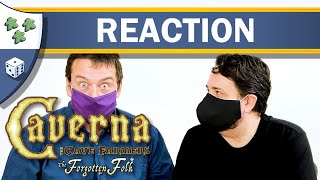
Caverna: The Forgotten Folk is a mini-expansion to Uwe Rosenberg's Caverna, published by Lookout Games, and it reworks the base game by replacing its plain dwarves with unique playable races. Nights Around a Table approached the expansion as an unboxing, and the discussion kept returning to the race cards. Michael Todd, the guest on that unboxing, found the races the most interesting element of the box, but they also felt that many of the underlying resources and ideas were basically variations on the base game.
The packaging drew mixed reactions. Michael Todd noted that the back of the box carried no pictures of the game and questioned how a buyer could know what they were getting, while Ryan pointed out how strongly the front of the box pushes its fantasy theme. The Broken Meeple discussed the expansion inside their ranking of favorite games. They praised the asymmetric player boards and the adjusted race rules, then delivered a sharply negative verdict. Ryan's Agricola solo stream also touched on the expansion's trolls, which they found fun enough to consider showcasing in a future stream.
Core Mechanics That Define Caverna: The Forgotten Folk
Races as Asymmetric Player Powers
The central change is that each player's worker-owning dwarf is replaced by a race with its own rules. Reviewers described the races as pairs of traits, usually one advantage and one drawback. Michael Todd compared this to Root, where each faction carries two rules that can both be strong, both be weak, or combine into a balanced package. The Mountain Dwarf lets twin tiles overlap inside the mountain, which allows a denser cave, but the same race must place a single tile when a twin tile is called for. The Elves are described as lovers of sunlight and woodland habitat, and the Cave Goblins are presented as clumsy, incompetent and numerous. Trolls eat an absurd amount of food, yet they can eat things other races cannot, including dogs, which Ryan described as a fun twist on the base game's rules.
New Resources, Buildings, and Scoring Tiles
The expansion layers new components onto the Caverna board. Gemfruits are the most discussed addition. They can be paid as food, exchanged for a ruby, and sown and harvested like crops, a combination Michael Todd suspected explains the item's name. Mushrooms appear as a separate resource, and the expansion adds extra ruby mines, extra tunnels and extra fields. The new buildings are mostly scoring tiles such as the Bird Hide, Hunters Hut, Feeding Room, Elven Market, Mining Office, Training Room and Overseer's Dwelling. Michael Todd observed that many of these buildings describe very specific strategies, such as the Elven Market's exchange of wood and stone for a pumpkin and ruby, and the Overseer's Dwelling scoring rubies and ore based on how many mines a player owns. These tiles add scoring routes on top of the base game's existing point structure.
The Caverna: The Forgotten Folk Experience
A Looser Feel Than Agricola
Ryan's solo Agricola session on Nights Around a Table offers the clearest contrast with the Caverna family. They described base Caverna as a lot looser than Agricola, saying it is nowhere near as strict and offers more ways to score. In Agricola, one taken space can undo a plan at the wrong moment, and that pressure creates the tense knot Ryan described feeling during their stream. Forgotten Folk keeps the looser Caverna framework and adds races and buildings that open further routes to points. Ryan also admitted that watching how-to-play videos does not convey the feeling of playing a game like this.
Lighthearted Fantasy Tone and Replay Variety
The hosts treated the expansion with humor. Ryan expected to see wooden dwarf workers in place of the generic components and noticed that the expansion avoided that choice, which suited a table where the workers are not all dwarves. The Cave Goblins drew the most teasing, and the hosts joked about the trolls, the dark elves and the amount of food each race consumes. That tone matters because the races change the opening plan, the food math and the buildings a player chases each game. Reviewers consistently framed the appeal as variety that rewards a player for adapting to whichever race they draw.
What Makes Caverna: The Forgotten Folk Stand Out
Races That Refresh a Familiar Engine
Michael Todd suggested that the decision to keep the workers generic may have been intentional, since a dwarf-only table would clash with a roster of different fantasy species. The races give the base game's familiar worker placement and farm-building engine a new identity. The Broken Meeple praised the asymmetric player boards and the way the adjusted rules change each player's approach, calling the race tweaks really good fun. For players who already know Caverna, the expansion turns the same board into a different puzzle each time a new race is dealt out.
Value for Existing Caverna Owners
The expansion is most appealing to players who already know the base game well. Michael Todd reasoned that the expansion's dense buildings are likely the product of extensive playtesting, with a large player base discovering very specific strategies over time. Ryan saw the same pattern in the buildings and the new resources, which give experienced players further avenues to explore without requiring them to relearn the core rules. The expansion therefore works as an extension of an existing habit rather than as an entry point.
Potential Drawbacks
Setup Load and Rulebook Density
The expansion's physical footprint is a recurring concern. Michael Todd pointed out that in Caverna, special abilities sit on tiles that go on a common board, while Agricola places them on cards, which makes Caverna a pain to set up. The rulebook runs twelve pages with few pictures, and Michael Todd described it as heavy text. They added that nearly all of Uwe Rosenberg's games carry a lot of components and setup time, so the expansion inherits that weight. Players who want to bring it to the table will need time and patience before the first turn.
Uneven Race Design and a Divided Verdict
Race balance is the sharpest point of disagreement. Michael Todd joked that the designers clearly enjoyed writing negative traits, and questioned whether several races are ones a player would actually want to choose. The Broken Meeple offered the most critical verdict, calling the expansion hot garbage and suggesting that players avoid it entirely. They noted that it came out with little fanfare and that most people do not know it exists, which may reflect its limited marketing as much as its design. Reviewers who enjoyed the races and reviewers who rejected them are describing the same core content, so prospective buyers should weigh the design against their own tolerance for uneven pairings.
If You Enjoy Caverna: The Forgotten Folk
Players who want the expansion's core should first learn the base game, since the races modify its tiles, resources and scoring. Reviewers pointed to several titles that share its design DNA:
- Caverna (base game): the foundation for every race and tile in the expansion, and the looser alternative to Agricola that Ryan described.
- Agricola: the original farming worker placement game, where family growth, food pressure and harvest timing create the tension Ryan contrasted with Caverna.
- Caverna: Cave Farmers: The Broken Meeple's favorite follow-up, offering open-ended farming with the freedom to pursue whatever strategy a player prefers.
- A Feast for Odin: Michael Todd linked its puzzle-like tile fitting to the grid-based building layout Rosenberg uses across their games.
- Root: Michael Todd compared its two-trait factions to the race pairings in Forgotten Folk.
What Reviewers Are Saying
"I think the races are the most interesting thing to look at. So there's two more, yeah, no, I think so. Like, there's, there's interesting resources, but they're basically variations on Caverna."
— Nights Around a Table
"But they can eat everything. There's dogs in the game, and the rule of the game is that you can't eat dogs and Caverna, but if you're the trolls, yeah, go ahead and eat some, eat some dogs. It's fine, you can just bake, you can eat rocks, you can just basically just devour everything because they're just voracious, these, these trolls. It was pretty, it was pretty fun playing it, so I might actually bust out the Forgotten Folk on an upcoming stream."
— Nights Around a Table
"To summarize, that expansion is hot garbage and you should not go anywhere near it. You know, I mean, it literally came out of nowhere. Most people don't even know it exists."
— The Broken Meeple