














CloudAge Deep Dive
What the Community Thinks About CloudAge
CloudAge is a one-to-four player engine builder from Capstone Games that mixes campaign play with a light deck-building layer. Across the community videos used for this overview, the consensus is that it is a streamlined euro with more substance than its table presence suggests. Reviewers describe it as simple to learn, quick to play, and consistently engaging from start to finish. The praise centers on how much a player can accomplish on each turn, while the criticism centers on a small number of components and rules that do not explain themselves well. Most reviewers come away treating CloudAge as a strong entry for players who want more decisions per turn without a heavy rules load.
Core Mechanics That Define CloudAge
Engine Building
The engine in CloudAge is built from upgrades and project cards placed on the airship board. Each player runs an airship with upgrade areas for movement, combat, and production, and new cards slot into the matching phase of the board. Early choices about which upgrades to buy shape the actions available in later rounds, so the engine compounds as the game goes on. Because cards with immediate effects resolve as soon as they are placed, a player can see the payoff of a good purchase quickly, which is a large part of why reviewers describe the game as one of constant progression.
Deck Building
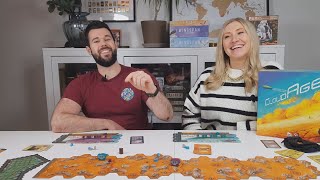
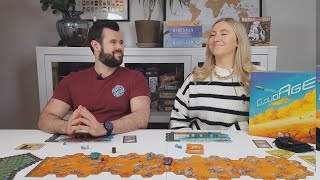
The second mechanic is a deck-building layer that runs through the navigation cards and the project cards. Navigation cards are drawn, used, and cycled through the deck each round, so the hand a player holds depends on what has already been played. Project cards join the airship as the game moves forward, and the strongest of them can change how a player moves, fights, and produces. The playthrough from Board of It shows how tightly these pieces connect: a card taken for one purpose can later make a combat or production action possible, so the deck feels like a plan rather than a random draw.
The CloudAge Experience
A Round Built From Three Phases
Each round is divided into three phases, and reviewers found that structure easy to follow. The first phase centers on production, where players spend resources to gain water and energy and draw navigation cards. The second phase handles airship movement and resolves any fight with the Cloud Militia that occurs in a city. The third phase is the action phase, where players spend their turn on cards, upgrades, and city actions. Experienced players can overlap the first two phases almost entirely, which helps the table keep a steady pace and makes each turn feel self-contained.
Tight Turns and Limited Downtime
Board of It highlights how little time players spend waiting. Because the first two phases can run almost in parallel once a group knows the rhythm, and because each decision connects to the cards already in play, the game holds attention for most of the table. The chunky feel comes from the number of options available rather than from long rules explanations or slow setup. Reviewers consistently describe the flow as brisk, which suits a table that wants a full strategy experience in a single evening.
What Makes CloudAge Stand Out
Cloud Sleeves on City Cards
Some city cards sit behind cloud sleeves, which means a player must choose one without seeing its contents. That adds a risk layer to resource gathering that reviewers found memorable and distinct from more predictable collection games. The choice of which hidden card to take each turn becomes a small gamble, and it gives the city phase a sense of uncertainty that many resource games lack. Players who enjoy a little luck in their planning will find this part of the design especially appealing.
Campaign Play and Variable Setup
CloudAge is built around a campaign rather than a single session. Course the News describes the game as an engine and deck building campaign game, and Board of It notes that the ideal way to play is through the campaign with its legacy elements. Variable setup and scenario-specific cards mean that each scenario plays differently, and the game also supports solo play against an AI opponent. That flexibility gives the box more longevity than a one-off game, and it rewards groups who want to see how their airships develop over several sessions.
Potential Drawbacks
Unclear Resource Signals
The most consistent complaint concerns the cloud-covered city cards. The remaining abundance of a resource is meant to show through the visible card art, but the rulebook does not explain that link clearly. Board of It described a stretch of the first few games spent working out how to read the signal, and that learning curve can slow a table that expects everything to be obvious from the start. Groups who prefer clear, printed feedback may want to agree on how to read the art before the first turn.
Combat That Feels Like an Ordinary Action
Combat in CloudAge is light. Board of It describes it as not really combat per se but just another action, and losing a fight carries only a modest cost. That keeps the game moving, but players who want tense battles or a heavy military layer will not find it here. The low risk can make some fights feel routine rather than dramatic, and that tone may not suit every group.
If You Enjoy CloudAge
CloudAge suits players who like engine building in a compact package with a clear turn structure, light combat, and a campaign that rewards repeat play. Course the News places it lighter than Great Western Trail and Maracaibo but heavier than Isle of Skye, which makes it a comfortable middle step for groups moving up from simpler euros. Rolling Dice and Taking Names reviewed it as nothing like Great Western Trail, so fans of that game should expect something different rather than a direct follow-up. Players who want a deep solo experience, a heavy military theme, or tense combat may look for a different title.
What Reviewers Are Saying
"It's simple to grasp yet still has that chunky euro feel and a reasonable play time."
— Board of It
"To me this feels nothing like Great Western Trail."
— Rolling Dice and Taking Names
"It's quite chunky and you'll get a lot going on but also it's very streamlined and plays really quickly."
— Board of It