







Crown of Ash Deep Dive
What the Community Thinks About Crown of Ash
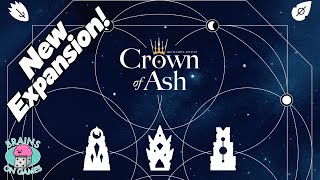
Crown of Ash has captivated reviewers as a fresh take on worker placement gaming, blending traditional euro mechanics with visceral area control and an elegant combat system. Dr. Brian McDonald of Brains on Games called it "a really clever combination of worker placement and resource gathering mixed with area control and combat," and counted it among the year's favorite games despite reviewing only a prototype at the time. The Allies or Enemies channel praised it as "refreshing" for an area control game that works reliably across all player counts, while The Dice Tower's Tom Vasel appreciated the game's directness, describing it as "very in your face" with "cool concepts." Reviewers consistently note that Crown of Ash stands apart from competitor titles like Everdell, Viticulture, and Fresco by delivering genuine player interaction where every action shapes what opponents can do next. The game's focus on interactivity rather than quiet, solitary engine building has made it a standout among worker placement designs.
Core Mechanics That Define Crown of Ash
Worker Placement with Meaningful Scarcity
Each round, players command a limited hand of four workers to place on action spaces across the board. The simplicity of the action set belies the strategic weight beneath: gather resources (coins, bone, ash), build new structures that provide ongoing income and points, battle to seize opponent-controlled territories, or reclaim spent combat cards for future conflicts. Because workers are few and the board spaces limited, every placement forecloses other options. Reviewers emphasized that this creates a planning challenge where every single decision is interesting: budget your resources to purchase powerful fighters, secure high-value locations to pay for future actions, or disrupt opponents by claiming spaces they need. The interactivity is heightened because players benefit from any location they visit, even if an opponent owns it; the owner receives a modest "owner's tax" of resources whenever someone uses their structure, rewarding control without locking others out entirely.
Combat: Mutual Benefit and Card Memory
Combat in Crown of Ash is where the game's design elegance shines most visibly. To seize an opponent's territory, you place a worker on that location and commit one or two fighters from your hand. Both players then play a combat card face-down simultaneously, adding it to the total strength of their forces. The winner claims the territory and places a control token. But the design includes a revelation: even the loser benefits. Defeated fighters return to a graveyard, not a discard; at the end of the round, they rejoin your hand, restoring your options for the next turn. Combat cards are similarly finite: once all are spent, they face upward on your player board until you take an action to reclaim them. This creates a tactical layer where memory matters: tracking which cards opponents have played forces you to estimate what options they retain. The bonus system means you might intentionally lose a battle to secure specific resources or trigger a favourable card effect, inverting the typical confrontation dynamic. Reviewers found this "clever" and "so interesting," transforming combat from a zero-sum trade into a negotiation of which player can best afford this turn's costs.
The Crown of Ash Experience
Dark Fantasy Atmosphere
The theme of necromancers awakening from a hundred-year slumber and harvesting the dead saturates every element. Fighter cards depict skeletal archers and ghosts with unsettling artistry. Resources bear thematic names: bone and ash, not generic cubes. The art direction is described as "terrific," with each of the four Lords receiving a unique dual-layer player board and distinctly sculpted meeple minions that make ownership instantly visible. The board itself flips to offer two modes: a colorful "emo" side and a stark, dark mode. Tom Vasel's comment that the game is "very stark looking" captures the aesthetic intent: this is a world of tombs and decay, of undead soldiers marching across haunted territories. The thematic coherence between mechanism and narrative means that players aren't just moving abstract tokens; they're raising armies of the damned and watching them shamble into combat.
Tense, Confrontational Gameplay
Crown of Ash prioritizes direct player interaction over the quiet solitude of many euro games. At every table size, players are jockeying for the same high-value territories, competing to control the Citadel, and deciding when to attack versus build. The game creates a sense of escalating pressure: as the rounds progress, land becomes scarcer, battles grow fiercer, and a single player's dominance at a key location can feel game-defining. This tension builds especially sharply at the Citadel, where control can change hands round after round. Reviewers noted that the game creates a feeling of "very much fighting back and forth," with the Citadel serving as a lightning rod for conflict. Unlike games where blocking is a side effect, here direct combat is the primary lever for upending the board state. The graveyard mechanic, returning defeated forces to your hand, means no attack truly eliminates a player from the game; instead, it cycles threat back into an opponent's arsenal, perpetuating a cycle of raids and counterattacks that keeps tension high through the final round.
What Makes Crown of Ash Stand Out
The Citadel as a Game-Defining Focal Point
At the centre of the board sits the Citadel, and it is not a secondary objective. Controlling this location for a full round yields victory points that escalate each turn: one point in round one, rising to six points in the final round. The Citadel is unusual in two respects: it offers no resources of its own, only points; and once you place fighters inside, you cannot swap them out as you can elsewhere. This makes holding the Citadel a commitment: you must defend with your chosen figures and cannot adapt mid-round. The multiple attack paths (two restricted spaces for single attacks, one unlimited central space for repeated assaults) mean that an undefended Citadel may change hands twice in a single turn. Reviewers found it "quite important" and emphasized that "you do not want to leave a player sitting on the Citadel for more than one round," as the point escalation makes it "often a game-deciding thing." The Citadel's design elegantly encodes a social contract: it is always in play, always tempting, always contested, and managing access to it defines the strategic conversation at the table.
Excellent Production and Player Aids
The physical components reflect care in design. Each of the four Lords has a dual-layer player board with a distinct visual identity and bespoke meeples, making faction presence unmistakable at a glance. The art on both fighters and structures is described as "terrific," conveying the undead theme without descending into gratuitous gore. Allies or Enemies noted that while resource cubes are "just cubes," the broader material quality and visual clarity make the game "look and feel great." Player aids are "very helpful," though the iconography and game flow are intuitive enough that veterans rarely need to consult them. The board itself is double-sided, offering choice between vibrant colour and high-contrast dark mode, accommodating different table lighting and aesthetic preferences. No reviewer flagged production as a weakness; instead, the care in presentation was cited as part of the game's polish.
Potential Drawbacks
Substantial Table Space Requirement
Crown of Ash is unapologetically a table hog. The main board, player boards (four of them), discard piles for combat cards, and worker placement space demand real estate. Dr. Brian McDonald noted that even on a large gaming table, the board and player areas fit but all the cards struggled to be arranged comfortably. The Brains on Games review emphasized that "you need a big space to play it on," and players should plan accordingly. For casual groups accustomed to smaller games or crowded tables, setup can be cramped. This is not a game for a narrow coffee table or a tight convention booth. That said, it is not a design flaw: the space affordances reflect the game's ambition and scope, but it is a practical consideration.
Lack of Faction Powers and Asymmetry
One reviewer noted that the prototype build lacked individual faction powers that might differentiate the four Lords beyond their visual identity. While all four characters have thematic flavour and distinctive boards, they do not possess asymmetric abilities or special rules. This means replayability hinges primarily on the randomization of structures and fighters available each game, and on player interaction. For some groups, the absence of asymmetric powers might feel like a missed opportunity to deepen individuation and strategic variety. However, this was flagged as a potential area for future development rather than a core weakness of the design as shipped.
If You Enjoy Crown of Ash
Readers captivated by Crown of Ash's interactivity should explore other worker placement games that prioritize player conflict. Viticulture offers a gentler resource-building experience with less combat but comparable decisiveness. Everdell delivers gorgeous production and accessible rules but foregoes the direct confrontation that Crown of Ash emphasizes. Scythe shares Crown of Ash's aesthetic ambition and area control systems but operates at greater complexity and playtime. Fresco rounds out the comparison group: a lighter euro with area control elements but far less interactive combat. What sets Crown of Ash apart is its refusal to let any player sit quietly building an engine; the Citadel, the limited territories, and the mutual-benefit combat system ensure that every choice ripples outward, forcing opponents to react, defend, and adapt. If you value games where the board state is constantly contested and victory comes from reading the table as much as optimizing your own strategy, Crown of Ash deserves a place on your shelf.
What Reviewers Are Saying
"Every decision that you're making is interesting and you're not losing those fighters. This is a special game."
— Brains on Games
"It's a really clever combination I think of worker placement and resource gathering, which is typical of most worker placement games, and then you get the area control role in combat mixed in with that. But even if you lose you're still earning something from the combat."
— Brains on Games
"There are a lot of interesting things going on here with regards to combining worker placement, resource management, and combat, and it's refreshing to see an area control game that seems to work fairly well."
— Allies or Enemies