/pic4547154.jpg)
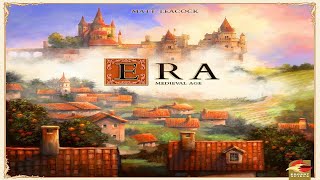
Era: Medieval Age serves as the spiritual successor to Roll Through The Ages. While Roll Through The Ages was a pioneer for roll-and-write-style games, Era is a pioneer for roll-and-build!
In Era, your dice represent different classes of medieval society as players attempt to build the most prosperous city. The "build" comes into play as players actually build their cities on their boards. You will use beautifully modeled three-dimensional components such as walls, keeps, farms, and other structures. By the end of the game, each player will have a unique city of their very own!
Era: Medieval Age is made even more challenging as players interact with each other in ways such as extortion, scorched earth, and, of course, disease! Hey, this is the Medieval Age, right? Speaking of which, Era serves as the first of a new series of standalone roll-and-build games from Matt Leacock and eggertspiele!



- Great sale price
Mechanics (from transcript analysis)
Video topics + discussion points
Quotes (from this video)
- hey board gamers I'm back from both BGG con and Pax with a little bit of a haul
- if you're more into wanting to sit down in a quiet space and game all weekend BGG con is for you if you're more so wanting to participate in talks and walking around the venue uh going to lines and tournaments and stuff then Pax is more for you
- for me I'm leaning more towards BGG con for next year although I'm not too sure if I'll do either because I'm just booked a trip to the UK Games Expo
- this one is by far my favorite game this year and I know I don't pick favorites very well I want to play this game over and over and over again
- those are the games I picked up I also got a new Kickstarter that came in today
- you know I love to take my pictures
- until then keep on playing games with James that sounded weird
References (from this video)
- Much better than Roll Through the Ages.
- Has a toy factor and looks neat when placing buildings.
- The theme is brought in much more than in similar games.
- The disasters are not very punishing.
- Laid-back and not high stress.
- The buildings dictate the type of dice you get, which have special abilities.
- The expansion makes the game more pleasing.
- The solo game with the expansion is nice and fun with scenarios.
- The teaching mechanism for roads and rivers is neat.
- The 'big game' with all collector sets is fun.
- Has a story-telling element when you build.
- Tactile buildings are better than drawing on paper.
- Good value for the amount of plastic.
- The dice have custom designs.
- The expansion significantly improves the game.
- Not much better than Roll Through the Ages.
- Extremely simple concept.
- Almost always maxing out on resources.
- Turn order determines who builds first.
- Can feel repetitive after a while.
- The game felt like it was getting up there in time.
- Wanted the game to end because of doing the same thing over and over.
- Once walls are closed, it feels like 'now what?'.
- Aesthetically pleasing builds can be ruined.
- Disasters could have been more punishing.
- Base game has limited options and can lead to analysis paralysis.
- Player interaction is very seldom and doesn't matter much.
- The espionage mechanic is basic.
- The base game felt limited.
- Not a lot of player interaction.
- Never felt personally challenged in what I wanted to get.
- Never felt a race to build something before someone else.
- Player interaction in espionage doesn't matter much.
- The way espionage is worded can be exploited.
- Doesn't need to be cutthroat for its atmosphere.
- Could use more depth, more options, more meaningful mechanics.
- The scorched earth mechanic could be more interactive.
- Attacking could be meaner.
- Base game felt a little bit long (almost an hour).
- The three-player count is perfect; four and five make it longer.
- Turn order can be an issue for players going last.
- Relying on the monastery for dice mitigation.
- No need for hospitals or science when you have god.
- The base game felt limited.
- Slightly lower rating than other players.
- Medieval
- Roll Through the Ages
- Bronze Age Roll Through the Ages
- Suburbia
- Tapestry
- Tiny Towns
- Cartographers
Mechanics (from transcript analysis)
- Area Control — Opponents lose an unwalled building. If it's walled in, you can't attack.
- Dice Rolling — You literally roll dice, and you're almost always maxing out on resources.
- Espionage — You roll three things, steal one resource, and if you refuse, you lose two.
- Resource Management — Almost always maxing out on resources.
- Roll and Build — This is a rolling build where you have tactile buildings.
- Set Collection — Buildings you get dictate the type of dice you get, and the dice have special abilities.
- Tile Placement — You're actually placing your buildings, your walls, and writing the stuff.
Video topics + discussion points
Quotes (from this video)
- It's extremely simple in its concept like you literally you roll dice.
- Almost always maxing out on resources so it's just kind of like turn order who's gonna kind of build literally almost anything that they want.
- This brings the theme into it so much more true because you're actually placing your buildings it looks neat it has a toy factor to it.
- I was kind of wanting the game to end because I was getting tired of doing the same thing over and over and over.
- The expansion adds more complexity and strategic depth.
- Player interaction is generally loose and not very impactful.
- It's not super expensive. I mean, you know, maybe it's pricier, of course, but it's not what you'd expect with all the plastic that comes in the game.
References (from this video)

- The 3D buildings are loved.
- Fits all expansions into one box with an insert.
- The box is a little bit bigger because of the 3D buildings.
- Trying to find collector's edition buildings can be difficult as people don't want to separate them.
- Building an age.
- Medieval age.
Mechanics (from transcript analysis)
- 3D buildings — Features 3D buildings.
- insert — Uses a 3D printed insert to fit all expansions in one box.
Video topics + discussion points
Quotes (from this video)
- These are games that I think actually are worth the space that they take up on the shelf because they are packed full of content.
- This is how you get views. Have dog.
- I know, yes, I know.
- Although I wish it came with a stain.
- Are you singing me the song of your people?
- My games only get played once, two, three times.
- Bo has decided he's had enough treats and his tail is destructive.
- Let me know down in the comments below which is your physically largest game that is taking up the most space but totally worth it.
References (from this video)

Mechanics (from transcript analysis)
Video topics + discussion points
Quotes (from this video)
- I have a really big problem with the status quo.
- I'm desperately looking for more colonialism themed games at least from the Western colonial eyes.
- Don't ruin the magic if you prefer not to but do you preset the first few turns of a playthrough so that you could better show the rules or is it all standard setup and you show the rules as they come?
- I pre stack cards like in terraforming Mars I made sure that there were cards in people's hands so that a greenery tile would go down a Sydney tile would go down an ocean would go down that every single little button could be pressed in that first generation.
References (from this video)
- city-building feel with big chunky components and online play via tabletop simulator
- parallel dice drafting and building phase create interesting strategic choices
- variety of buildings with different scoring patterns and abilities
- flow and pacing when playing online was enjoyable
- massive sheet of costs can be overwhelming at first
- dice corruption and penalties add complexity
- game can be space-intensive and the price point discussed
- dice-drafting and city-building with corruption mechanics
- medieval town-building
- Through the Ages
Mechanics (from transcript analysis)
- adjacency and corruption penalties — accumulated corruption symbols impose penalties on orthogonally adjacent buildings
- enclosure and scoring — walls enclose areas; fully enclosed areas score double points; some buildings generate ongoing benefits or food
- Resource Management — resources (food, stone, wood) are gained from dice and spent to place buildings on a shared sheet
- resource management and building placement — resources (food, stone, wood) are gained from dice and spent to place buildings on a shared sheet
- simultaneous phases with dice rolling behind screens — players roll dice behind screens, with up to two rerolls; dice have a corruption symbol that can constrain rerolls
- space management and supply limits — limited supply of plastic pieces; optimizing space and timing is crucial
- two-board balance between money and points — one side emphasizes money, the other emphasis on victory points
Video topics + discussion points
Quotes (from this video)
- I really like the flow of it.
- I really like the way this one works.
- I would definitely play this again in the future.
- not cheap to buy… MSRP is close to $100, it's an expensive game that takes up a decent amount of space on your shelf
- this is a pretty cute game
References (from this video)

Mechanics (from transcript analysis)
Video topics + discussion points
Quotes (from this video)
- i've never actually written a rubric before
- a board game is just a pile of bits and uh cards without rules so that's a very important part of this
- i am super excited to actually own a copy of this
- i spent a decent amount of money to get this copy because i wanted to cover it for the channel
References (from this video)

- Interactivity; brutal potential; dense scoring options
- Very interactive; quick to be destructive of others' progress; heavy rules
- Not retaining due to complexity and learning curve
- Roll-and-write + construction simulation
- Medieval era; European expansionist themes
- historically-tinged civilization-building
Mechanics (from transcript analysis)
- Roll-and-build / tile/worker-like management — Roll dice; build and manage a village; consume/produce goods; potential for disaster effects
Video topics + discussion points
Quotes (from this video)
- I'm going to go over right now the list of games that I've acquired in 2024
- I've decided to get rid of the bottom three
- it's sunk cost fallacy and I don't need to hold on to this
- the three I mentioned are Admirals, Rosio, Rap Gods
- this is one of those 'it's the wrong theme for today' moments
- I don't want to be gaslit into justifying my position in the comments
References (from this video)

Mechanics (from transcript analysis)
Video topics + discussion points
Quotes (from this video)
- I am such a data nerd
- I highly recommend you going out and buying the board game stats app
- the board game stats app is only $7.99 in the Canadian App Store
- It is so pretty
References (from this video)
Mechanics (from transcript analysis)
Video topics + discussion points
Quotes (from this video)
- Era Medieval Age is a dice driven city-building game in which players try to construct the best medieval village they can.
- The game comes with fully 3d plastic models representing the buildings with higher point scoring building standing taller above the others making the game a much more special gameplay experience than it could ever have been in cardboard.
- Most efficient way to build your village from a space perspective is to pack all the buildings tightly.
- Walls can be critical to point scoring as any buildings fully within a walled section of the village score double their base points.
- Noble dice to determine whether or not you're extorted, and you'll compare your final score against a table in the land.
- Culture is tracked on this track and there's a five-point bonus for having the most culture and a 10-point bonus for the largest walled area.
- Rule modifications for solo play using a dummy noble dice to determine extortion events.
References (from this video)
- 3D plastic building models add visual/tactile appeal and raise the game's perceived value
- dense village layout with walls provides defense-oriented strategy and spatial planning
- solo play option exists via a dummy noble dice variant
- varied buildings (e.g., markets, guild halls, universities, cathedrals) offer diverse scoring and bonuses
- culture track and culture bonuses provide additional strategic layers
- medieval city-building and defense
- medieval village
Mechanics (from transcript analysis)
- building construction from resources — Resources (wood, stone, and trade goods) are spent to construct buildings, with a maximum of one building per hammer icon rolled.
- culture track and tokens — Culture is tracked via tokens (book tokens) and yields bonuses; the game includes bonuses for leading culture and for the largest walled area.
- dice-driven population/resource management — Each round uses dice to represent population, with a Yahtzee-like roll revealing resources and actions; skulls cannot be re-rolled.
- disaster track and skull-based disasters — Rolling skulls advances a disaster track; certain skull counts trigger disasters that affect scoring and buildings.
- end-game trigger by building types — The game ends when a certain number of building types are removed from the supply, with the trigger depending on the play count.
- Engine Building: Triggered/Cascading — The game ends when a certain number of building types are removed from the supply, with the trigger depending on the play count.
- noble dice and extortion (solo and interaction) — Noble dice determine extortion opportunities; swords on dice enable extortion against opponents, with resource loss or points depending on responses.
- solo variant with dummy noble dice — Rule modifications for solo play use a dummy noble die to determine extortion events and compare final scores against a table.
- walls and defensive placement — Buildings are placed on the board, with walls enabling defensive play and affecting scoring when areas are fully enclosed.
Video topics + discussion points
Quotes (from this video)
- Era Medieval Age is a dice driven city-building game in which players try to construct the best medieval village they can.
- The game comes with fully 3d plastic models representing the buildings with higher point scoring building standing taller above the others making the game a much more special gameplay experience than it could ever have been in cardboard.
- Most efficient way to build your village from a space perspective is to pack all the buildings tightly.
- Walls can be critical to point scoring as any buildings fully within a walled section of the village score double their base points.
- Noble dice to determine whether or not you're extorted, and you'll compare your final score against a table in the land.
- Culture is tracked on this track and there's a five-point bonus for having the most culture and a 10-point bonus for the largest walled area.
- Rule modifications for solo play using a dummy noble dice to determine extortion events.
References (from this video)

- innovative use of dice as workers
- engaging build phase
- dice-as-workers in roll-and-write style
- medieval city-building and governance
- strategic, procedural
- Roll Through the Ages
Mechanics (from transcript analysis)
- city-building — place 3D components to develop the city
- Dice allocation — dice represent medieval societal classes and actions
- economic scoring — end scoring determines winner
Video topics + discussion points
Quotes (from this video)
- Kurios is a game of worker placement deduction and bluffing and it's simple and quick.
- Don't Get Got sounds like a game that I am definitely going to be subjecting a lot of my friends to frequently.
- Horrified includes high-quality sculpted miniatures of Frankenstein, the Bride of Frankenstein, the Wolfman and more.
References (from this video)

- medieval era with town-building elements
Mechanics (from transcript analysis)
- spatial/tetris-like placement — construction with blocks or polyomino-like components; spatial puzzle elements.
Video topics + discussion points
Quotes (from this video)
- I'm really into this now yeah so it's Catan but you know I had my top 50 games of all time list a long time ago a few months ago and I always kind of forget about cities and nights because I really loved that game.
- Catan star farers now this is the sort of a remake of star fares of Catan which is basically to be glib about at Catan in space but this carries with it a lot of the mechanics…
- it's basically that sort of more complex longer winded Catan that I really like but in space and I'm like super all into this now yeah so it's Catan but you know
- Combat Arena... it's set in the 40k universe and it's gonna deal a little bit more with the range combat
- Return to Dark Tower... I remember sitting in it and you know hitting the buttons and the stuff would talk and he'd move around the right moves
- Zombicide Green Horde I really enjoyed it I think it's a really good co-op idea
References (from this video)
- Deep, multi-dimensional scoring with walls and clusters creating strong strategic options
- Rich, thematic dice economy and upgradeable dice/wild dice (peasant dice, noble dice)
- Tension between clustering for bonus points and disease risk, which creates meaningful risk-reward choices
- Lots of room for player-driven strategy, including walling for doubling points
- Heavy setup and long, complex rounds that can be intimidating
- Potential for analysis paralysis with many placements and track interactions
- Balance can lean toward walling strategies that may overshadow other builds in some games
- Relies on accurate interpretation of rules; the tutorial itself is lengthy
- medieval fortress construction, resource management, and treachery/disaster balance
- medieval fantasy-era domain-building with fortifications and invasions
- instructional tutorial with live-play demonstration
- Era Medieval Age
Mechanics (from transcript analysis)
- building placement and walling — Players place buildings and walls in their domains; proximity to walls/adjacency affects scoring and disaster penalties; walls double VP for enclosed areas.
- dice-rolling and dice-drafting — Players roll multiple dice per round, with optional re-rolls guided by special rules (feathers) and skull outcomes affecting disasters.
- endgame scoring and track-based scoring — Endgame scoring considers multiple tracks (culture, disaster, points from buildings, wall area, and special buildings) with multipliers for enclosing and clustering.
- extortion and treachery disasters — Disaster steps introduce treachery and brigands threatening to remove or penalize buildings, with extortion mechanics to seize resources.
- resource management and feeding — Resources (wood, stone, food, trade goods) are gained from dice results and buildings, and must be spent to feed dice or risk disaster points.
Video topics + discussion points
Quotes (from this video)
- This is a dice game where in each round players are going to simultaneously roll their dice behind their shields
- every building fully surrounded by walls will have its victory points doubled
- extort in player order so we are going to start this off
- treachery and brigands will activate and place scorch tokens into unwalled areas
- you can construct up to one building or wall in this case we have three hammers