




Get on Board: Paris & Roma Deep Dive
What the Community Thinks About Get on Board: Paris & Roma
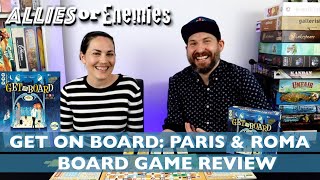
Reviewers generally treat Get on Board: Paris & Roma as an upgrade to the first game in the series rather than a straight sequel. Allies or Enemies describes it as closer to a remake, where the designer kept the core route-drawing loop of Get on Board: London and New York, fixed the problems players had noticed, and added new cities. The change reviewers keep coming back to is how the game handles other players. The earlier title penalized players who stepped onto someone else's bus line, while this one rewards players who follow a route someone else has already drawn. That single shift is enough for Allies or Enemies to prefer this version.
Meeple University reaches a similar conclusion from a full playthrough, contrasting the bus routes of the earlier game, where congestion lowers scores, with metro routes where linking to an existing line lets you cross off extra steps on your own sheet. kovray says the second entry works out a lot better than the first in their opinion.
Opinions are not uniform. Allies or Enemies calls the shared board contentious and admits to being on the fence, while Meeple University clearly enjoys the session despite a few frustrations with the map. Board Gaymes James is letting the copy go and says the original bus-route design is the one they want on the shelf. Board Gaming Ramblings had only heard great things about the game before receiving their review copy. Overall the community sees a polished, approachable title that improves on the earlier design while asking players to accept a shared board that not everyone wants.
Core Mechanics That Define Get on Board: Paris & Roma
Variable Setup by Player
Setup is where the game starts to feel different from one session to the next. Each player is randomly assigned a home station and a personal objective, and common objectives are placed on the board. Meeple University draws two ticket cards and picks a starting space from the numbered locations, with one side of the board offering far fewer starting spaces than the other. The first ticket drawn also decides which of the pre-existing burgundy or yellow routes are already filled, so every player sees a slightly different map on turn one. Allies or Enemies adds that the personal sheets differ in their ticket values, so players can be chasing different numbers on the same ticket.
Route Building and Crossing Off Passengers on a Shared Map
Each turn a ticket dictates how many track segments you draw and whether they bend or run straight, and you must extend a single continuous route. Meeple University highlights the rules that make this tense: you cannot branch, you cannot return to your starting station, and you cannot visit the same junction twice, so a route can box you into a corner. As your route reaches icons, you cross off matching spaces on your sheet. Grannies add points that grow with each one collected, students are multiplied against cinemas, tourists score by row, and flirts score when you reach restaurants. Allies or Enemies notes that the flirts replaced the businessmen from the first game and says the new name is simply more fun. Metros can be saved for two points each at game end or spent to extend a route. Allies or Enemies also identifies the shared map as what sets the game apart, since everyone draws on the same board and can build off each other's lines.
The Get on Board: Paris & Roma Experience
Social Despite Being a Solo Puzzle
The genre usually means heads-down silence, but reviewers describe this one as chatty. Allies or Enemies says that because the board is shared, the table can talk while playing, and they call it more social than many silent roll-and-writes. They contrast it with Hadrian's Wall, a game they play for an hour without a word. Meeple University's session is full of table talk about following each other's lines and getting boxed in, with players calling out moves and teasing one another about whose route is blocking whose. The result is a flip-and-write that still runs on individual sheets but feels like a group project on a single map.
Tight Route Puzzles That Reward Planning
The satisfying part comes from the constraints. Meeple University repeatedly gets boxed into corners, has to spend a metro to bend a route, or realizes a planned path would cross their own line, and they describe those moments as risky turns that force a rethink. Kovray highlights the tight decision making as a core strength, noting that the different passengers and scoring methods keep each choice interesting. Meeple University's final tally was close enough that a few points decided the winner, which underlines how much small choices matter at the end.
What Makes Get on Board: Paris & Roma Stand Out
Positive Rewards for Following Other Players
Allies or Enemies singles out the flip from negative to positive interaction as the reason to prefer this entry. In the earlier game, stepping onto someone else's line cost points, so players tried to trap rivals behind them. Here the trap is reversed, and players try to land ahead of rivals so they can ride a route someone else has already built. Allies or Enemies describes it as the same kind of interaction with a better reward, turning a penalty into a bonus. The metro mechanic adds another layer, since saving a metro for end-game points or spending it to extend a route is a real decision.
Thematic Components and Table Presence
Kovray praises the production as one of the most perfect balances of physical components in the genre. They argue that tickets and a proper board give the game a presence on the table that pen-and-paper roll-and-writes often lack. The tickets are a highlight, and the fact that players tear them rather than punch them is something kovray calls a clever thematic choice. Allies or Enemies agrees that the Metro tickets are wonderful and that the art is lovely, especially the flirts, who come in a wide mix of couples. They also praise the wooden Metro pieces and the way the board fills with routes over the session, which makes the map feel like a city being built.
Potential Drawbacks
Turn Order Can Stretch Waits at Four Players
Allies or Enemies flags turn order as the main friction. Because each route depends on the routes already drawn, the game cannot run simultaneously the way some flip-and-writes do, and at four players a round can leave a player waiting a long time for their next turn. The reviewers note that turns are quick and the game still fits in roughly thirty minutes at most, so the wait is noticeable rather than fatal. The map choice adds a related complication: the Paris side is set for four to five players and the Rome side for one to three. A two-player group that wants the Paris artwork has to play the Rome side instead, and Allies or Enemies says they appreciate the design logic but are still torn about it.
Iconography That Can Confuse Players
Allies or Enemies raises icon problems that catch players off guard. The restaurant tiles look like hotels, which led the reviewer to ask why the group is visiting a hotel rather than a restaurant. The student objective points to a music show in a building labeled as a cinema, which the rulebook describes differently, and the reviewers find the mismatch strange. The flirt rule also trips players up: crossing off a restaurant clears the rest of that line, and a new line must be started. Allies or Enemies says the rule is mostly intuitive once learned, but suggests a musician icon would have been clearer than a show. Meeple University also needed a moment to sort out the restaurant rule and the penalty for leaving a row unclosed.
If You Enjoy Get on Board: Paris & Roma
For players coming from the earlier title, Get on Board: London and New York is the route-building version this game builds on. Allies or Enemies points to Next Station London and Next Station Tokyo as lovely train-line games, and kovray describes Next Station Tokyo as a bit more puzzly than its predecessor. Allies or Enemies suggests Metro X for players who like putting pieces on a board and writing points off to the side. They also mention Boomerang Australia as a fun travel-themed flip-and-write and say they are eager to try On Tour. Players who want more interaction than Welcome To... offers may find this entry a comfortable step up.
What Reviewers Are Saying
"If you are choosing between this and New York and London, I think it's a no-brainer. I think this does a lot of the same things but better."
— Allies or Enemies
"One of the pleasing aspects of this game for me is how it creates these Metro routes. I like looking at Metro train maps."
— Meeple University
"Sometimes I feel a roll-and-write is very much pen and paper and it almost loses some of the magic, but here you get a nice thematic tickets and a nice board."
— kovray