















Great Plains Deep Dive
What the Community Thinks About Great Plains
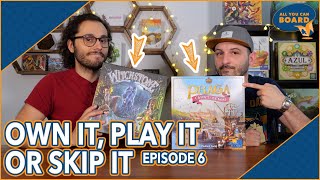
Reviewers who discuss Great Plains treat it as a two-player game that delivers far more decisions than its short box suggests. The All You Can Board channel, hosted by Carlo and Dylan, is the most enthusiastic voice. Carlo named it their number one game of 2021, and Dylan called it one of their biggest surprises of that year. Both describe a design that is easy to overlook because the box art does not reveal much about the gameplay. Designed by Trevor Benjamin and Brett J. Gilbert and published by Lookout Games, the game sits in the same two-player line as Mandala, and reviewers often place it alongside older area control favorites.
The dissent is narrower but clear. Chairman of the Board sold their copy as part of a collection cleanup, not because they disliked how it played, but because a clean, abstract design sat too close to other two-player games they preferred. Quackalope, a shop-visit channel from Cleveland, bought the game on a store recommendation and described it as a possible hidden gem, a sign that word of mouth is doing much of the work in spreading the title. The consensus is that Great Plains rewards repeat play, and that a few plays are needed before its depth becomes clear.
Core Mechanics That Define Great Plains
Area Control
Area control is the scoring engine of Great Plains. The shared map contains meadows, and at the end of the game each meadow is scored by whichever player has the most pieces in it. Carlo describes the scoring as deliberately simple: the player with the majority takes the full value, and nothing else is needed to explain it. The tension comes from the setup. Because the board is built from seven double-sided hexagonal tiles and each player places three cave tokens before play begins, the value of each meadow is different in every game. Dylan explained that one early game turned on a single meadow worth ten points that both players fought over for a long time, while another game had many small meadows that each mattered a little. Reviewers see that variation as the main reason the scoring never feels stale.
Network and Route Building
Pieces in Great Plains must start adjacent to one of a player's caves or to a piece already on the map, so every placement extends a growing web of positions across the board. Carlo points out that this creates a branching structure: players spread outward toward the meadows they want while blocking the paths their opponents need. Animal tokens add a second layer to the route system. A horse lets a piece move two spaces, an eagle lets it fly over mountains, and a bear lets it push an opponent's piece off the map or into a mountain. Carlo and Dylan both note that taking an animal token early can deny the opponent a power for the rest of the game, so route decisions are never purely about the shortest path.
The Great Plains Experience
Quick and Snappy
Reviewers describe Great Plains as a game that moves at a fast clip. Carlo says the turns are lightning quick and that the rules fit on a few pages, so a table can go from unboxing to a first game in roughly twenty minutes. Several reviewers mention playing best-of-three or best-of-five sessions in a single sitting, which Carlo says makes it a natural choice for a cabin weekend. The pace does not feel rushed, though. Because each turn is short, every placement carries weight, and the experience is closer to a tight puzzle than to a filler game. Carlo notes that one of the most satisfying things about the design is how quickly it gets to the table without sacrificing thinking time.
Interactive and Dynamic
Great Plains keeps both players engaged throughout. Because every placement changes the options available to the opponent, reviewers describe a constant back and forth. Dylan says the best moments come when a piece they placed for one reason suddenly becomes a block for their opponent's route, and Carlo describes a similar feeling when committing to a cave position that gives the opponent an easier path to the big meadow. Quackalope highlights the same dynamic when describing the game's appeal to players who like direct contest without elaborate rules.
What Makes Great Plains Stand Out
A Variable Setup That Changes Every Game
The most frequently praised feature is the randomized map. Carlo argues that a fixed board would defeat the purpose, because part of the fun is studying the layout, deciding where the caves should go, and figuring out which meadow is worth fighting for. Carlo also points out that the layout forces players to weigh the value of nearby meadows against meadows on the far side of the map that an opponent could claim more easily. This is a design choice that many reviewers say keeps the game fresh long after the first few sessions.
Restraint in the Rules
Carlo praises Lookout for resisting the temptation to add extra complexity. Carlo notes that the team could have added asymmetric powers, extra abilities, or variants for three and four players, and that each addition would have made the game heavier without making it better. Instead, the three animal powers are enough to create real choices. Carlo describes the rulebook as clear and easy to follow, and says that after reading it once, they were ready to play with little need to look anything up. For many reviewers, that clean rule set is what allows the decision space to stand on its own.
Potential Drawbacks
Randomized Setups Can Feel Uneven
Dylan raised a fair concern after the first game: when one large meadow dominated the scoring, the rest of the board felt like an afterthought, and Dylan wondered whether that outcome would become common. Carlo and Dylan both reported that later games produced more varied scoring, and they saw the randomness as part of the design. Still, the concern is a real one for players who want every game to feel balanced, and it is a reason some reviewers suggest playing a few games before judging the design.
Presentation and the Abstract Style
Great Plains is an abstract game, and reviewers acknowledge that its presentation is not its strongest asset. Dylan notes that the box art does not tell players what the game is about, and that abstract games often look somewhat drab before they are played. Chairman of the Board admits liking the design, describing it as quite head-to-head and very clean in its approach, while still preferring other two-player games in the same space. For players who need a strong theme or striking artwork to commit to a game, Great Plains may take more persuasion than its gameplay deserves.
If You Enjoy Great Plains
Players who enjoy Great Plains's area majority scoring will find a similar satisfaction in Babylonia, which also rewards careful control of contested spaces. Carlo draws the closest comparison to Blue Lagoon and Fjords, noting that Great Plains shares their two-phase structure, where the board is set up first and players then branch out from their starting positions. Chairman of the Board pairs Great Plains with Kingslike, another clean design that keeps the rules out of the way so that the decisions carry the experience. Players who enjoy the tight, mirrored tension of two-player pieces on a shared board will also recognize the spirit of Go, where every placement changes what the opponent can do next.
What Reviewers Are Saying
"When they're able to say no, the game is perfect as is, it doesn't need any more bells and whistles. The rules get out of the way and all the decision space is just there for you to explore."
— All You Can Board
"It was quite head-to-head, it was quite abstract in its approach and I did like it. I thought it was a nice, smooth design, very clean in its approach."
— Chairman of the Board
"He said that it's kind of flown under the radar but everyone that he showed it to has really loved it."
— Quackalope