/pic8442294.jpg)
Miskatonic Tales: Journey to Innsmouth is an immersive, storytelling board game that transports you into the realm of Cthulhu Mythos and confronts you with forbidden knowledge waiting impatiently to be uncovered. Unsure of who your actual enemy is, you must investigate a chain of events in a mysterious place fate has brought you to. Fortunately, other Investigators are with you and together you can solve this case.
Miskatonic Tales: Journey to Innsmouth is set in the universe known from the award-winning Call of Cthulhu horror and mystery TTRPG. The box contains three stand-alone sandbox adventures that can be played separately, yet share one large story arc. This cooperative game does not have a strict turn order, but emphasizes solving the case together as a group. Every move you make while exploring the map is accompanied by a paragraph from the book that reveals yet another piece of your story. Each time you play, the story can be different, and trying to solve the scenario several times eventually reveals the full picture.
Combining strategy, storytelling, and cooperation, the game offers an engaging experience where choices matter, teamwork is crucial, and the story's path is as unpredictable as it is thrilling.
Learn more about the Mythos by taking part in intriguing adventures. What role will you play in the story? Investigate the clues. Uncover the truth. Explore the story.


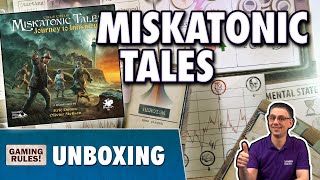
- Well-packaged
- Narrative-heavy with story taking center stage
- Creates your own story together
- Consequential decisions
- Characters may perish or lose sanity
- Replayable
- Includes a save system
- Immersive audio app included
- Not too big or complicated rule book
- Variety of characters
- Production delays for related game
- Initial sound issues during stream
- Unboxing contents might differ from retail version (e.g., ziploc bags instead of punchboard)
- Potential for spoilers if not careful
- Cthulhu
- Seaside resort of Innsmouth
- Horror on the Orient Express
Mechanics (from transcript analysis)
- Card Play — Players use cards like agility, appearance, and power cards to perform actions. Stress cards are drawn which have negative effects.
- Character Sheets — Character sheets are used to track health and sanity, and players start with specific cards.
- cooperative play — The game is described as 'cooperative'.
- Dice — The game includes dice.
- Event Board — An event board is included for each scenario.
- Narrative Story — The game includes a narrative story with three chapters.
- Save system — The game includes a save system to record progress and pick up playing later.
- scenario-based — The game comes with three scenarios, and the first playthrough will cover the start of the first scenario.
Video topics + discussion points
Quotes (from this video)
- This might be the most well packaged game that I have ever been sent.
- Experience a thrilling adventure where the story takes center stage. There are no traditional victory or defeat conditions.
- Instead, every decision, every discovery, and every sacrifice contributes to the narrative you create together.
- Some characters may perish. Others may lose their sanity. and still others might uncover horrifying truths about a world far stranger than anyone could imagine.
References (from this video)
- Can represent the Call of Cthulhu RPG experience for those without a DM.
- Includes exploration and character 'going crazy' elements.
- Later scenarios vary gameplay with overland maps.
- Cooperative card play can work well for groups.
- Time pressure element is generally good for this type of game.
- Major issues for true solo play due to movement hassle.
- Tons of errata and stickers, not ideal for a clean experience.
- Rulebook is vague and under-explained, leading to confusion.
- 95% of exploration is vague, unimportant nothingness.
- Extremely repetitive and dull exploration can feel like grinding.
- The red die in skill tests is frustratingly swingy and cannot be re-rolled.
- Removing negative cards from the deck is too punishing and difficult.
- Narrative is repetitive and not exciting, even when not drudgery.
- Scenarios don't connect well, feeling cobbled together.
- Innsmouth theme is overdone and not presented in an interesting or new way.
- Combat is uninspiring and worse than regular skill tests.
- Lots of swinginess in dice rolls and card draws.
- Does not respect player time due to slow pace and tedium.
- Very little replayability.
- Many better games do similar things more effectively.
- Call of Cthulhu adventures
- Innsmouth
- Mansions of Madness second edition
- Seventh Continent
- Seventh Citadel
- Arkham Horror: The Card Game
- Call of Cthulhu role-playing game
Mechanics (from transcript analysis)
- Card-driven actions — Players generally draw five cards that become their actions for the turn, with the option to play cards from hand to assist other players.
- Deck building (negative cards) — Injury and stress cards are added to the deck, which can cause damage or character defeat if too many are drawn, adding a push-your-luck element.
- exploration — Players move standees to explore locations, which trigger passages in an adventure book describing encounters and tests.
- Skill Tests — Tests require playing specific cards or adjacent attribute cards, with a dice roll component involving red dice (with negative outcomes) and white dice (affected by skills).
- time tracker — A time tracker advances, triggering events and potentially leading to an auto-loss if the end is reached, providing a time pressure element.
Video topics + discussion points
Quotes (from this video)
- And I think this game has major, major issues.
- 95% of what you're going to explore is vague, unimportant nothingness.
- It just gets very, very repetitive, and very, very dull. It feels like grinding through exploration is easiest way I can describe it.
- If you want a game that respects your time, I don't know if that's really the case here, cuz it really does feel like drudgery.
References (from this video)
- appealing Lovecraftian/narrative setup
- choices matter mechanic could create replayability
- campaign/scenario flexibility
- world familiarity may affect initial enthusiasm
- cooperative horror with narrative-driven exploration
- Cthulhu Mythos-inspired investigative horror in a cinematic universe
- sandboxy scenarios with campaign potential
- Arkham Horror: The Card Game
Mechanics (from transcript analysis)
- choices matter — narrative outcomes change based on player decisions
- Cooperative Game — players work together to solve cases and explore clues
- cooperative play — players work together to solve cases and explore clues
- Narrative Choice — narrative outcomes change based on player decisions
- standalone sandbox scenarios — three scenarios that can be played individually or as a campaign
Video topics + discussion points
Quotes (from this video)
- I love the theme.
- it looks beautiful on the table
- interrelationships within a complex ecosystem
- You're going to be doing exactly what you expect. You're going to be traveling around on a grid of cards.
- Become the most seasoned wanderer with sleeves full of the best stories, the star of every campfire gathering.
- Deckers is a re-implementation of Renegade.
References (from this video)
- Rich, immersive writing that evokes Lovecraftian atmosphere and kinship with Arkham Horror-style mythos.
- An innovative card-based attribute system that adds meaningful choice and tension compared to fixed stat dice games.
- Solid support for solo and cooperative play with companion sheets for easier 1-4 player gameplay.
- Practical save and organization features that help with longer campaigns and multi-session play.
- Replay potential through branching endings and item-driven variations.
- Rulebook quality and clarity issues in the first printing, requiring Errata and FAQ for proper play.
- Need for external resources (Arata/FAQ) to avoid misinterpretations and to fix missing references.
- Lengthy, verbose narrative sections that can slow play and create dead ends in some paragraphs.
- Encounter design can feel repetitive in places, with limited variability in certain sequences.
- First printing had missing text and references, potentially breaking play until fixed in later printings.
- Investigation, survival, madness, cosmic horror
- Lovecraftian investigative narrative set in Innsmouth and surrounding environs, in a sleepy New England coastal town with deep cosmic horror undertones.
- Choose-your-own-adventure style narrative with branching paragraphs and a scenario book
- Mansions of Madness
- Arkham Horror LCG
- Orient Express
Mechanics (from transcript analysis)
- Card-based attribute system — Attributes are represented by cards drawn from a face-down deck each round. You may draw up to five cards, choosing to stop or continue. Cards can grant auto-success, provide modifiers for tests, or trigger narrative events.
- Deck cycling and hand management — At the start of each round, your played, discarded, and in-hand cards are shuffled back into your deck, creating a dynamic pool where previously unseen cards can appear later and tests become less deterministic.
- Dice Rolling — Tests roll a red die with mixed outcomes. Playing a card matching the test type can grant auto-success; cards can also add white or other modifiers to the pool. Symbols on cards can trigger events and progress the story.
- Event board and escalation tokens — An event board tracks a timer and accumulates elder signs, skulls, and tentacle tokens. Failing to manage the track can escalate difficulty and trigger adverse effects.
- Events — An event board tracks a timer and accumulates elder signs, skulls, and tentacle tokens. Failing to manage the track can escalate difficulty and trigger adverse effects.
- Keywords and narrative progression — Progression occurs via keywords that unlock new narrative branches and endings. Keywords are tracked on a sheet and discovered through exploration and story events.
- Map grid locations and location-based actions — Locations are laid out on a grid. Players move around, interact with objects, and perform actions described in the scenario book, sometimes consuming actions from cards to perform tasks.
- Skill tests with red dice — Tests roll a red die with mixed outcomes. Playing a card matching the test type can grant auto-success; cards can also add white or other modifiers to the pool. Symbols on cards can trigger events and progress the story.
Video topics + discussion points
Quotes (from this video)
- There are key parts of the narrative here that are missing from the book or not very well explained or missing entirely from the text that can potentially break your game.
- If you can get through that, you are treated to some well-written narrative.
- This is not the most complicated game in the world, and the same can't be said about the rules.
- I give this one a good solid 8 out of 10.