






Paper World Deep Dive
What the Community Thinks About Paper World
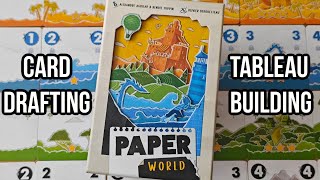
Paper World has earned appreciation from board game reviewers as a clever, cozy filler that works equally well for casual players and experienced gamers. The Dice Tower's Z Garcia notes its appeal is immediate but warns the gameplay doesn't deliver as much depth as the striking 3D box art suggests. TheGameBoyGeek praises it as simple yet nuanced, recommending it for both casual neighborhoods and dedicated gaming groups. Rahdo Runs Through's Jen loved it, and the channel's reviewers consistently describe it as sharp, smart, and fun, with just enough structure to keep everyone engaged. The consensus leans positive, though reviewers acknowledge it occupies a specific niche: a quick, accessible card game without pretensions to heavy strategy.
Core Mechanics That Define Paper World
Set Collection
Paper World's most distinctive mechanism revolves around constraint-driven set collection. On your turn, you either take cards or play them, but with a critical restriction: you must take or play all cards of a single color or all cards of a single number. This creates sharp decision points. As TheGameBoyGeek explains, when you're taking cards, "the twist of what you can take does lend itself to great decisions of what should I take. Should I take these two twos that I really need that are different colors, or do I just take all the oranges which gives me three cards which are already sequential?" This push-and-pull mirrors the tension of two-player games like Jaipur, where revealing new options to your opponents carries strategic weight.
Compound Scoring
Your final score combines multiple sources: stars earned from cards you play (structured so higher numbers yield more points), bonuses from completing objectives unique to each game, special tokens like the scissors, and penalties for discarded cards. Z Garcia notes the scoring feels "squished," with final scores often separated by just a few points, which can make high-value cards feel too essential and lower-value plays feel inconsequential. Yet this constraint is by design; it keeps everyone tense throughout, since there are always fewer fives than players, and completing end-game objectives becomes a genuine race.
The Paper World Experience
Cozy, Quick, and Conversational
Paper World is designed to move briskly. Games typically finish in 20 to 30 minutes, and the simplicity of turn structure lets players converse freely without worrying about complex rules. TheGameBoyGeek calls it "really clever and cozy little filler game," and Rahdo describes the experience as "a fast, fast, fun little game with tough decisions from start to finish." The game rewards both casual play and deliberate strategy; you can participate in breezy table talk or lean hard into tracking probabilities and opponent strategies.
Tense Endgame with Scarce Resources
As the five card stacks diminish and endgame approaches, the game accelerates. Players hold limited cards in hand (maximum nine), and hand size becomes critical. TheGameBoyGeek highlights this: "The game is tense because there's one less five, which is the most points, than the players. And it's like so it there's a tenseness to this game cuz you're trying to do all these different things. You can't do everything." The scarcity of high-value cards means players must commit to their strategies early, yet the final rounds can still shift outcomes dramatically.
What Makes Paper World Stand Out
The Scissors Token Mechanism
The scissors token is Paper World's most tactile innovation. Normally, skipping a number in your play sequence costs you a card discard, which penalizes you one victory point. The player holding the scissors token can skip once per turn for free. This creates interesting drama: the token rewards aggressive play but locks that stack from being built upon further, forcing players to weigh the benefit of free movement against board positioning. Z Garcia notes it as "a clever idea," and TheGameBoyGeek explains the subtlety: "You don't have to take it. Since saying like the game is very simple, but there's all these like little nuances that over time... the little nuances in the scissors, the little nuances in the goals, the little nuances in... how I'm building things and when I'm building things and how fast I build these things and do I skip."
Variable Objectives That Shift Strategy Each Game
Three randomly selected objective cards change your 3x3 grid's scoring landscape every game. One game might reward having all four corners match in value; another might require a diagonal line of one color. Rahdo notes this keeps play fresh: "Three objective cards each game that represent how we are trying to build our grid that we want like all the same color in one column or we need to have all the same number in the corners or whatever it might be. Everybody can see those. Everybody is both doing two things: trying to have all their nine spaces with the highest value number possible because the higher the stack, the more complete the picture, the more points you get, but also can I build to be the one to snag those objective cards before somebody else does."
Potential Drawbacks
Theme and Visual Storytelling Feel Disconnected
The box promises layered paper art projects (hence "Paper World"), but the actual gameplay is abstract. Cards simply stack in sequence from one to five; there is no visual revelation of a layered illustration beneath. Z Garcia expresses this disappointment directly: "I wonder how many folks are going to be disappointed when they discover that even though the game on the back describes it as you basically stacking up paper, that you're not really doing that. You are putting a card on top of another card and there is no actual transparencies. Everything, of course, is a new illustration with those pieces stacked." Rahdo echoes the sentiment: "The theme of building paper projects, you know, art projects where you take paper, you cut it up, and then you layer paper on top of paper on paper to make lovely pieces of art... that's the theme. And essentially, that's what we're doing, but not really because it's not like this game has transparent cards... I you know, okay, that's the theme. And essentially, that's what we're doing, but not really... this is very much an abstract um, card grafting and card playing game."
Game Can End Suddenly, and Memory Elements Can Shift Strategy
Paper World's speed is both feature and bug. The game ends when only two card stacks remain, and everyone gets one final turn. This sudden conclusion can feel abrupt; TheGameBoyGeek notes: "The game almost feels too quick. I would much rather a game end too soon than too late. This game, oh my gosh, it gets to the end fast. Oh my gosh, there's only two piles left now. Oh my gosh, the game's going to end. We only got one turn left." Additionally, players must track which cards have been played and where they were discarded, creating a memory element that some players find unnecessarily taxing. TheGameBoyGeek prefers playing with cards face down to avoid unintended information leakage.
If You Enjoy Paper World
If Paper World clicks for you, Z Garcia recommends Castle Combo as a spiritual successor, noting it "ticks every box a little more strongly" in a similar 3x3 grid space. For lighter card games with similar turn tension, Jaipur offers a two-player push-and-pull where your card choice affects your opponent's options. Fans of the Welcome To series (and Paper World co-designer Benoa Turpin's work) will appreciate the objective-driven puzzle feel, though Paper World resolves much faster. Machi Koro 2 and Uno share the "take all cards of one type" constraint in different contexts. Those seeking cozy, quick card games without heavy rules should explore Tokaido or the original Welcome To Las Vegas, which share the minimalist-but-tight design philosophy.
What Reviewers Are Saying
"It has a little bit of a feeling of Jaipur in that sense. Uh very well-known two-player card game in which you want to be careful that the new flop, so to speak, isn't a bunch of new information for your opponents."
— The Dice Tower
"Simple turns, but good decisions. Simple. Take cards or play cards. Uh, but there's some nuances there. The game is tense because there's one less five, which is the most points, than the players."
— TheGameBoyGeek
"It's sharp, it's smart, it's fun, and my wife loved it. I liked it. And I can say I would have loved it if... they could have gotten a theme that just brought it together a little bit more. But still, I would be happy anytime, anywhere to play this game."
— Rahdo Runs Through