
Game Info
Year
2025
Players
2-4
Playtime
60 min
Collection
Your Tier
Loading…
Mechanic profile
Not enough video data yet
Vibe profile
Not enough video data yet
Description
A competitive deck builder in which asymmetric frog factions vie to control ponds and recruit legendary frogs for victory points
Featured Videos
Review

Pond - TCbH Review
Rules Teach

Pond - Teach & Playthrough
Ask a Rules Question
All mentions
Browse transcript mentions, sentiments, pros/cons, mechanics, topics, quotes, and references.
Total mentions: 2
This page: 2
Sentiment:
pos 2 ·
mix 0 ·
neu 0 ·
neg 0
Showing 1–2 of 2
Video 1lbU5sUh81I
The Cardboard Herald Review at 0:00 sentiment: positive
video_pk 111081 · mention_pk 319542
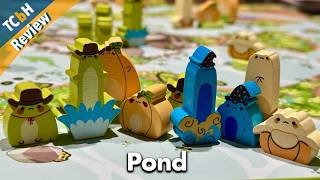
Click to watch at 0:00 · YouTube ↗
Overall sentiment (raw)
positive
Pros
- Energetic and easy to table combative
- Embraces its poppiness and identity
- Smart deck-thinning system with hero frogs
- Takes the sting out of 'take that' gaming
- Vibrant and fun table presence
- Appeals to both hardcore gamers and family
Cons
- Small symbols on cards are hard to distinguish
- Some players might not like the 'baby goo goo ga ga' speak/theme
- Wizard frogs might be too powerful due to card draw ability
- Not a game of grand strategic depth
Thematic elements
- cute forest critters vying for control and points
- wilderness
Comparison games
- Root
Mechanics (from transcript analysis)
- Area Control — combative area control games
- deck-building — the cards in your hand, and by proxy the cards in your deck, are what drives all of your action capabilities
- Dice Rolling (combat) — roll dice equal to your units there, up to three, then assign damage to other players present based on results.
- Hero Frogs (Permanent abilities) — your hibernated cards actually become a currency to buy hero frogs, unique frogs that instead of going into your deck, sit on top of your paid hibernated frogs and give you permanent passive abilities.
- Hibernation (Deck thinning) — every time you have to shuffle because your deck is out of cards to draw, you have to mandatory hibernate one card from your play area or your discard pile of your choice, permanently removing it from the game
- Point generation (Lily pads) — one bonus point for each lily pad you occupy, whether you control the location that lily pad resides in or not.
- Take That — You get points for each damage you do to the enemy's long frog.
Video topics + discussion points
No key topics recorded for this video.
Quotes (from this video)
- I think because of how disposable the frogs are and how valuable it is to both have your own and beat up other long frogs, it encourages expansion and getting in the thick of it in ways that combative games often turtle.
- Pond is an absolute hit and one of my favorite games that I've covered so far this year.
References (from this video)
No references stored for this video.
Video CgwDktOAghE
Before You Play Rules Teach at 0:05 sentiment: positive
video_pk 80085 · mention_pk 304832

Click to watch at 0:05 · YouTube ↗
Overall sentiment (raw)
positive
Pros
- Unique frog factions with asymmetric abilities and cards.
- Engaging deck-building and area control mechanics.
- Direct player interaction through attacks and dice rolling.
- Variety of cards and hero frogs add strategic depth.
- Appealing art style and component quality (deluxified version mentioned).
Cons
- Game can feel aggressive in a two-player count.
- Hibernating cards can feel like a necessary but sometimes detrimental part of the game.
- Player might miss out on point-scoring opportunities if not careful with berry management.
Thematic elements
- commanding unique frog factions
Comparison games
none
Mechanics (from transcript analysis)
- action selection — On their turn, players can perform multiple actions such as playing cards, purchasing cards, or recruiting hero frogs, with flexibility in order and repetition.
- Area Control — Players aim to control ponds and lily pads by having the most frog pieces in a location to score victory points.
- Deck Building — Players start with a small deck and purchase cards from a central market to add to their deck, improving their capabilities over the course of the game.
- Dice rolling combat — Attacks are resolved by rolling dice, with different faces (swords, bombs, misses) determining the outcome and potential damage to players and their frogs.
- Hand Management — Players play cards from their hand each turn, and any unplayed cards are discarded at the end of the turn, requiring careful planning of card usage.
- Set Collection (for Hero Recruitment) — Hero cards are recruited by spending hibernated cards, requiring players to collect a specific number of these cards.
- Variable player powers — Each player commands a unique frog faction with asymmetric abilities and unique starting cards, offering different strategic options.
Video topics + discussion points
No key topics recorded for this video.
Quotes (from this video)
- Players are going to be commanding unique frog factions.
- Ultimate goal is to control the various pawns and of course sit on top of the lily pads that are in those ponds so that we can score the most amount of points.
- This is a deck building and area control game for two to four players that plays in about 30 to 60 minutes.
- Players will be playing cards from their hands, purchasing additional ones and taking actions such as marching around the board and attacking other players in order to control these pawns and lily pads.
- Because at the end of your turn, you'll score one victory point for each pond you control and for each lily pad you occupy.
- Players gain victory points for attacking them [long fogs].
References (from this video)
No references stored for this video.
Transcript Navigation
Showing 1–2 of 2