/pic2583214.jpg)
The theaters of London are abuzz. In one week, her majesty the Queen will attend their new shows and will grant her support to one of the troupes. It's the chance of a lifetime for the young authors who are inflaming the populace with ever more audacious and motley plays. But how do you create a masterpiece in such a short time? Whoever has the answer to this thorny question will probably enter the rolls of history!
In Shakespeare, players are theater managers who must recruit actors, craftsmen, jewelers and others in order to assemble everything needed for the play's performance at week's end.
In more detail, the game lasts six days and on each day players recruit one new character — starting with five at the beginning of the game: four identical ones on their individual player board and one that they've drafted — and take 1-5 actions with the characters they have. Characters and their actions are:
Actors: Rehearse one or more acts in the three-act play; the more you rehearse, the more benefits you receive during the dress rehearsals on days four and six.
Costume mistress: Take costume elements to enhance your actors; if they lack a complete costume, they can't participate in the dress rehearsals.
Set dresser: Build the set. The more elaborate the set you build, the more rewards you receive — but the set must be symmetrical!
Handyman: Set them to work on whatever you need. These joes can assemble both costumes and sets, but they're not very good at it.
Assistant: Increase the power of your craftsmen, i.e., the three roles described above.
Jeweler: Take a gold costume element or set piece to dazzle the crowd.
Queen: Earn money by giving her an early peek, or gain an objective to win her favor on the final day.
After players take actions, they check the individual ambience level in their theater, gaining or losing points or rehearsal time depending on the atmosphere. Dress rehearsal on the fourth and sixth days provide another chance for fully-dressed actors to perform, and those who are well-rehearsed earn points or money.
On all but the final days, players must allow characters who performed to rest, with only one of those characters being able to work the next day. Thus, the more you put them to work today, the less you'll be able to do tomorrow — but those who don't plan to do as much act before other players, so that might be a good thing.
In the end, players must pay their actors, with each unpaid actor blemishing your reputation and costing you points. Whoever finishes with the most prestige points wins.


- Can go visit with the queen in the game and she gives favors
- Great choice
- Very out of print
- Putting on a play for the queen
Mechanics (from transcript analysis)
Video topics + discussion points
Quotes (from this video)
- We are the brothers Murf.
- Box King has sent us this uh box thrown uh shelf and we are going to fill it with kingly games.
- The criteria, you have to be able to argue that it's royally related.
- This one of those games that like I play like once a year maybe and every time I play it I'm like god this is one of the best games ever made.
- When rats get all mashed up together, they form the king rat.
- My crowning achievement is going to be Star Wars Rebellion.
- Let us know in the comments who won.
- Bing bong, of course, to get you a discount on Box King products.
References (from this video)
- William Shakespeare
Mechanics (from transcript analysis)
Video topics + discussion points
Quotes (from this video)
- We are the brothers Murf.
- Box King has sent us this uh box thrown uh shelf and we are going to fill it with kingly games.
- The criteria, you have to be able to argue that it's royally related.
- This one of those games that like I play like once a year maybe and every time I play it I'm like god this is one of the best games ever made.
- When rats get all mashed up together, they form the king rat.
- My crowning achievement is going to be Star Wars Rebellion.
- Let us know in the comments who won.
- Bing bong, of course, to get you a discount on Box King products.
References (from this video)
- Did not make the current list
- Rococo
- Isle of Skye
- The Downfall of Pompeii
Mechanics (from transcript analysis)
Video topics + discussion points
Quotes (from this video)
- It's just fun, lighthearted, dice rolling, points multiplying kind of game.
- And the fun thing is, is that you draft all these dice, you roll them, you get a bunch of stuff.
- One major way to get points is to get runs of dice.
- He just was like, I'm getting every bad hazard dice.
- It's great. Yeah, it's great. It's like Hartie's fun. It's it's a light game on the light side and yeah. It's good fun.
- I think it's just a light, silly, fun, dice rolling game that I just have always enjoying.
- It's barely, but it's an experience.
- You never know what I need to keep you interested.
- was a fun game.
- That was a great game.
- didn't make my list, but I've only played it once.
- Isla Sky didn't make the list and now I'm thinking, oh, man, I love Isla Sky.
- And Shakespeare is on the list.
- And Rococo, Shakespeare, Roco, Isle of Sky, the downfall of Pompeii, all these games, there's so many great games that I feel could have just been on the list that I just chose different ones this time, really.
- I like all these games. Obviously.
- I am not saying you will like them. I like them. But I don't know you.
References (from this video)
- stunning, gorgeous components
- vibe of putting on a play
- multiple focus paths (costume, set, writing) adds variety
- balanced action economy
- concern about replayability since end-game scoring cards are fixed per game; only order changes
- putting on a play
- Shakespearean era
Mechanics (from transcript analysis)
- action bidding — Players bid the number of actions to take; lowest bid goes first; highest bid goes last; most actions provide more options but risk resources.
- recruitment of performers and staff — On each turn you hire a new person (actor, seamstress, craftsman) who impacts the production; these people can perform roles or contribute to the set or writing.
- set and costume construction via tableau — Build the set and costumes on a personal tableau using chits; affects production quality.
Video topics + discussion points
Quotes (from this video)
- this game is stunning it's just absolutely gorgeous
- I really enjoyed playing this game
- the awesome action mechanic was not enough to sway me away from the relatively dull gameplay of majority in general
- there is a humongous problem with this game
- the mechanics were cool I want to explore this one quite a bit more
- I am terrible at Buy Low Sell High games for some reason
- I think it's a really solid sticky game probably the thinkiest of the tiny epic game so far
References (from this video)
Mechanics (from transcript analysis)
Video topics + discussion points
Quotes (from this video)
- my guys are blue they're not bathed in in blue liquid or anything but non it's unfortunate but they are covered in in arm which is probably makes them a little bit stronger and blue and that blue is gonna be said if I was wearing that much armor
- look I'm not trying to ski can son look this is not product placement here your carpenter there's no sponsorship happening here look someone's gonna ask I'm just letting people know
- well they don't call them open the bold for nothing I'm gonna charge back in here and attack that bloody ax-wielding sake
- well good job there we can see down here it means you're going to be getting one glory token and if you complete an objective like this during the action phase you immediately draw a new one
- I think my names are just so much nicer than yours I got steel hurt I've got over in the bowl I got bright shield and you've got cars is the chain Targa or Garrick Gorby wrong with their parents why did they give them such terrible names
References (from this video)

- backstage expansion is just up there
Mechanics (from transcript analysis)
Video topics + discussion points
Quotes (from this video)
- nay i don't really go in for expansions for a couple reasons we'll get into
- i don't play any of my games enough to need any expansions really
- board games are meant to be an experience that everybody enjoys and everybody comes away from feeling better
- just because it's rated low doesn't mean it's bad it just means it's misunderstood
- don't judge a book by its cover especially when it's a board game
References (from this video)
- Engaging theme for Shakespeare fans
- Compact production cycle (six rounds)
Mechanics (from transcript analysis)
- Production planning — Players assemble productions using collected props and actors.
- Set Collection — Players collect actors and prop makers to fulfill event requirements.
Video topics + discussion points
Quotes (from this video)
- We are celebrating our second anniversary of our channel so we are doing our top 100 of all time.
- It's a really smart dice placement game where your dice are slowly moving up every turn until they retire and new dice start moving around the track.
- Meadow is super smart as a tableau builder with a simple, elegant arrow system.
References (from this video)
- backstage expansion was a fantastic expansion and definitely essential
- Shakespearean plays
Mechanics (from transcript analysis)
Video topics + discussion points
Quotes (from this video)
- The older games are less as more and the newer games are more as more
- I really don't like Katan at all so I wouldn't know what to suggest in terms of expansions or house rules
- normally my favorite games have a good ratio of low rules overhead in comparison to the complexity and decks or so more of the depth of the game
- I like games that are kind of 90 minutes maximum
- I don't like using computers to play board games
- I generally like games that have a degree of uh incentive building
- I love supply and demand you know and kind of know Buy Buy Low sell high that kind of thing
- my thoughts are pretty neutral um I'm pretty numb about the subject to be honest
- for me it just felt like a generic deck building game and but instead of having more cards you are just boosting up the cards you already have
- I like point salad style games and I don't really see it as a matter of you know being a point salad I just see it as you know you get eight points on your turn I get three points on my turn therefore you've gained five points and I haven't
- games with a heavy setup is quite a big um deterrent for me
- I would say you can get a really good collection in 10 to 20 games
- I don't have a lifestyle game um I like dipping in and out of tons of different games rather than doing a deep dive into one particular game
- I did like the the dice system in tetum you know either choosing a dice for the resources or for the action strength I thought that was a cool mechanism
- I reckon this is kind of a p kind of a perfect storm really
- it's a face Toof face um social activity rather than being behind a screen
References (from this video)

- Fantastic game
- Super tight
- Lots of player interaction
- Great way to turn people onto games
- Can be really mean
- Putting on plays
- London
Mechanics (from transcript analysis)
- Auction — There's an auction at the beginning for turn order.
- turn order drafting — Bidding on turn order is "super important" as it determines drafting additional characters.
Video topics + discussion points
Quotes (from this video)
- Dez & Seagull is an intriguing concept. It's a deck building game, it's an area control game.
- The Expanse is a deck building game, it's an area control game. It's a very cinematic experience. It's a challenging game.
- Dice Throne is exciting. It plays quickly. It's satisfying.
- Spirit Island is a challenging game. It's very thematic. It has a lot of complexity. It's cooperative. It has deck building and area control.
- Root is a strategic game. It's asymmetrical. It has area control and variable player powers. It's got a charming theme.
- Terraforming Mars is an engine-building game. It's strategic. It's a long game. It has tile placement.
- Gloomhaven is an epic game. It's a campaign game. It's challenging. It's a dungeon crawl. It has card drafting.
- Twilight Imperium is an epic game. It's a very long game. It's a grand strategy game. It has area control, negotiation, and is a 4X game.
- Scythe is beautiful. It's strategic. It's an engine-building game with area control. It has a unique theme.
- Brass: Birmingham is an economic game. It's strategic and deep. It has network building and resource management.
- Ark Nova is a complex game. It's strategic and engaging. It has action selection and set collection.
References (from this video)
- Fantastic game
- theatrical/performing arts
Mechanics (from transcript analysis)
- Character recruitment — Players recruit characters to win on tracks, building up a stage.
Video topics + discussion points
Quotes (from this video)
- Ticket to Ride Legacy, it's not designed to be played hundreds of times.
- I personally find the more thematic the game the lower the replayability and the more abstract the game the higher the replayability.
- I've recently played White Castle 50 times this year.
- The White Castle remains one of my all-time bangers.
- Not many. I would say Castle Burgundy I've played over 100 times.
- This is a dice placement kind of set collection game. It's quick, it's fast, the artwork is just top tier.
- Shakespeare. Oh, Shakespeare. What a fantastic game.
- Arboritum. One of my favorite card games that exists. It's been remade. The second edition is equally beautiful.
- Nippon, big economic game, but truly a beautiful system.
- Viticulture Essential Edition came out in 2015. Viticulture was my favorite game of all time for a very long time. I love Viticulture.
- Seven Wonders Duel came out in 2015.
- a wild card because that's a little game called Daxu.
- Blood Rage, Code Names, Pandemic Legacy Season 1.
- This is a sequel to Just Lewis and Clark, I think it was called.
- Is it playing Carcasson in Carcasson? You know, going to Gen Con?
References (from this video)
Mechanics (from transcript analysis)
Video topics + discussion points
Quotes (from this video)
- I will cry if it gets me points.
- The judge's rule is final.
- Bring me the most off-putting box cover.
- Bring me the coolest component.
- Bring me the game with the best player colors.
- Bring me the thing I would least like to step on.
- Bring me the game I'd most like to play right now.
- Bring me the thing with the best sound.
- Bring me the game with the most boring theme.
- Bring me the best game I can fit in my pocket.
- Bring me the card that would make the best tattoo.
References (from this video)

- Elegant tableau-building with literary flair
- Strong integration of theme and mechanics
- Expansion (Backstage) is hard to find; base game balance can be delicate
- Shakespearean plays as the basis for actions
- Elizabethan era
Mechanics (from transcript analysis)
- Action selection with bidding — Up to five actions per turn, with a bid-like mechanic about who goes first.
- Tableau Building — As cards (characters from Shakespeare plays) are added, they become actions.
Video topics + discussion points
Quotes (from this video)
- it's a super simple version of croconol which is a Canadian treasure
- I love the theme your bees that are making honey and selling it to Forest creatures
- Merchants Cove really shines in its asymmetry this is as asymmetrical as a game can get
- you've got to sell Goods to these different ships that are coming down to The Cove
- Unmatched is a great little card blade card playing game
- Star Wars Rebellion is a Star Wars experience
- Civilization New Dawn and this is a Civ game but it plays so quickly
- Rolling Realms really adds so much replayability
- Gloomhaven opening those boxes was really cool
- it's such a smooth, welcoming heavy game
References (from this video)

- Prestige earned in various ways (costumes, sets, ambience, rehearsal tracks, Queen's favor).
- Set symmetry contributes to aesthetic appeal.
- Costume completion immediately scores prestige.
- Jewelers provide end-game prestige for collected yellow elements.
- Queen's objectives offer additional end-game prestige.
- Money earned during the game can be used to pay for characters, avoiding prestige loss.
- Losing prestige points for every character not paid for at the end of the game.
- Players can lose ambience if purple three set pieces remain on the board.
- Players can lose prestige if their disks are in the bottom three spaces of certain rehearsal tracks.
- Characters with rest tokens cannot be activated in the next round.
- Failure to complete Queen's objectives means lost potential benefits.
- Theater owners earning prestige
- Shakespearean time
Mechanics (from transcript analysis)
- action selection — Players take turns performing one action at a time, choosing to recruit a character or place an action marker on a character to activate its power.
- bidding — Players bid action markers to determine turn order, with the lowest bidder going first and gaining prestige, and ties broken by initiative track order.
- End-game scoring — Scoring occurs at the end of six rounds, including Queen's objective cards, prestige for jewelers with yellow elements, and payment for hired characters.
- Engine Building — Recruiting characters (actors and craftspeople) and activating their powers contributes to a player's overall strategy and ability to gain prestige and resources.
- Hand Management — Players manage action markers and recruitment cards, deciding which characters to hire and which abilities to activate.
- Set Collection — Players collect costume elements and set elements to complete actors' costumes and build sets, respectively, which trigger scoring and special abilities.
- Worker Placement — Action markers are placed on characters (printed on player boards or hired cards) to activate their abilities, with each character activatable only once per round.
Video topics + discussion points
Quotes (from this video)
- oh hello and welcome to maple University's how to play Shakespeare
- and that's how to play Shakespeare I hope you enjoyed the video and I hope you enjoy playing please subscribe to our channel if you'd like to see more from evil University
References (from this video)
- smart and engaging, holds up well as an older title
- accessible despite its thematic depth
- mechanics support a mini theatre production feel
- older design may require teaching for new players
- some players may not know Shakespeare, though knowledge isn’t required
- theatre production, performance dynamics, casting and roles
- Elizabethan theatre (the Globe) and Shakespearean era
- theatrical, with emphasis on actor selection and play outcomes
- Civilization: A New Dawn
- Eclipse
Mechanics (from transcript analysis)
- action selection — players choose actions to influence their theatre production.
- Set Collection — collect actors, costumes, and other elements to complete plays and score points.
- set collection / resource management — collect actors, costumes, and other elements to complete plays and score points.
- theme-driven card play — cards representing roles and scenes drive scoring and interaction.
Video topics + discussion points
Quotes (from this video)
- it's incredibly simple game
- it's a lot of little rules in Eclipse
- i regularly do forget about so it's not so much cheating as just poor playing
- it's too intense and the physical one on the table
- Shakespeare ... it's absolutely terrific
- it's a shorter game but it is a great game
References (from this video)
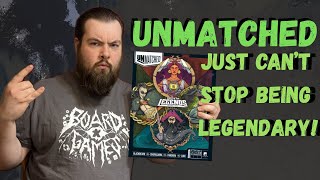
- Adds literary flavor and variety
- Keeps Unmatched’s fast, light play feel
- Less depth discussed for this character in the video
- Literary theming and humor within duel mechanics
- Unmatched arena featuring a legendary literary figure
- Cultural mash-up with playful interactions
- Massive Darkness
Mechanics (from transcript analysis)
- Character-specific micro-game — Each character has a unique ability that plays as a side game without slowing main play.
- Mini-Games — Each character has a unique ability that plays as a side game without slowing main play.
Video topics + discussion points
Quotes (from this video)
- Blackbeard is absolutely terrific, and I can see climbing the ranks of my unmatched tiers very quickly.
- The back-and-forth economy can give you major swings if you plan ahead properly.
- Pandora delivers a really interesting push your luck mechanism into the gameplay.
- Loki is a very technical character to play with and can be absolutely deadly.
- Chupacabra is the most basic character in the set. It's basically a way to farm cards.
- Unmatched is not afraid to give a character as their special ability essentially a little mini-game.
References (from this video)

- Hyped by influencers (The Brothers Murph)
- Hard to find in many regions
- playwriting/theatre production
- Elizabethan theatre
- theatrical
- Shadows over Camelot
- Mouse Guard: Swords & Strongholds
Mechanics (from transcript analysis)
- Role selection and theatre-themed actions — Players simulate theatrical performance through action choices.
Video topics + discussion points
Quotes (from this video)
- Rick dawn of Kiev this has been on my Grail list actually for a very long time
- damn Friedman fries
- I want all the fastest losses of racing game
- forbidden stars is one I'm really really excited to add to the collection
- Balloon Cup to the collection I want the OG Balloon Cup
- Monster Slaughter ... it's your turn to hunt down and slay those insufferable teenagers
References (from this video)
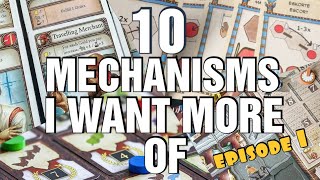
- clear demonstration of priority bidding: early initiative can pay off
- expandable with expansion content
- modest thematic flavor; heavy on bidding math
- initiative-driven worker bidding for priority
- renaissance work / worker deployment
- thematic but largely mechanics-driven
- Cashar
Mechanics (from transcript analysis)
- bidding for turn priority — players bid with workers to gain first turns; expansion adds more nuanced choices
Video topics + discussion points
Quotes (from this video)
- the potential for this mechanism is you know we've barely scratched the surface
- there are so many ways you can invert that mechanism and make it different
- it's a brain burner it definitely makes you think in a different dimension
- mind games that can come into play here in terms of trying to intimidate your opponent
References (from this video)
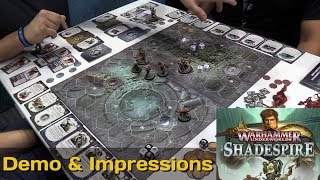
- Low entry barrier
- Beautiful miniatures
- Customizable gameplay
- Tactical combat system
- Warband combat for glory
- Ruined underground city
- Competitive miniature combat
Mechanics (from transcript analysis)
- Activation-based combat — Players take turns activating models with 4 activations per round
- Combat: Damage Based — Players take turns activating models with 4 activations per round
- Combat: Dice — Special combat dice with different symbols determine attack and defense success
- Deck Building — Players customize decks with power and objective cards
- dice-based combat resolution — Special combat dice with different symbols determine attack and defense success
Video topics + discussion points
Quotes (from this video)
- The real joy of this game comes from the customization of the decks
- You can have a hundred cards if you want, but of course you have less power