






























Spartacus: A Game of Blood and Treachery Deep Dive
What the Community Thinks About Spartacus: A Game of Blood and Treachery
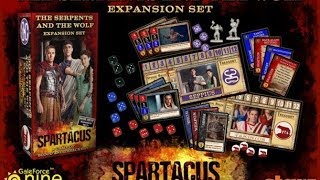
Reviewers broadly agree that Spartacus: A Game of Blood and Treachery is built for groups who enjoy bargaining, bluffing, and betraying one another across the same table. Gale Force 9 first released the game in 2012 and has since reprinted it, and the reviewers covering that reprint framed it as a social game first and a combat game second. Board to Death TV summed up its appeal as a single box that combines trading, scheming, fighting, betting, alliances, and treachery, and gave it a high score for the price. BoardGameBollocks awarded it top marks and highlighted how its asymmetric houses play differently from one another.
Enthusiasm is not universal, and the disagreements are mostly about group size and tolerance for table talk. Board Games UnLocked placed the game among its favorite group games, with the caveat that it should not be played with only three people. On the same channel's combat-system list, the co-host dismissed it outright, which illustrates how strongly the game's player interaction divides a table.
Core Mechanics That Define Spartacus
The Intrigue Phase: Influence, Schemes, and Reactions
Every round opens with Intrigue, which reviewers consistently call the heart of the game. Rolling Dice & Taking Names explained that each Dominus has a hand limit based on its influence, and that many powerful cards can only be played when the player's influence meets the value printed on the card. A player who falls short can pay gold to make up the difference or ask another player for assistance, and that request is where bargaining begins. Reaction cards add a second layer: a player facing a scheme can spend a guard to attempt a foil by rolling a die, where a four, five, or six succeeds, and a lower result still costs the guard. Because almost every play invites a counter or a bribe, reviewers describe the phase as a running negotiation rather than a sequence of card effects.
Arena Combat and the Dice Pool
Each Gladiator carries three stats that set how many dice are rolled: blue for speed, black for defense, and red for attack. Speed dice determine movement and who acts first, and attacks are resolved by lining up attack dice against defense dice in descending order. Rolling Dice & Taking Names noted that an attack die beating its matched defense die inflicts a wound, while an attack with no defense die left to meet it lands automatically. Each wound forces the defender to discard one die of any color, but the pool can never drop below one die. Losses escalate from injury to decapitation as the dice disappear, and the Gladiator is removed when all three are gone. Board Game Replay added the final step that gives the arena its drama: the host decides whether a beaten Gladiator lives or dies by giving a thumbs up or thumbs down, which opens a new round of bargaining between the host and the loser.
The Spartacus Experience
Treachery and Shifting Alliances
Reviewers describe a table where promises last only as long as they are useful. Rolling Dice & Taking Names recalled that the early rounds were fairly straightforward, but that players grew more aggressive as the game went on, offering deals, bargaining over influence cards, and threatening to play cards that undercut anyone who refused. Board Game Replay made the same point about the temporary nature of deals, noting that alliances last only for the moment. Board Games UnLocked put it bluntly, saying that players can lie about nearly anything and back stab their friends, which the host considered a feature rather than a flaw. The atmosphere feels closer to a tense dinner party than a tactical puzzle.
Brutal Swings and Shared Tension
The arena produces a different kind of tension, one in which everyone at the table has a stake. Rolling Dice & Taking Names described the wagering on fights as a way for spectators to stay engaged, since bets on who lives, who is injured, and who is decapitated keep the non-combatants invested. Board Game Replay described the game as King of the Hill in practice, where the player in front gets targeted by everyone else. Reviewers see that pattern as part of the design, and the hosts noted that a player in the lead can be knocked back by a well-timed scheme or a combat result that goes badly. The swings are sharp enough that a single bad fight can feel like a lost evening, which is part of why reviewers describe the game as dramatic rather than relaxed.
What Makes Spartacus Stand Out
A Theme That Survives the Rules
BoardGameBollocks argued that the game sets a useful standard for how publishers should handle licensed television themes, and that the house abilities and combat rules feel like they belong to the Roman setting. Board Game Replay made a similar point, saying that the theme matters in a way that few games manage, and that it puts players in the mood to fight. Reviewers say the theme does not disappear once the rules are learned. Instead, the wounded Gladiator, the thumbs decision, and the slave income all keep the setting present during play.
Asymmetric Houses and Simple Dice Combat
Every player controls a Dominus with a distinct house ability, which gives each seat a different way to approach the Intrigue phase and the arena. BoardGameBollocks singled out this asymmetry as one of the game's strongest qualities. The combat resolution is the other standout. Rolling Dice & Taking Names called the phases very simple to learn, and Board to Death TV noted that the powerful Gladiators feel true to the TV series even when they are a little overpowered.
Potential Drawbacks
Intrigue Can Stretch the Evening
The most common complaint is that the Intrigue phase can take a long time, particularly when players are deep in negotiations. Rolling Dice & Taking Names reported that even the quick game ran about two hours with three players, and the hosts observed that a game can drag when a leader nearing the winning influence is repeatedly pulled back by the others. Board Game Replay described Intrigue as the phase where the game is decided, which is also where most of the time goes. Reviewers who favor shorter, more direct games tend to find this the hardest part to accept.
Player Count and the Catch-Up Problem
Reviewers generally agree that Spartacus is best with a full table. Board Games UnLocked advised players to avoid three-player games and to aim for four to six, and Board to Death TV noted that the expansion exists largely to support five and six players. With fewer players, the arena becomes a duel while the rest of the table watches, and the Intrigue phase can feel thinner. Some reviewers also find the leader-targeting mechanics a double-edged sword. Board Game Replay described the leader being pounded by the rest of the table and suggested that the game rewards players who keep a few cards in hand and manage turn order carefully, but players who prefer a clean race to victory may find those dynamics frustrating.
If You Enjoy Spartacus: A Game of Blood and Treachery
- Munchkin: Board Game Replay compared the leader-targeting dynamic to Munchkin, where the front-runner gets jumped on by the table. Players who enjoy that laughing, table-talk tension will find a similar rhythm in Spartacus, though its combat is more deliberate.
- Cosmic Encounter: Rolling Dice & Taking Names pointed to Cosmic Encounter as the closest parallel for the late-game pull-back, where a player on the verge of victory is dragged down by the others. Players who enjoy Cosmic Encounter's negotiation and alliances will find the same satisfaction in Spartacus's Intrigue phase.
What Reviewers Are Saying
"Just the theme of it brings you into it and you are ready to go into battle, and it, I, I think it's really one of those games that finds that niche where the theme actually matters. You puts you in the mood to really kick some ass."
— Board Game Replay
"If you love backstabbing and talking and bartering, this is the game for you. It's just full of that stuff. It's very easy to learn, and each phase is really simple."
— Rolling Dice & Taking Names
"Now with this expansion truly adds is the Primus, a battle in the arena of two teams formed by four Gladiators. To do this, the current host must declare a Primus at the start of the Arena phase."
— Board to Death TV