















Tiny Epic Defenders Deep Dive
What the Community Thinks About Tiny Epic Defenders
Reviewers tend to describe Tiny Epic Defenders as a quick, tense cooperative game that rewards repeat play. Those who enjoy it point to a tight tempo, a turn deck that keeps shifting, and a boss fight that feels earned. Those who don't tend to see a straightforward tower defense in a small box, and they argue that the series leans on compact design where more depth might have been welcome. The split is less about whether the game works and more about whether its simplicity is a feature or a limitation.
Practical points draw broad agreement. Setup is light, the table footprint stays small, and a full game runs about 20 minutes once players know what they are doing.
Core Mechanics That Define Tiny Epic Defenders
Cooperative Game
Every hero works against the same threat. Each round, regular enemy cards strike two regions unless a hero stands in the way and absorbs the damage with health. Players share a pool of actions to move between regions, reduce incoming damage, and activate character and item abilities. Because a destroyed region affects the whole table, reviewers note that the game pushes players to coordinate instead of optimizing alone.
Boss Battler
The Epic Foe starts hidden beneath the Horde and joins the turn deck as rounds pass, so the final confrontation builds gradually rather than arriving as a separate setup. Capital city damage is permanent and cannot be healed, which turns the late game into a race. The Watch It Played live playthrough follows this arc closely. The capital city falls in a cascade of destruction, and the Demon Lord boss arrives as the defense frays. Dire enemies add tougher threats along the way, and defeating one earns an equippable item.
The Tiny Epic Defenders Experience
Collaborative
The game asks everyone to pull in the same direction. Reviewers describe the table as shared problem solving, where a bad round becomes a joint puzzle and no single player wins alone. The Cardboard Herald review also notes that the game holds up as a solo experience, so the collaborative core works at different table sizes.
Gateway and Accessible
Reviewers frequently point to Tiny Epic Defenders as a light entry point. Board Game Coffee found it easy to teach to younger players during a convention demo, and the rules are short enough that a new group can follow the flow after a single round. The small box and minimal table space help, though the item meeples add some setup fiddliness, covered below.
What Makes Tiny Epic Defenders Stand Out
Turn Deck Tension
The turn deck drives the rhythm of the game. Each round a new Horde card joins the deck, so familiar threats return alongside unpredictable additions. The Cardboard Herald review argues this balance works well: players can anticipate where trouble will land, yet new cards keep them from relying on a single optimal line. The reviewer credits the design with eliminating much of the quarterbacking that can creep into cooperative games, where one player dictates every move.
No Two Games Alike
Variety comes from the combination of heroes, epic foes, artifacts, and dire enemies. The Cardboard Herald review argues this keeps replay fresh, and it calls the game arguably the one entry in the series that fits its name across size, scope, space, and time. The second edition brought a visual overhaul, rebalanced some powers, and added new characters, foes, and dire enemies. Reviewers generally treat that as a welcome refresh rather than a reinvention.
Potential Drawbacks
Simplicity and a Dated Feel
Critical reviews focus on how little the game asks of players. Allies or Enemies placed Tiny Epic Defenders near the bottom of a two-player ranking, framing its simplicity and older design as real limits. What Happened To described it as super dry. A separate list discussion called it a straightforward tower defense game in a series more interested in gimmicky tiny-box packaging than in depth. These critiques are not about the game failing to function. They question whether the decision space is large enough to sustain interest across many sessions.
Fiddly Pieces and Cardboard Standees
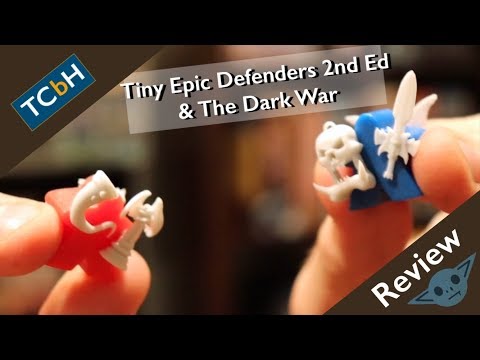
Physical components draw mixed reactions. The Cardboard Herald review found the item meeples a little fiddly to push into their bases, though it praised their construction. It was less convinced by the Dark War's cardboard standees, including the manticores, which it felt would work better as plain meeples.
If You Enjoy Tiny Epic Defenders
The Dark War expansion adds dire enemies, epic foes, characters, and items, along with a campaign of linked games that takes roughly an hour to play through. The Cardboard Herald review finds the experience and skill systems add depth but make the campaign a heavier commitment, and suggests the Great Battle mode suits regular sessions better since it keeps the core game's pace.
For players comparing the wider line, Tiny Epic Galaxies is the title What Happened To suggests as the stronger starting point, pointing to its resource management and competitive feel. Tiny Epic Kingdoms and Eight Minute Empire occupy similar territory for players who want compact strategy games. The cooperative focus is what sets Defenders apart within the series.
What Reviewers Are Saying
"It's a fast playing, really enjoyable cooperative or a great solo game that is easily repeatable and has tons of dynamic elements that can kind of shift the game around."
— The Cardboard Herald
"they do a neat job of all the various locations do different actions so it does feel like you have various decisions to make and enough differences between the locations and the bosses that each game feels a little bit different"
— Allies or Enemies
"nobody I played this with enjoyed it it was just super dry and like really straightforward and not really having any excitement at all"
— What Happened To