







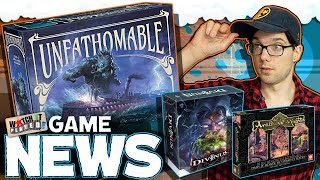


Divinus Deep Dive
What the Community Thinks About Divinus
Divinus has generated notably mixed reactions from reviewers who have engaged with its 12-scenario legacy campaign. While early prototype sessions generated some optimism about the core dice-rolling mechanic and app integration, reviewers who completed the full campaign have expressed significant reservations. The game's trajectory appears to be one of initial promise followed by repetitive mechanical iterations and a narrative that fails to deliver on its epic mythological premise. Most reviewers who finished the campaign describe growing fatigue with the system, suggesting the experience works better as a rapid series of games rather than spread across months of gameplay.
Core Mechanics That Define Divinus
Dice Rolling and Tile Acquisition
At its heart, Divinus is a dice-drafting and tile-laying game where players roll six dice at the start of each round. Using addition and subtraction, players combine die values to purchase tiles from a numbered grid, spending their dice on the spot to claim the tile. A reviewer described this as a satisfying puzzle: "it's just this you're rolling these dice and you have those dice and you're having to plan out what is it you're going to do based on the little simple math that you're able to do." The mechanic is straightforward enough to teach quickly but offers tactical decisions about when to lock in dice and when to rest (re-roll all dice). Once a player builds a complete 4x4 grid, the scenario ends and scores are tallied by the app.
Legacy Customization Through Dice Stickers
As the campaign progresses, players earn sticker tiles to permanently modify their dice, replacing face values with higher numbers or special combinations (1-6, 3-10, etc.). This personalization creates a sense of progression and allows increasingly flexible tile purchases. Stickers appear early and often as part of both scenario rewards and mid-game mechanics. However, reviewer experience with sticker application has been problematic: the adhesive is described as unreliable, especially on warm dice or when layering stickers, with many falling off mid-campaign or refusing to stick despite repeated attempts.
The Divinus Experience
Mythological Conflict and Shifting Alliances
The thematic framework pits Greek against Nordic pantheons, with players as demigods seeking to win favor through their board development. Different gods have different victory conditions: some reward large connected regions of terrain, others reward scattered zones. The app tracks decisions that carry forward, and location tiles trigger narrative moments. Despite the mythological grandeur, reviewers consistently report that the story remains bare-bones. One experienced campaign player noted the narrative arrives "in little bursts and bits" but ultimately fails to create emotional investment, with most story beats feeling disconnected from actual gameplay decisions.
App-Driven Campaign Progression
The app manages scenario transitions, quest tracking, scoring, and story beats. Notably, it requires no QR codes: players can manually enter tile numbers when needed, which reviewers appreciated for eliminating obstructive barcodes from the board's aesthetic. The app also automatically tracks favor, quest progress, and end-game conditions. However, the app's actual content is sparse: story text is functional rather than engaging, quest descriptions are straightforward, and the narrative does little to make the campaign feel epic despite the design attempting to frame it as such.
What Makes Divinus Stand Out
Accessible Dice-Based Math Puzzle
The core mechanism of rolling and combining dice to reach specific tile values is genuinely engaging for a few sessions. Reviewers found the simple arithmetic satisfying, describing "a fun little puzzle" that is fast-moving and makes players feel like they are making meaningful choices. The moment when a player uses all their dice on a high-value tile feels like a genuine risk-reward decision. For players who enjoy light, puzzle-like games with minimal randomness after the initial roll, this core loop is the game's strongest element.
App Integration Without Forced Connectivity
Unlike many app-driven games, Divinus allows playing the physical game while recording numbers in the app, avoiding the need to hold a device at the table during play. The app's automatic tracking of favor and quest progress removes bookkeeping overhead. Reviewers specifically praised the design choice to support manual number entry alongside QR codes, making the app optional during actual play rather than intrusive.
Potential Drawbacks
Sticker Production and Component Reliability
The most consistently cited production problem is sticker quality. The adhesive is unreliable on dice faces, particularly when multiple stickers are layered or when environmental heat is present. Some stickers remain firmly adhered while others fall off within seconds of application. A reviewer who completed the campaign reported extensive frustration: "there was a lot of times with the dice I had where I would try to put a sticker on and it would just slide about it would just keep falling off." This is compounded by the fact that stickers are central to campaign progression, so when they fail, player agency and customization suffer. Additionally, at least one player reported receiving wrong components (duplicate green boxes instead of yellow), requiring months to resolve with customer service.
Repetitive Mechanics and Narrative Fatigue
Multiple reviewers report that by scenario 3, the core experience begins to feel repetitive. While new rules are added in each scenario, they are described as minor variants on existing systems rather than transformative changes. One campaign veteran stated: "the new stuff didn't adds isn't that interesting it's just subvariant of what you've seen before." The narrative never escalates into something epic; instead, it remains a thin scaffolding around incremental rule tweaks. The recharge pack needed to replay the campaign is described as extremely tedious to assemble, requiring extensive sticker removal and component recovery. Reviewers who played through all 12 scenarios found the experience exhausting rather than satisfying, with the bare-bones story failing to justify the time investment, especially when games are spaced weeks or months apart.
If You Enjoy Divinus
Reviewers suggest exploring related games that handle similar core mechanics or themes more effectively. Charterstone offers legacy mechanics combined with a Euro-style worker placement game, providing a similar sense of permanent progression without relying as heavily on repeated dice rolls. Ticket to Ride Legacy delivers a campaign experience with a familiar system that opens up gradually; reviewers found it far more rewarding in terms of progression and narrative payoff. For those interested in app-driven board games with strong thematic narratives, Destinies or Chronicles of Crime provide more robust story integration, though with different mechanical cores. My City strips back legacy mechanics to their simplest form (rolling dice, coloring a grid) and delivers better replayability and accessibility through its minimalist approach.
What Reviewers Are Saying
"It's just this you're rolling these dice and you have those dice and you're having to plan out what is it you're going to do based on the little simple math that you're able to do to make it happen. It's just in that slight simple third grade math kind of way a fun little puzzle that you're doing but it's very very fast."
— Hungry Gamer
"I kept wanting more out of the experience. In fact, Divvenus is probably better than my number 17, but Divinous took more time to play, which made me resent it a bit more."
— BoardGameCo
"The story in this, who the hell cares? Who gives a crap? The story of this is non-existent. It is a barebone story that you could have written an English GCSE lesson. There is no really gripping narrative or anything like that. It is a bare bone a plot as you can get for a game where you're basically just putting together a bunch of tiles carcassone style each game."
— Broken Meeple