






PORTALS Deep Dive
What the Community Thinks About PORTALS
Reviewers across multiple channels embrace PORTALS as a thoughtfully designed abstract strategy game that delivers surprising depth within a compact footprint. The consensus centers on the game's elegant mechanics, striking visual presentation, and the engaging puzzle it poses to players. Totally Tabled praises its clear teaching structure and engaging solo experience, while The Board Game Garden highlights the accessibility of its core systems and the quality of its components. Board Stupid emphasizes the game's high interactivity and clever scoring tension, though acknowledges it demands focus and may frustrate those prone to analysis paralysis. The game has struck reviewers as better than expected given limited pre-release attention, suggesting PORTALS has found an audience that appreciates puzzle-forward design with meaningful player interaction.
Core Mechanics That Define PORTALS
Drafting Elemental Stones
The heart of PORTALS revolves around a shared drafting system where players take turns selecting Elemental stones from communal pools arranged in a circle. Each stone type corresponds to one of five elemental colors (white for air, green for earth, orange for fire, blue for water, purple for time), and players strategically claim stones while denying options to opponents. The drafting areas are limited; once a player has taken three stones from any single pool, that pool closes off to them for the round. This constraint forces players to balance pursuing their own needs against preventing opponents from monopolizing high-value areas. Designer Maxim Istomin uses the drafting mechanism not merely as a selection tool but as the primary source of meaningful decisions each turn.
Pattern Building and Key Cards
Players progress by charging Key cards, each marked with specific spot placements where Elemental stones must be positioned. Key cards come in three difficulty tiers: orange cards need two stones, red cards need three, and purple cards require four. Once a key card is fully charged with the correct Elemental stones, players activate it and transfer the pattern onto shared Elemental boards. The rotation rule is crucial here; patterns can be placed in any orientation as long as the arrangement holds. Players then earn Victory Points by matching stone colors to the board beneath them and earning adjacency bonuses when same-colored stones sit orthogonally or diagonally next to each other. This mechanic creates a spatial puzzle where planning the optimal placement demands forethought.
The PORTALS Experience
Meticulous Spatial Puzzle
PORTALS delivers a deeply satisfying puzzle experience that rewards careful planning and pattern recognition. The solo mode frames this most clearly: players move through 25 rounds placing stones sequentially from a numbered grid, building their board state one placement at a time. The solo campaign offers tiered difficulty levels, and reviewers report spending substantial time working toward perfect scores. Each decision feels consequential because stone placement is permanent and visible to all players, creating a record of strategic choices. The puzzle nature extends to multiplayer, where reading other players' incomplete patterns and predicting their next moves adds a layer of competitive foresight.
Tense Player Interaction Through Shared Resources
Unlike traditional euro games where each player maintains isolated player boards, PORTALS features floating boards shared between adjacent players in multiplayer. This creates constant awareness of what opponents are pursuing and forces players to consider not just their own scoring paths but the consequences of their stone selections on shared real estate. The spell module amplifies this tension by introducing tactical actions that can relocate stones, remove pieces, or trigger premature scoring. Players describe an unusually high level of interactivity for an abstract puzzle game; you are not merely denying opponents tiles but competing for placement space on boards you both influence.
What Makes PORTALS Stand Out
Striking Visual Design
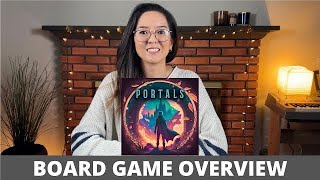
The game's presentation resonates strongly with reviewers. The cover art depicting a wizard portal against a vibrant, magical landscape sets an immediate visual tone. Production quality throughout is polished: the Elemental stones are tactile and satisfying to handle, the Elemental boards feature clear color differentiation, and cards are readable and sturdy. Reviewers highlight the beautiful color palette and the care taken in visual hierarchy across components. The theme of time travelers following wizard Dominique Day across interdimensional portals, while light in mechanical weight, threads cohesively through the component design and rules explanations, creating an aesthetically unified experience.
Flexible Modularity and Solo Depth
PORTALS ships with optional modules that meaningfully expand the experience without overcomplicating the base game. The magic spells module introduces four special actions that can be triggered in place of standard drafting, with color restrictions that prevent easy access to every spell every turn. The secret signs module awards bonus Victory Points when players construct specific patterns on their boards, adding a memory and opportunism element. The solo mode is particularly robust, offering a 25-round puzzle campaign with its own scoring thresholds and optional difficulty tiers. Reviewers praise the solo experience as a genuine puzzle variant, not an afterthought, and note that the modules available in multiplayer remain accessible in solo play, creating substantial replayability.
Potential Drawbacks
Analysis Paralysis and Table Downtime
The spatial puzzle that makes PORTALS engaging can become a liability at higher player counts or with analysis-prone players. With multiple Elemental boards visible, active card slots to consider, and the floating drafting pools constantly offering new options, some players may spend considerable time calculating optimal placement. Reviews explicitly warn against playing with anyone prone to overthinking every move; the combinations of stones, board positions, and future draft availability can paralyze decision-making. At four players, downtime between turns can stretch noticeably, especially during the placement phase when each player must carefully position their charged key cards in ascending order.
Abstract Theme with Limited Narrative Immersion
While the wizard and portal fiction provides a pleasant aesthetic frame, PORTALS remains fundamentally abstract. Players are not narrating the adventures of Dominique Day or the discovery of new worlds; they are solving elemental puzzles with pattern-building mechanics. The theme does not drive mechanical decision-making or create emergent story moments. Reviewers note this explicitly, acknowledging that PORTALS is not designed to deliver thematic immersion but rather to offer elegant abstract strategy. For players seeking deep narrative integration between story and mechanics, the lightweight theme may feel decorative rather than integral.
If You Enjoy PORTALS
Players who appreciate abstract puzzle games with elegant spatial systems will find natural homes in Azul, which PORTALS reviewers cite as a touchstone for drafting and pattern placement, though PORTALS layers additional interactivity through shared boards. The hidden Victory Points and secret objectives mechanic mirror the tension found in Ticket to Ride, where keeping cards face-down creates uncertainty about who is pursuing which strategies. Those drawn to PORTALS's modular design and solo depth should explore Evolution: Another World, published by the same publisher with similar accessibility and solo replayability. For the cozy, puzzle-forward aesthetic, Cascadia offers parallel satisfaction in a smaller time investment. Fans of the collaborative push-your-luck elements embedded in the spell module and solo campaign will find kindred mechanics in team-based or timer-driven party games where timing and shared resources create tension.
What Reviewers Are Saying
"There's one other way that we score points in this game and that's with these secret sign cards. These show patterns of stones that if we can achieve them on our board we can immediately score that card and get four points."
— Totally Tabled
"Portals is absolutely gorgeous, and I think this is probably one of my favorite covers I have ever seen on a game. There is just something about this art that just makes me so incredibly happy."
— The Board Game Garden
"I think this is a really tremendous game. I'm not sure if it got a huge amount of hype but it's much better than I thought it would be."
— Board Stupid