















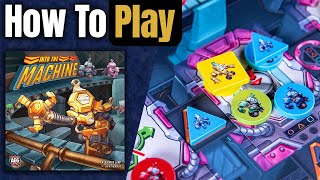
Into the Machine Deep Dive
What the Community Thinks About Into the Machine
Into the Machine has earned strong approval from board game reviewers across multiple channels, who recognize it as a clever hybrid that defies easy categorization. While marketed as a racing game, reviewers consistently emphasize that the true depth lies in the tension between building an efficient engine and committing resources to the actual race. The Dice Tower praises its fresh approach to familiar mechanics, BoardGameCo highlights the intricate balance required to win, and Tantrum House celebrates its streamlined rules paired with surprising strategic complexity. There is broad consensus that the game works best at moderate player counts and that its modular board design ensures meaningful variety across plays.
Core Mechanics That Define Into the Machine
Worker Placement with a Strategic Payoff Structure
Players spend their robots as workers across action spaces on the main board, competing for access to powerful actions by stacking pieces higher than their opponents. The space requirements scale with competition, creating a push-and-pull dynamic where players must decide which actions justify the resource cost. Reviewers note that square-shaped bots unlock the most powerful actions and that access to these premium moves becomes a defining strategic advantage. As one reviewer observed, the most powerful actions sit at the bottom of the board, and gaining enough square bots to use them efficiently requires careful planning and prioritization of early-game upgrades.
The Pivot: Racing Versus Building
Unlike deck-building games where the endgame pivot is predetermined, Into the Machine forces players to judge when to stop investing in their engine and begin racing. Reviewers from The Dice Tower and BoardGameCo both highlight this as the game's most interesting decision point. Early commitment to the race guarantees falling behind; pure engine building without a race phase wastes turns. Players must sense the moment when their bot upgrades are sufficient and pivot toward movement actions. This creates constant tension and makes each game a negotiation between two competing win conditions rather than a linear progression.
The Into the Machine Experience
A Racetrack Full of Tactical Moments
The movement system on the conveyor belt creates surprisingly tense and rewarding moments. Pieces slide, hop over opponents, and leap ahead when positioned correctly. Reviewers describe the satisfaction of setting up and executing a well-timed chain of moves that rockets a bot from the middle of the pack to near victory. The two-way track (circles moving right, hexagons moving left) means your pieces stay on the board in different contexts, and catching up to opponents is possible through strategic use of movement actions. This prevents runaway leaders and keeps the race competitive until the final turns.
Satisfying Engine Moments and Efficient Upgrades
Converting circle bots into stronger triangle and square bots triggers a feedback loop of satisfaction. Each upgrade opens access to better action spaces, and players feel the payoff when they finally have the tools to execute their strategy. Power cards scattered across the board offer tactical surprises and clutch plays. Reviewers emphasize that holding power cards until the endgame can swing a close race, rewarding patience and observation. The upward progression of bot strength mirrors the gradual escalation of player options, making the mid-game transition smooth and rewarding.
What Makes Into the Machine Stand Out
A Clever Blend of Worker Placement and Racing Without Compromising Either
Into the Machine avoids the trap of feeling like two half-games awkwardly stitched together. Reviewers consistently affirm that the engine-building and racing elements reinforce each other rather than compete. Every bot you upgrade makes your race moves faster. Every racing delay costs you turns to build. This creates natural friction and meaningful trade-offs. The variable placement of action tiles means the optimal strategy shifts from game to game, preventing solved states and encouraging exploration. Designers of Great Western Trail and Magic Maze are mentioned as references by reviewers seeking comparable design sophistication.
Streamlined Production Design That Respects Player Time
Setup is quick, rules are easy to teach, and most games finish within the target time. Reviewers appreciate that each player box holds their pieces and some game components, reducing table footprint and making storage elegant. While one reviewer noted that token piles can obscure board icons and that half-height track overlays feel unconventional, these are minor production quibbles. The rulebook is thorough without being condescending, and symbol recognition is intuitive. The modular board ensures that no two games feel identical, and the power deck brings unpredictability without breaking the game.
Potential Drawbacks
Game Length Can Stretch at Higher Player Counts
Reviewers who played with four or five players report games exceeding ninety minutes, while three-player sessions stay closer to the advertised sixty minutes. The addition of extra players increases the complexity of board state management and adds more opportunities for stalling. One reviewer noted that at higher player counts, the waiting game dynamic can emerge, where players hold back from racing because moving early would only give others a free turn to build. This slows pacing without deepening strategy. Reviewers suggest the game plays best with two or three players, though it remains solid at four.
Limited Action Variety Can Feel Samey Without Expansions
The core actions (move, add, upgrade) repeat across the board. Reviewers acknowledge that while this simplicity aids learning, replay novelty depends heavily on the variable board layout and the Track Gadget expansion. One reviewer observed that without the track gadget module adding portals and magnets to the conveyor belt, the strategic puzzle can feel solved after several plays. The expansion is recommended and, in that reviewer's estimation, nearly essential for sustained engagement. Power cards stay fresh through the shuffled deck, but the action set itself remains static.
If You Enjoy Into the Machine
Players who love the engine-building pivot will find similar satisfaction in Dominion, which inspired the design of Into the Machine's central tension. Those drawn to the racetrack mechanics and movement blocking should explore Mancala as a spiritual ancestor or Great Western Trail for a meatier tableau-building race. Reviewers also recommend Hansa Teutonica for its upgrade-focused worker placement system and The Quest for El Dorado for a race that hinges on deck building. For fans of real-time movement and chaos, Magic Maze (by the same designer) offers a completely different experience. Players seeking lighter racing alternatives with worker placement elements should consider Robo Rally, though it emphasizes chaos over engine strategy.
What Reviewers Are Saying
"I was surprised at how tactical that that racetrack is. Cuz there's there's plenty of games where you're like, okay, the first one to a certain amount of something wins, right? But, because you're doing the sliding and because you have that space that lets you catch up to the front, right? There's so many moments where you can have really clever things that happen because people are hopping over and sliding and jumping."
— Wendy Yi, The Dice Tower
"The core engine building plus worker placement works. It is an interesting combination where you have this racetrack. You are ultimately just a race. That's all it comes down to. You're trying to figure out what's the fastest way to use worker placement to go ahead and race along the track."
— Alex Radcliffe, BoardGameCo
"It reminded me a little bit of Mancala. If you've ever played that, where you're sort of like going around, jumping people and moving but there's a lot more going on."
— Kevin Delp, Tantrum House