



Tiny Epic: Invincible Deep Dive
What the Community Thinks About Tiny Epic: Invincible
Reviewers come to Tiny Epic: Invincible from two directions. Fans of the Amazon series are drawn by the license, while followers of the Tiny Epic line look for the compact, dice-driven tension that has defined the series. Designed by Scott Olms and published by Tycoon Games, the cooperative game supports one to four players and runs about 30 minutes. Jeremy of Man vs Meeple said they generally love most of Olms' designs and wanted to see whether this one felt different.
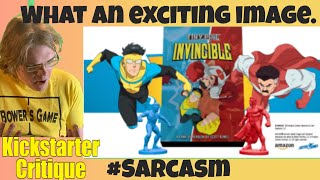
The consensus is that the dice carry the game. Jeremy said that gameplay is what sells them, and the dice are what they kept coming back to. Jeremy described the feel as closer to Pandemic and Marvel United, where the job is to solve situations across locations rather than race along a track. TheGameBoyGeek walked through the full turn structure and framed the design around how much decision space each roll creates. Bower's Game Corner approached the release mostly as a crowdfunding critique, but kept returning to the appeal of building a team of heroes from the show.
Core Mechanics That Define Tiny Epic: Invincible
Combat: Dice
Every hero turn starts with a risk roll. If a location has more threatened civilians than secured ones, the hero rolls the riskier gold die. If secured civilians match or outnumber the threatened ones, the hero rolls the black die instead. TheGameBoyGeek explained that the player then chooses how many of the four action dice to roll, and each die that lands at or below the risk value grants one action. Rolling fewer dice raises the risk value by one for each die left out, a trade-off that lets a player gamble on a better number. Yellow and blue action dice unlock different actions, so the choice of which colors to commit is a decision in its own right. Some faces also show location icons, and a hero who rolls one can take that location's benefit.
Jeremy put a finger on why this works. Jeremy said the risk is what sells them, since the game puts pressure on players to roll both yellow and both blue dice while still needing to land under a number. Jeremy noted the design includes dice mitigation through hero abilities, so the pressure is real but not hopeless.
Cooperative Pressure Against the Game System
Everyone wins or loses together, and the opposition is the board itself. At the end of each round, enemies are checked against the heroes and allies at their location to see whether a location can be diverted or secured. TheGameBoyGeek laid out the win condition clearly: secure the required number of locations before the round limit, which is six rounds for four players, eight rounds for three, and 10 rounds for two. Losses come from several directions, including losing four locations, having the villain kill six civilians, or simply running out of time. Jeremy captured the imbalance by saying players have plenty of ways to lose and only one way to win. The single villain adds another layer. Omniman, for example, stacks an extra villain onto any action taken at his location, and the villain moves to wherever the last enemy card was placed.
The Tiny Epic: Invincible Experience
A Pressure of Luck on Every Turn
Reviewers describe turns as a series of calculated gambles. Each roll forces a choice about how many dice to commit, and TheGameBoyGeek noted that this creates a real pressure of luck. Players must weigh a better chance of success against fewer actions, and every decision is made before the dice are rolled. The tension comes from the dice rather than from any fixed plan, so a turn can feel exciting even when the outcome is uncertain.
A Crowded, Juggling Scramble
Reviewers describe a board that is always close to spilling over. Jeremy said the game goes for a big run, with a lot happening in a small footprint, and admitted being a sloppy player during the demo. Civilians shift between secured and threatened, enemies stack at compass locations, and a fourth enemy at one location overruns it. Positioning matters as much as dice, because the only way to fight more than one enemy at a time is to team up with another hero at the same location. The overall feeling is a tight scramble to keep locations from collapsing.
What Makes Tiny Epic: Invincible Stand Out
Heroes and Villains With Distinct Abilities
Each hero has a base ability tied to a condition and a power ability that costs power to activate. Jeremy gave the example of Invincible, who gains extra strength when three enemies share a location, and Rex Explode, who can take an enemy along when evacuating civilians. The villains are just as distinct. Each game features a single villain with a standard side and a more challenging red side, and every villain carries its own rules. These asymmetric abilities give each hero a different way to approach the same board.
Locations That Change From Game to Game
Setup adds four locations beside the Guardians' headquarters, drawn from a pool that includes Atlantis, Mount Rushmore, and a college. TheGameBoyGeek noted that each location brings its own benefit for heroes to use in the right circumstances. When a location is lost, it is replaced with one that was not used during setup, which keeps the board from repeating itself across games. Combined with a different villain each time, the setup gives replay variety that reviewers expected from the series.
Potential Drawbacks
Appeal Tied to the Show
Jeremy was direct about the license. Jeremy said the game is an IP game, and that players are either into the IP or they are not. Bower's Game Corner made a related point about the release's presentation. Even without knowing the show well, Bower's Game Corner said, a cooperative game about building a team can still be appealing, but the pitch did little to make that case for players outside the fandom.
Luck-Driven Turns and Stacked Losses
The same dice that create tension can also swing a turn, and the loss conditions stack quickly. Jeremy's demo ended with an overrun location and a board Jeremy admitted handling sloppily, which shows how fast the threats can build. TheGameBoyGeek also stressed that the components shown were prototypes, so the final dice faces, art, and rules could still change before release.
If You Enjoy Tiny Epic: Invincible
Jeremy of Man vs Meeple linked the game to Marvel United, citing its team-based feel and the way players solve situations across a shared board. If you like assembling a superhero roster and working through simultaneous threats, that is the closest reference point. Pandemic is the other touchstone Jeremy named, and it suits players who enjoy a cooperative game where the board itself escalates and the group must plan around it. Both pair naturally with Tiny Epic: Invincible for players who want a cooperative experience built on pressure and shared responsibility.
What Reviewers Are Saying
"But for me, just gameplay, because gameplay is above everything for me, it's these dice. I like dice mechanics, and if you do something interesting with them, like this game, it excites me."
— Jeremy, Man vs Meeple
"There's a bit of a pressure of luck here because you're deciding how many to roll. You're going to be successfully able to take an action for each of the dice rolled if, when you roll these action dice, it's less than or equal to the value of that risk die."
— TheGameBoyGeek
"I like the idea of dice chucking and building my team of heroes because I like invincible."
— Bower's Game Corner