Top 100 Board Games Of All-Time 2025 (100 - 91)
Games in This Video
8 games are featured in this video — they unlock as you watch.



Transcript
Welcome to Allies or Enemies. I'm Jess.
And I am Sean. And today we are kicking off our top 100 favorite board games of all time, the 2025 edition.
And every year it gets harder and harder to do these lists because every year we play more games. And we play a ton of games. and we both individually rank them and we haven't seen each other's list. So, I'm curious as to what made the cut for you.
Yeah, I have no idea what you're going to have. Well, I got some idea what you're going to have, but the other thing we want to talk about this year is sometime I think during this this bad boy is going to go up on Kickstarter. So, our preview page is up right now. We are planning on launching officially on August 19th. So, please go and check that out. We are going to talk about a little bit in some of these videos. So, you're going to hear a bit more about that. But for now, let's get to it. 2.
My number 100 is In the Footsteps of Darwin. And this is the first in a series of the In the Footsteps games with the other one being Marie Curie. And I really like that it's focusing on historical scientist and they're really like beautiful games, really accessible. And for the Darwin one, I have a zoology background. So, I like that you're kind of recreating Darwin's journey in a bit of an abstract way cuz you're collecting these different animals that you've seen on your journey and you're putting them on your really lovely journal board and then things score in like slightly different ways and the HMS Beagle's going around the board and that's how you draft your tiles. But, it's just it's really lovely. I really liked the theme and then once the expansion came out it just kicked it up a notch for me and it's my number 100.
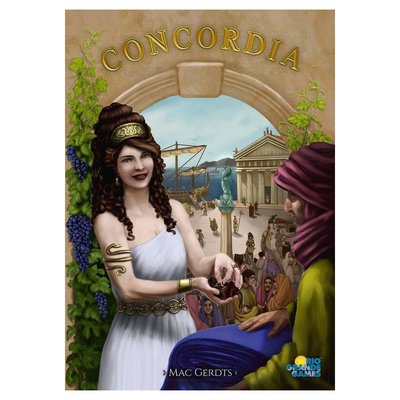
My number 100 is Concordia and this is a stone cold classic. This is a Max Girtz game. It's from 2013 and that does sound like it's recent but in board game years that is a grandpa but this grandpa has aged very well. This is it's just such a terrific like streamlined game cuz in it you are moving around the map. You've got these guys in the land. You got these boats on the outside and then you're setting up shop in all these different towns and that's going to get you goods that you can kind of buy and sell in this really abstracted way. But the thing I love about this game is as you go you're gaining these cards which are your action cards. So you've got so many action cards. Everyone's got the same. You're gaining these cards that you can play out, but those are also your endgame points. And you have no idea what anyone is scoring. That obfiscates the whole thing so well that at the end of the game, all of the all of the point scoring is such a huge surprise. And I love that in this game.
And that is my 100. My number 99 is Captain Flip. And Captain Flip is a very quick game. How it works is you take a tile out of a bag and then you have to choose to either put that tile down as is or you can flip it. But if you flip it, you have to use the other side. And so it creates a bit of a like, oh, I I think I can get enough points with this, but it always feels like the grass is greener on the other side. And I'm always like, but I just want to see what it is. And it's just it's really satisfying. There's lots of different characters that score in different ways. If you get three bombers, that gives you lots of points, but if you have three at the end of the game, then you lose. And so it doesn't matter how many points you have. And then other tiles that let you flip tiles, other tiles that let you draw another tile, but are negative points.
So, just enough interaction between all of the tiles that it's always interesting, super super fast, and whenever we play it, we always play again. And it's my number 99.
My number 99 is Baron Park. And Phil Walker Harding does this thing really well where he takes one board game mechanic and he just drills right into its core. And Baron Park is his tile placement game. And this is just so much tile placement. You're taking these tiles, you're going to put them on another tile, and those are going to get you more tiles that you're then going to place to get more tiles. And you're going to add tiles that you're putting tiles on top of. You've got tiles that are your tile scoring goals. You've got tiles everywhere. But it is so so streamlined this game. And I love the idea of building a bear park. Is that even a thing that exists? I really I really like the theme. I just I love how easy this is to teach. and it is my 99.
My number 98 is obsession. And this is like Jane Austin the board game. You start off as like a somewhat welloff family but with not a lot of money, not a lot of rooms in your estate and only uh a couple of servants. And what you're trying to do is you're trying to increase your reputation, increase your amount of money, get more guests visiting you, and just host a whole bunch of different activities. And I really like how tongue andcheek it is cuz it does have like the activities they did at the time, like playing wis and having a ball, but it has all of these great guests with these oldtimey pictures and some like wonderful descriptions. And so it's it's just really fun to like put on these silly activities um and try and court the fair child, which is another thing you're trying to do. And it is my number 98.
My number 98 is Mage Knight. And this one is designed by Vlad Shivatel. I don't know if I'm saying that right, but this he is just the ultimate in like I can't believe all of these different games are coming from one person. Galaxy Trucker, Code Names, and Mage Knight all came out of the same brain. That blows my mind. But Mage Knight is by far the heaviest of those. And I don't play it enough because I'll only play this solo because it's such an interesting solo adventure. You're moving around this map and you're fighting bad guys, but it's done in just this really, it's not not simplified at all, but kind of on the map. How you show it is in a way simplified, but you've got this very complex card mechanic, how you're building your deck, how you're playing your actions, how you're spending these special gems. It takes me at least an hour to relearn every time I play it.
Takes me 3, 4 hours to play it, and it is so worth it every single time. It's such a big rewarding experience. And it is my 98. My number 97 is Solstice. And Solstice is a tile drafting game, but all of the tiles are taken from like this one scene that has been cut up and divvied up into tiles, like a puzzle. But whenever you take a tile, that means you're taking a piece of that picture, and your opponent doesn't get that. And what you're trying to do is you're trying to connect kind of the like largest group of that picture as possible, but you can see which pieces you're never going to get.
There are ways to fill those gaps cuz there's like rainbow tiles you can put out and there's these great like animal tiles you can put out to score things in different ways. And we played this a ton on BGA and then we got it in person and I just like I I love it in person too because those like animal tiles are like wooden and they look lovely and it is my number 97.
My number 97 is Camel Up. And Camel Up is one of my go-to games if you've got a bigish group of players and especially if they're not necessarily board gamers. Although board gamers love this one too. This is a gambling game and you got a bunch of camels and you're you're gambling on a camel race, but on your turn you either choose to bet or to roll a dice, which obviously comes out of a pyramid. And the tricky thing is when you roll that dice, you're giving everyone else information. But if you bet, maybe you don't have enough information. And like any real life camel race, when the camels go to the same space, they stand on top of each other. So that can really change. All of a sudden a camel can move like three times in a row even though you've only rolled that dice once. So the race can change a lot lot lot. Just super silly, super fun. And it is my 97.
My number 96 is STI. And this feels like a board game that really tried to take the science a little bit seriously cuz what you're doing is you are listening for signs of extraterrestrial life. And so you're making these satellites, you're sending these satellites out into space. The satellites are orbiting planets and moons and landing on them. And then I love that at some point you actually have discovered enough clues that aliens do turn up. So, it starts off like super scientific and then you get these aliens arriving and there's like five different aliens, but you only ever use two each game and you don't know what they're going to be until you've uncovered enough clues and then you find out what kind of alien it is.
So, it's a it's a really like heavy tight resource management game, but I really like the theme and I really like the variability of the different aliens. And it is my number 96. My number 96 is Underwater Cities. And this one is this is really an all or nothing for me. It really depends on the day. This is a Vladimir Succi game and so it is very very tight like an awful lot of his games are. But some days when I'm playing this game, everything just works out for me. You've got these cards that you got to play into matching color slots. You don't have to, but you get a bonus if you do. So you really want to. And those are going to let you do all these different actions that really have to do with building an underwater city. You've got these domes you're putting out. You've got resources. You're connecting up your domes in your city.
But some days I'm getting the right cards. Everything really works out. But boy, when it doesn't work out, this is a real real uphill battle. But it's still fun and it's still interesting and such a well-made puzzle. And Underwater Cities is my number 96. And we're going to come back with our number 95 right after this very exciting commercial.
Heat. Heat. Heat. Heat.
My 95 is Sonora. And Sonora is a flicking dexterity rolling right game. And I like dexterity games and I like rolling right games. And how it works is on your turn, you've got a disc that you flick onto a shared board. And so everybody is taking turns flicking these discs onto the board. So obviously, one of the things you're trying to do is to flick other people's discs so they end up in spaces they don't want to end up because at the end of the round, wherever your discs are, you get to cross off those sections on your roll and write board. And like a lot of roll and rights, you're trying to combo. So, you're usually maybe trying to focus on like a couple of those sections, but you don't have full control of where those discs end up. And it is just it's a lot of fun. And it is my number 95.
My number 95 is Beacon Patrol. And Beacon Patrol is a different kind of co-op game. When I think co-op game, it kind of feels like there's three kinds of games that like exist in the world. Either it's a dungeon crawler, you've got to put cards in some sort of an order, or you got to put out uh fires, kind of like pandemic. Beacon Patrol does something totally different. You both have ships, or you all have ships, however many people are playing, and you're trying to discover what this like Arctic island land looks like. And so you're just traveling around adding out tiles and you're trying to build this map together, but you can only go so far. And that's the really tricky part. So you can kind of trade tiles back and forth, but you don't know what the other person's going to want. You can only do one a turn. And it's it's really it's really more of a puzzle than you would expect for such a simple rule set. And I just appreciate that it is a different kind of co-op game. And it is my 95.
My number 94 is Roleplayer. And this is a game where you're like building a DND character. You're not using the character. You're just building the stats for the D&D character. But it is a dice drafting placement game that is very much a puzzle. It feels, I think, a little bit like a Sudoku because you're always mathing things out. You're trying to make your rows add up to certain numbers. You're also trying to make sure your dice colors end up in the right spots. And there's also like a a cube that's like moving position for your alignment. You'll never be able to accomplish everything, but it will feel like you can cuz every time you place a dice, you get to do like a dice manipulation or get more coins that might get you market cards. So, you'll always feel so close to being able to get everything just right. But it's a fun puzzle to be like, "Okay, I'll give up on that and I'll try I'll try doing this instead." And it is my number 94.
My number 94 is Septima. And this is from Mine Clash. And Mine Clash is one of my favorite publishers that is out there. They make very heavy games, but with some really interesting themes. And this is you are witches and you're trying to protect this village. You're very nice witches, but all the villagers, of course, are superstitious fools and they don't like witches, so you have to clandestinely help all of them out. It's got this interesting action selection system where your cards are your actions. But if you play the same card as someone else, you get an extra bit of action. It becomes a super action, but it also raises suspicion. So, it's a little bit tricky. And I I really like that part of it. I also like that at the end of each round there's like a trial and so you're trying to gain witches to your coven.
You're definitely not trying to lose your witches. So you've got to kind of mix moving around this map. You've got to think about which card you're playing. You've got to think about the trial that's going to happen at the end. A lot to think about in this. It's a beautiful game. It's got a terrific theme. And it is my 94. My number 93 is Red Rising. And this is based on a series of books. And I had never even heard of the series of books until the board game was announced. And then I started reading them. And I really like the series and I really like that world. And what you're doing in Red Rising is you are trying you're managing your hand and your hand is made of cards that are the different characters. By the end of the game, you'll usually end up with like about seven cards. And each of those cards will score based on the other cards in your hand, the other characters. So, you're really trying to create the perfect hand, but on your turn, you have to play a card. So, you have to get rid of one of those. And when you play it, you're able to like get helium or go up a flight track or do influence, which are other scoring conditions in the game. And usually the higher scoring cards will also give you the best benefit to play them, but then they're available for your opponents to take. So it's really challenging to try and make sure by the end you have the right mix given that you always have to give up one. And it is my number 93.
My number 93 is Santorini. Santorini is just such a terrific classic abstract game. On its surface, all you really have to do is stand at the top of a building. On your turn, you build a bit of a building and you stand and you move up a bit of building and that's it. And you got to stand on the top. But what really throws a wrench into that is you've got all these different god cards and there's a whole bunch of them. And all of them have a different special power. And when you only have two actions, having a third very different, very powerful action makes the game really different for every player. And there's just so many different combinations. It plays totally different every time we play it. I just I never get tired of this game. And it is my 93.
My number 92 is Skull King. And Skull King is a tricktaking game. and it can play up to 10, but probably five to six is more of the sweet spot. But you're not trying to win all of the tricks. How it works is there are 10 rounds and every round increases in the number of tricks for that round. So the first round there's going to be one trick. Second round there's two tricks. Third round three tricks. Exactly.
How many how many in the fourth round?
In the fourth round four tricks.
Wait, in the fifth round?
And in the fifth round there are five tricks that you'll be playing. And at the start of each round, everyone looks at the cards that they have and they have to bet on how many of those tricks they're going to win. So say it's, you know, four tricks happening. You might think, okay, I think I'm going to win two. And the key thing is you want to make sure you have bet correctly. So it's not about winning the tricks necessarily. Well, it's really not. It's about making sure you're matching your bet. And it gets really fun when say again it's like four tricks and there's four players and you all think you're going to win too because that means most of you are going to be wrong and some rounds all of you are going to be wrong and so it's just it's chaos but it's really fun and it is my number 92.
My number 92 is Luier. And this is one of the newest games on this list cuz it obviously it just just came out. And Luth here is by the same designer as Distilled. And I really like Distilled. And like Distilled, it is a really, really nice production. But this is quite a bit heavier of a game than Distilled was. And I really like the theme. It's got this really cool theme about classical music. And I really like that that theme pushes the mechanics and everything that you're doing kind of makes sense. You're making instruments. You're you're finishing those instruments. You're making them for specific people. You're fixing other instruments. You're trying to get your instruments into the hands of people who are in this orchestra. And it's got this really cool worker placement system where everyone puts out their workers first, but you don't know what each of those workers are worth. And then when it comes time to actually take the actions, you can take the action of a space and now everyone who went there has to take that action. And I love that cuz this is a game where you really want to do things in order, but you definitely cannot because everyone else gets to decide what the order is going to be. And it's a really clever twist on worker placement and it is my 92.
My number 91 is Rajas of the Ganges. And this is a dice game. So all of your actions will be dependent on the value of your dice and the color. and that's going to determine even like which action spaces you can go to. However, sometimes you need to spend your dice and that will get you tiles that you put down on your board. So, you're also needing to just manage how many dice that you have and like trade in one dice for multiple dice or get a bonus that will give you more dice. But one of the cool things is there are two different tracks. So, some of your scoring will be fame scoring and that's going to move you along one side. The other will be the money and that's going to move you along the other side and then the end of the game is when those two points cross over and it's whoever has the most from that crossover. And so this is something Arknova uses, but this game used it first and it was the first place I've seen this and I always find that super interesting because you can play very very differently where you really push one track or the other or kind of do them both equally. And it's my number 91.
My number 91 is Terrammystica. And I really like Terrammystica. The one problem is it really only works at four or five players. If you're going to play with less players, just play Gaia Project. But when you do have four or five players, this is a terrific game. And I think the really cool thing about it, well, what it is is you're putting out buildings on this map and you're trying to raise up those buildings. So, you're trying to replace buildings with stronger buildings and you're trying to build kind of a network of buildings. But the cool thing about the interaction in this game is it's cheaper often to build buildings next to other people. But anytime you build next to other people, it gives them a little bit of a bonus where they're moving these things around that gives them like extra power.
But that's really helpful because this game is extraordinarily tight. But that system makes it such an interesting dynamic of where am I building and how am I building and who am I giving that bonus to when I'm building next to them. And and it's also whilst it's kind of a heavy game, surprisingly easy to teach to new players and really nice jumping in point I think to slightly heavier games. And it is my 91. And that is it. That is the first part of our top 100 in the books counting down from 100 to 91. And next time we're going to be coming back with the very exciting numbers 90 to 81. Thank you so much for watching. Please do check out our Kickstarter preview page of last week of summer. And as usual, please like, subscribe, and hopefully we'll see you next time for another game.