Graeme's Top 100 Games of All Time: 30-21
Games in This Video
7 games are featured in this video — they unlock as you watch.


Transcript
So, now are my top 30 games. I do create a top 100 list every few years to track how my tastes have changed. And looking at my top 30 games compared to last year, there is some shuffling and only a few games that have jumped up to the top 30 games. And there's actually two new games that have jumped right up near the top of my list. So, with that, let's get into it. My number 30 game is the last on my list from Andreas Odenthal and he is the co-designer on this one. This is called El Burough and has actually replaced Arana for me as I prefer this re-implementation. Players take on the role of farm managers who want to deliver the goods to the market stalls, local towns, and hopefully to the ports of Palma. You're going to be doing this through using the same basic mechanisms as Lacrania, just kind of turned up to 11 essentially. There are multi-use cards, as you know, always a plus for me. depending on what side of the board you place it will do something different. Of course, all sides are useful. So, always having a fun decision. With the dice drafting mechanism, you're going to be drafting a die and taking out the inner and outer action. The outer action usually the main action you perform. Well, the inner one is kind of a benefit. And there's always going to be one more die than the number of players. That last die will be a benefit to all players. They will receive the inner benefit from wherever that die is left. One of the key other points I really enjoy about this one is the help your neighbor. When you're doing a market stall delivery, you can actually deliver to your own market stall and hopefully get a reward, but you can also deliver to an other player space in the market. You'll be able to move your marker up the rewards board.
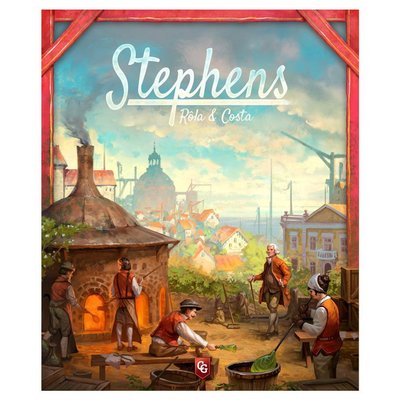
Yes, it's helping that player out by filling up their market delivery, but you're getting the reward. The end of these reward tracks are also end of game scoring. It's the only way to move them up. There are also so many ways to approach this game that each time I play, I feel like I'm doing something different or focusing on a different area. And with the game again only being four rounds, I never ever have enough time, but I still have a great time playing. So, it comes in at my number 30. 29 on my list is actually the last of my new games on my list, and this is called Stevens. Players take on the role of glass makers in Portugal in the 18th century. You're working towards gaining the most prestige before the arrival of the Napoleonic forces. And that's kind of the timer of the game. The main mechanism in this one is kind of a common action selection. Each of the main furnaces are filled with different colors of glass. On your turn, you can select one of these pieces of glass to store and then take the action associated with the furnace that you took the glass from. During the game, players are going to be playing cards beside these furnaces so that when a furnace is activated, all the cards are going to be triggered. Now, there will be more workshops opening up along the way as where players can play their cards. And there, of course, a good balance. Having a card aligned to a workshop on the outskirts of town may mean it's worth more points at the end of the game, but it's harder to get because the requirements of having more cards closer to town, and it may not be triggered a lot either. Now, there's a great push and pull of resources and shipping abilities and points, and this is the engine building that I find so enjoyable. Often, you're looking for the choices of where to take your action.
Emptying might bring around the end of the round, and it might allow other players to trigger their cards on that action space. So, is it really worth it if they're getting more bonuses out of the action than you taking that action space? The other reason why I enjoyed this game so much is the end of game trigger. It's largely dependent on the players when there are certain number of furnaces empty to the round, the end of round stuff happens. During this, they're going to be several things that players are going to be doing that they can only during during this phase and the Napoleonic forces move a step closer. As soon as one player scoring piece passes the army piece, because they're going to be going in opposite direction, the end of the game is triggered. I realize I'm probably an outlier for liking this game so much, but I've had so much enjoyment every time I play it that it's ended up as my number 29. Now 28 is Crusaders Thy Will Be Done. I was very happy to see this one being picked up for reprint by another publisher and is available again. In this game, each players will lead nightly orders to expand influence across medieval Europe. This is all done through a very interesting rondelle action system combined with the Monala mechanism. What this means is that each player has a rondelle that's split up to wedges for actions like build, move, crusade, and upgrade. Each wedge will have a number of tokens on it. And on their turn, you're going to select a wedge and perform the action. The action strength will be the number of tokens on that action. You then pick up the tokens from that action and place them one at a time on the next wedges, making them more stronger while making that action you just took significantly weaker.
You'll be able to upgrade these wedges during the game, and each game starts with a random distribution of these wedges. So, you're not always going to have, let's say, build next to move. You can also start the game with an asymmetrical knight, which will affect the setup and gameplay for you, which again, I enjoy. Players will be using this actions to spread out across the land and build buildings from their player boards, which are going to give them additional abilities and points. There is some battling through the crusade action, but it's all deterministic. the strength of the rondell action and your player board is compared to the enemy and you know what they're going to be and whether you're going to beat them or not before you even take the action which is kind of combat I prefer but really the reason why this game is 20 on my list it really comes down to that rondell and Moncala combination I find it so fun and enjoyable that you might see a crop up later on my list next is number 27 and that is Lost Runes of Arnac players are exploring a mysterious island to uncover artifacts defeat guardians and advance on research tracks when deck building first came out. I was all in for it. I couldn't get enough of playing them all.
Over time though, I started to get a little burnt out on kind of straight deck building game. Lost Runes of Arnack changed that for me. Yes, there are other games that offer deck building plus something else. But when you combine it with worker placement, advancing on tracks, and a fun theme, this has become my deck building game of choice. You'll be doing some worker placement and paying for the actions by using the cards. One of the actions is to purchase more cards to add to your deck. Your cards can also have an action or ability on them as well. There are also exploration sites to visit to get rewards, but you'll come across guardians that need to be overcome. And finally, there is a research track, which I tend to focus on a lot in this game for you to advance on and open up more scoring opportunities. Probably to my detriment that I spend so much time looking at that. For me, this me this mix of mechanisms and theme just works so well for me that if someone wants to play a deck building game, this is kind of always the one I'm going to suggest and why it's my number 27 on my list.
Number 26 is Heaven and Nail. Each player takes on the role of monks brewing beer in a monastery. a theme I can definitely get behind considering one of my game groups meets weekly at a bar. Now, the main mechanism for this one is a kind of a one-way rondelle action selection. You can move forward any number of actions you want, but you can never go backwards. When all players reach the end of the rondelle, the round is over. There's so much I enjoy in this game. First, that main mechanism. You can go as far as you want to get something you really, really want, but you might be skipping and leaving valuable items for the other players. But since this game is only six rounds long, you want to be as efficient as possible. and maybe jumping is the best solution. Some of the actions have you requiring new hex's to place on your board, which are kind of split into two halves. One half of your board is light, which means it can generate income. The other is dark, which generates resources. You can place a newly acquired tiles anywhere, but you have to pay the cost for the tile, and double if you place it on the on the light side of your board. And when you completely enclose a shed space with these tiles, depending on the value of the tiles you placed, you'll be able to place a shed and activate some of the tiles surrounding that shed, which is going to get you more resources, money, etc. Oh, and at the end of the game, scoring is interesting as well. Depending on where your brewer is, you can exchange your most abundant resource for your least abundant one. Then you multiply the value of your least abundant resource by where your brewer got to. And this is a big piece of your scoring. There's just so much to like in this game for some the fantastic rondelle angst balance between money and resources. And knowing the timing is pretty critical and why it's this is my number 26. Next is 25 and that is riverboat. Players managed farms in the 19th century along the
Mississippi. You'll be growing crops, harvesting them, and then shipping down the Mississippi River. Each round of the game has five phases. At the beginning of the round, though, players are going to draft these phases to be the leader of that phase. The leader will definitely get a benefit and a bonus, but all players get to do that phase. Deciding what benefit you really need during that drafting phase is vitally important as all bonuses are going to be useful. From grouping your workers in the cultivation phase to planting different vegetables to harvesting them and shipping them and then scoring, it's all intertwined with the previous phase. So, you need to be making sure that what you're doing in one phase are going to support what you want to do in the next phase. And I love that the rules are pretty light, but that allows you kind of the space to figure out what you need to do and which phase bonus you really need to draft this round. One aspect that I also enjoy is the scoring phase.
This is the only time you can actually score your opportunities, but you can only score a maximum of two per round. Early in the early in the game, you don't have a lot to score. Or maybe you want to grow them before you score to get points. But later on in the game, you may have more possible points, but you can still only score two per round. You often get close to the end of the game and realize, you know what, I'm just not going to be able to score some of the items because you just run out of time. It's that scoring tension combined with the interesting draft phase and the simultaneous play that lands this one is my number 25. Next on my list is 24 and that is my favorite Vital Lerta game and this is Lisboa. Players are helping rebuild the city of Lisboa after three 18th century disasters hit. Earthquake, tsunami, and then fire. Players will be managing their resources, constructing buildings, and influencing the royal court. On your turn, you can dock your ship, then take gold or take an action.
After the action, you take a political card, and do some basic upkeep at the end of your town turn. Now, it sounds simple. Even the action sounds simple. You're going to play a card into your portfolio to sell goods or maybe trade with a noble. Or you can play into the royal court as long as you have the appropriate noble or treasure card. Although the actions themselves are simple in concept, the cascading repercussions are where Lizboa gets its depth. Everything is tied together in interlocking cogs. Taking any of the top level actions, for example, trade with a noble action, that cascades into more options depending on which noble you trade with. And each noble wants something different for trade. You're often working backwards from what your short-term goal is. Like, I want to build a ship. Then you work backwards. I have to trade with this noble. He requires goods or gold or tools to trade. So, where do I get the tools? Okay, I need to do this action first so I have something to trade. And I love games like that. I know what I want to do, but I have to figure out all the steps I need to do to achieve it. And I find of all of his games, Liz Bow is the one that gets that balance perfect. Long enough chain to keep my mind whirling, but not too long as to make it seem impossible. And that's why it's my number 24 on my list. 23 is a game about developing the most advanced and profitable railway network across Russia. This is Russian Railroads. This is another worker placement game where the action spaces can take different number of workers, one to three. Each player board has three different routes and there are room for different track types, black, gray, brown, natural, and white. And they all have to be built in order. And a higher value one can never be in front of a lower value one. As you advance each route, you're going to be opening up various rewards like being
able to start another higher value track delay, victory points, or maybe bonuses. There's also a train on each track which will tell you how far down the line you can score. This is another Euro game that has some very intricate working cogs. You can easily see what influences what and what you need to do, but you want to do it all and all at the same time, and you always think the other players have it figured out better than you. It is a great mechanism where you can get an engineer for the next round, which is kind of like a private worker placement spot that's just for you. The main worker placement are pretty straightforward and they're all useful. So, if you really want to advance on a track and someone takes the that action, well, maybe jumping ahead in turn order is good or maybe getting an engineer or heck, even getting two points is going to be useful or two coins I should say. With many past victory and realizing you cannot do everything makes this one so enjoyable for me and why it's my number 23 on my list. And number 22 is a longer euro that I prefer at lower player counts because I often want to play the entire game. This is the colonists.
Players are tasked with building and managing a hopefully thriving community over multiple eras. Players will want to be building bringing in new farmers, craftsmen, and citizens along with longerterm goals of full employment. Now, this game does allow you to customize the experience you have. It's played over several set eras, and you can choose just to play the first era or jump to a later era. I like the concept of that, but I find that the game much more rewarding to play all the eras. That means it's going to be a long game. This is another worker placement game, or more like a worker movement. Each player will have a steward on the board which is comprised of action hex's. You move your steward to an adjacent hex to take that action. Later on the game, you can increase the range of your steward to maybe reach further. At the start of the game, there's going to be some basic actions you need to perform to get your settlement ready. As the game progresses, players will be pulling out new action spaces as the town grows and get more powerful actions on the board.
Players are also managing their own community. It starts off with just farms and farmers, but you can grow to having like a casino, a theaters, or even a library. This game is such an enjoyable journey as you build up your community that does feel very thematic if you play over four uh eras. The main mechanism of having to move your steward to take an action is also fast aim because as the board grows, there's no predetermined place for these actions to go. It's kind of up to the players where these actions on the board are. This is one of these games that I play for 3 hours or so, but have so much fun playing it, I don't realize how much time has passed. And that's why it's my number 22 on my list. Now, we have the final one of this section of 10. It's another failed and another one with a tight economy where every action needs to be thought through thoroughly to make sure it supports your long-term strategy. This one is bonfire. Players act as gnomes trying to rekindle the magical bonfires by guiding the guardians through a mystical world.
Yeah, I'm not sure what the theme is either, but what really stands out to me is actually the main mechanism. Each player has a grid in front of them with a random tile placed in the middle. Each of these tiles has three squares, and each square represents an action. The rest of your tiles are randomly placed in a cube beside your board. On your turn, you're either going to take the top or bottom tile from this queue and place it into your grid. You're going to get all the actions that are on that tile that you just placed. But if you place a tile, so its actions are adjacent to one already on the board, you can do that action as many times as the size of that new group of identical actions. The actions that are doing themselves are pretty straightforward, you know, but what this game is, it's a game of chains. I want to take this task because I think I can achieve it. First, I have to move my boat. I need to pay for it, so I need the resources. So, I need to make sure I have those. Then, I need to take the take a task action. Since the tasks are limited, you will be racing against the other players to make sure you get the ones that you think you can complete. There are also many aspects of the game that require you to make sure that everything is in order and requires careful planning. You can get partway through the game and realize there's no way you can achieve that task that you've wasted valuable time and resources getting. It's kind of up to you, though. I realize not everyone's going to like that, but I just find it fascinating, enjoyable. I love planning everything out and cursing the other players when they foil my perfectly laid plans. But it's just so much fun and it's my number 21. So there you have it.
30 through 21. Even when doing this list, I'm looking at most of these games thinking, "Ah man, I love these. How could I this not be my top 10?" But then I look at the one that's above and realize them that yeah, I do like the other ones more. But next time we'll be into my top 20. Spoiler, it's going to be more euros and maybe even a fel or two. Until next time, thanks for watching.
Hey everybody, thanks for watching another video from the Dice Tower. Hey, do you want to learn more about us, communicate with us, we have a Facebook group, we have a Discord channel, lots of different ways to get involved with the Dice Tower. You can find that in our linkree link below. So, just click that. It will take you and you can communicate with us on Facebook, join our Facebook groups. There's lots of cool things that you can find and become part of the Dice Tower. Thanks. so much for watching. I'm Tom Bassel.