Top 10 Competitive Games with Positive Interaction
Games in This Video
6 games are featured in this video — they unlock as you watch.


Transcript
Hey Nick, can I have some points?
Uh, sure man.
Oh man, that's a positive player interaction you just did, man. Let's shake on that.
That's really good. Hi everybody. I'm Mike.
We've been shaking hands for 15 minutes. My shoulder is
injured now.
I'm Nick.
We are the brothers smurf. And yes, we're going to talk about games that have positive player interaction,
which is our preferred way of interaction.
If I'm interacting with people, I want it to be that we're each getting a little something something.
Yeah. And we're not really into like, I'm taking this from you or I'm blocking this space for you. We generally like positive player interaction. Those kinds of games are great. A lot of people love that. That's wonderful. We just tend to like, hey, I'm doing this thing and you're going to get a bonus because I took your spot or
secretly hopefully I get a little bit more out of it than you do because I do want to win the game.
Totally. So, we're talk about our top 10 favorite positive interaction games. Our number 10 is going to be Fam. This is a game we've talked a lot about. This is from Freeman Freeze. It's a game where you are all working on the same central board uh and working for the pharaoh. So, we are playing cards, doing their actions, buying new cards that are going to have stronger versions of the actions and kind of building out and taming the land, building settlements and then cities and stuff and this kind of general progression. But because we all work for the pharaoh, we don't own any of this, any of the things that are on the board, they are not ours. So, I can build something and then someone else can build a road off it and go in a whole different direction than maybe I would have liked or plan to do, but it's it's all in the benefit of the kind of greater good because someone might do that, but then they create, you know, a city here or a vineyard or something and then I can play cards that are going to now benefit from the infrastructure someone else has built.
So, we all are kind of, you know, rising up as a society together. And I'm just hoping to eek out more reputation, which are your victory points, than, you know, my opponents. And I just really enjoy the nature of the everchanging board. The fact that you can kind of change, mitigate, uh, anything that's been built before and do different stuff, uh, and often benefit from something someone else has done. So, any game where you get to kind of mooch and be like, "Hey, great. Thanks for doing that. I'm going to do this over here and score these points. That's fantastic for me. Makes me feel good.
Number nine is going to be La Hav. Laave has some good player interaction and good for the most part positive player interaction. Sometimes it can be negative. So some people might be like that's not positive, but I personally think it is in this one. La Hav is a great Uve Rosenberg game. One of my favorites and one thing I like about La Hav is just how simple it is. um you will move your boat kind of down along this line and then you will repopulate some stuff and then you basically have two choices. You can either take a big pile from one of the depots like a big pile of fish, a big pile of clay, a big pile of wood um or you can activate one of the buildings and you can activate one of your own buildings for free or you can activate kind of the town's buildings or you can activate anyone else's buildings and that's where that player a interaction comes from because if I place my disc on their spot there is blocking. you're blocking that spot for them. And sometimes that can be bad, but I feel like more often than not in this game, it's usually good because most cards have you have a cost of either food or money. Um, and again, if you're activating your own cards, you don't have to pay that. But if you're activating someone else's cards, you have to pay them that stuff. And I always enjoy games like that. I don't particularly enjoy just blocking in games. I don't really find that kind of interaction to be fun or interesting.
That's just me. Other people really like that kind of aggressiveness. I don't. I just don't really like it. So, I enjoyed this was like, "Hey, I'm going to use this, but you're going to get something out of it." In a game where particularly food tends to be very tight in the first like half of the game, someone activating one of your building and giving you two food can be honestly really, really great. And so, I really like that kind of player positive interaction that is in La Hob. Sometimes be tough because you're like, I really needed to go there, but at least I got this little thing out of it. Um, I love La Hav. It's simple. It's great. That little bit of player interaction is wonderful. It's a banger.
Now a constant kind of like source for positive player interaction is the action follow action mechanism and earth does that uh to like the top. So, this is a game where uh the active player is going to choose one of four action types on a turn and they are going to get a stronger version of the action, but everyone is going to get to take a version of the action that was selected. And then as you're building out a tableau of cards of all these different types of uh plant life, you are going to be able to trigger any of your cards in your tableau that are matching the action type that was selected. So, if it was the red action type, for example, I'll do uh, you know, even I'm just following a version of the action, which will be weaker, but then I still get to do all of my cards, which is super powerful and beneficial, especially if I've been building up toward having a lot of red banner cards. So, I can get all of this stuff, all of these resources, you know, progress my game uh, forward a whole bunch even when it's not my active turn. You're always engaged with the game. You're always playing. you're always making decisions and doing things and that's super duper satisfying. And this game is all about chaining 15 combos off of each other and and creating like a synergy as you go through that tableau activating all your cards. And so it's very satisfying every time.
Number seven is Lanterns. Lanterns is so good. I feel like this this game is older at this point and so not many people talk about it, but I think it's really really outstanding. And this is positive player interaction kind of in a weird way because this is a game where you are placing out these lantern tiles which will have different colored lanterns on the four quadrants of the tile and you're placing them out onto the lake and the lake you'll be putting it next to other lantern tiles and then after you place a tile basically everyone will get the color lantern that's pointing at them. So, if it's like white, green, purple, and white, let's say white again. This person would get white, I would get white, purple, green, whatever colors I said, green, purple. Um, and so it's that positive interaction where you're always, every single turn, people are always going to be giving you cards.
There's never a situation where they won't. The only time would be is there if you are out of those cards, then they wouldn't get anything. But for the most part, that's the kind of interaction. It's always this positive interaction. But it makes it very interesting because when you are the one choosing which lantern tile to point out put out, you are trying to really look at what people have because you are turning in these lantern cards to get points from the emperor and you can turn in pairs. You have to turn in like two or I think it's three pairs or you can turn in one of all seven types of colors or you can turn in a four of a kind. So, if I see that Mike has three orange ones, I don't want to point an orange one at him because that's going to give him four for that four of a kind that he can then just turn in and score points. So, it's positive interaction, but at the same time, you have to pay really good attention of what you're giving people because you might be giving them exactly what they need to score. And so, it's this interesting thing where it's positive for everyone, but not really for you because you're constantly giving people other stuff, but at the same time, you're always getting stuff on your turn as well. And getting lanterns cards is always useful. There's never a time where you don't really want one.
Um, I really, really love Lanterns. Uh, it's been a little while since we've played and gosh, we got to get it back to the table because this is one of our first games that we played and I still really adore it. Um, I love the look. I just love the kind of relaxed nature of it. I love the fact that you're always getting those lantern cards. It's very good.
All right, next up is going to be Age of Innovation. This is a Terrammystica game. You could also say Terrammystica and Gaia Project all have this kind of positive player interaction where where you build on the board and how close you are to your opponents can be very beneficial for your opponents or for yourself because you are are benefited from building next to or having other players build next to you most specifically because every time I go to build a building, any players that have buildings surrounding the building that I built will get to cycle power. Uh they have to spend victory points. So there is a trade-off and they can cycle up power which can then become either kind of free anytime actions or there are certain actions on the board that could only be triggered using uh power. So you have to be kind of funneling you know energy through this engine and moving things through. So you are incentivized to build toward each other to build in a way that is going to uh have it be that people build next to you. But then me as a player, I don't want to just gift people power, but again, they have to spend some of their victory points, which maybe helps me get a little bit closer to their score. So that's really nice. And then also, there are certain buildings where they have a cheaper cost if you build adjacent to an opponent.
And so it's like, okay, well, I want to get to over here because I really don't have much money and I need this trade post to be a little bit cheaper. So again, all of the Terrammystica games uh feature this kind of positive player interaction, spatial, you know, relationship to each other, uh in terms of where we build uh both for our like home planet or terrain type, but also for being next to opponents or building a spot that opponents build next to me so I can do some of that cycling of power.
Number five is going to be Septima. This is a big really cool game by Mind Clash Games where you are um witches and you are witches in a coven. It is a is a competitive game, but there is a little bit of semi-oopness and that's kind of where that positive player interaction comes from. But you are witches and you are good. You are not like bad evil witches. You are good witches and you are actively trying to help out people in this town, but the town folk don't like or trust you and so they're constantly trying to arrest you. There are witch hunters out that are out to get you even though you are good. It's kind of one of those like very these good people are misunderstood. It really pushes that home and it's it's done a very cool way. It's got a very cool look. I really like Septima a lot. But there is a lot of good positive player interaction in the game because it is kind of simultaneous selection in terms of what different action you're going to do. And if you choose the same action as someone else and you both go to that same place, the action is a lot better.
It's a lot better. It's a lot stronger. It's really, really good. And so that's that kind of positive player interaction, a little bit of semi-oopiness where you're like, "Hey, let's let's both do this thing. The problem is is because both of you are together and you're doing this really powerful thing." It is going to attract the attention of the witch hunters and make them more likely to come to you. And so, it's one of those things where it's like there's positive player interaction, but there's kind of a big consequence for it as well. You don't want to do it all of the time, but there is really any downside to doing it other than downside for kind of everyone involved. But there's no like, you know, blocking each other or like, "Ah, I got this and you don't get it anymore." There's none of that in the game because again, you're kind of, it's a competitive game, but you're not really against each other in terms of like thematically. You know, in the game you are, but not really thematically because again, you're all good witches and you're doing good stuff out there.
You're just misunderstood and so you're being put onto trial. Um, and you can get people off of trial. It's kind of a big part of the game. It's a really, really interesting game with a really cool theme, a really cool look, and I really enjoyed that kind of positive player interaction, but with some consequences.
Next up is going to be Brass Birmingham. This is a game that is all about positive player interaction, which is something I didn't realize the first time I played the game. And it actually made me dislike the game because I didn't understand the kind of game it was. This is a game all about mooching. you're trying to mooch off of other people's stuff or you want to be mooched upon so that you can benefit because there are various tiles you can build out onto the board where uh you know it might be an iron you know you're smelting iron so you're providing iron uh either to the market or other players can use the iron that's on your tile and you want people to use this iron. Now, if you're using it, then maybe you're using it to do something that's going to score you some points. Okay? But as the iron comes off of my tile, if it's completely empty, I get to flip and upgrade that tile, which is going to increase the value of things, my uh income, and stuff like that. So, that's one level where I'm like, I'm actually benefited the more you use my stuff. I might also want to use it for myself, so maybe I want to use it first. But either way, I'm going to get something out of it. There's also the other thing of people have built up a city. Birmingham itself has been filled up with a bunch of tiles. Well, okay, I'm going to build my canals or or trains depending on which area you're in up to uh Birmingham and I'm going to get victory points based on the buildings that are in that city even if they are not mine because you have to be able to transport your goods around. So, I'll provide that for you. You can use my trains. And so you
are again benefiting off of what other people are doing. Uh and I just love the fact that anything and everything can be useful. You can do it yourself. Uh or you can have it be that someone else has done something. You're like, "Okay, I'm going to use that beer now and go do this thing. And yes, you're going to flip that tile and that is very beneficial for you, but I really need to make this delivery or need to build out this track or whatever it might be that's going to use this resource." So, it's it's that constant like stress of like making sure I get out of this a little bit more than you because we're both going to benefit.
Number three is going to be Space Base. Space Base is one of those no downtime games because there's always positive player interaction. I mean, I guess you could yell at someone for rolling bad, but that's kind of it. This is a game where you will have a space dock, uh, space base, and you're going to have 12 different ships numbered 1 through 12, which is what you can roll on a on two dice. So, on your turn, you're going to roll two dice, and then you're going to activate your ships. You can either put those dice together, like five and five to activate 10, or you can activate your five twice, or if you have like a six and four, you can activate your four and then your six, or your 10. The cool thing is is on whenever you get a new ship, because you're constantly buying new ships, say by a ship that goes into slot seven, what's already in slot seven will turn around and go behind your board and that new ship will go there.
And things that are behind your board will activate on other people's turns because then if Mike then rolls a 10, I can activate the ships behind my board in slots six, four, or 10. So, it's this really nice positive player interaction because what you're doing is not affecting other people. So, like if I activate my 10, it's not like, oh, that means Karen can't activate her 10. Haha. There's none of that. It's just like, I rolled a six, everyone activate your stuff. I'm going to activate my stuff. It's all positive. And that's really, really fun. So, I guess the only thing you could do is like be annoyed that someone never rolled a 10 when you when your 10 slot is like absolutely stacked and you're can someone please roll a 10 so I can activate all this. That would be something you could be I guess be negative, but for the most part it's all positive. I really really enjoy it. You are racing to 40 is it just 40? I feel like it's 40 or 42 or something like that points and then at once someone gets there at the end of that round that will be the end of the game. I really enjoy Space Base. We played this again recently and I was kind of reminded just how much I really like that game. game.
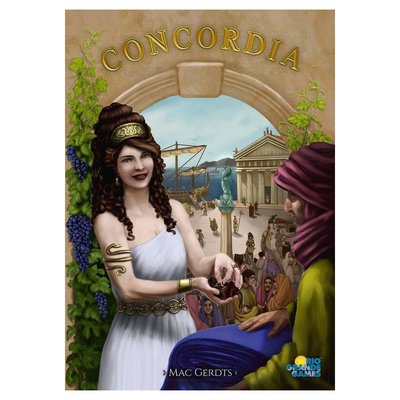
It had been a little while since we played, but it's got that positive player interaction. Absolutely no downtime. I just love it. Concordia has been on the mind recently because we just played it and I've been playing a bunch on the app and realized that this game really has uh a a center that is very interactive in a positive way. And that is going to be specifically with a prefect action where you're going to be activating a certain region gaining a bonus. Uh but then all of the buildings in that region will activate and if you have uh built buildings in certain cities, you will get the resources that are provided by it. But of course, if opponents have also built in those cities, they will get resources. So this is a game where you will occasionally get stuff off turn which can really kind of set you up for your turn. And I just enjoy the fact it's like, okay, I'm going to do this region. I really need the bonus that's going to come, but it does mean that some other people are going to get some, you know, some cloth or or some bricks or whatever that I that I would love for them not to have, but it's a concession I'm willing to make. And like that kind of interaction is really cool. And then every player also has uh a card that will allow you to copy the top most recently played card by an opponent. So for everyone who's uh played your cards and stuff, the top of your discard pile essentially will be face up and you
will, you know, occasionally copy something that's really powerful. Like maybe someone bought a card from the market and I don't have a strong version of this action yet, but I can make use of their action. there's always that kind of fun like little bit of like what what what what have people been playing? What can I what can I make use of here? And it feels really cool. Uh you know, especially if someone just bought that and then everyone uses it and they're like, oh well that uh you know, you're welcome everybody. So I enjoy that because it doesn't like actively hurt them for me to have done that, but I do get to benefit off something someone else did and that's very fun. And so the timing of those uh Diplomat I believe cards is always like really interesting trying to see what's going on the table so I can play it at the right time.
Number one is going to be Keyflow. Specifically Keyflow, not Keyflower because Keyflower is much more mean. Keyflow is not mean at all. Uh Keyflow is in the Key series. There's a whole bunch of different games here. Again, Keyflow is kind of a card driven version of Keyflower. Um, and that is a game where you can um activate other people's stuff. And in Keyflow, you're going to have basically kind of a a growing tableau of like upper cards and kind of lower cards. And those cards will allow you to do various different things. They might allow you to produce these kinds of resources like coal or ore or wood or stone. Some might allow you to transfer and move those other places because a lot of the cards will you will need to have the things on them for you to be able to activate them. Or at the end of the game, they're going to score a certain amount for a certain amount of resources on it. It's a lot of producing stuff, changing stuff into other stuff, and then moving it around to where you need it to score at the end of the game. The cool thing about this game is that you can activate other people's stuff, your neighbor stuff. So the person to your left, this is my right, person to your right, person to your left, you can activate their stuff because how you activate things is with these mele cards or keep cards they're called because it's key stuff, right? So on these mele cards, uh, they will have arrows pointing straight down, which means you get to activate stuff in your kind of tableau, but they might have arrows pointing to to the right and to the left. And when they're pointing that way, that means you get to activate stuff in other people's things. But when you activate their stuff, it doesn't block them. It
doesn't stop them from doing it. you say, "Hey, I'm using this card." And they go, "Okay." Because that's it. It's all it is. And so, I really enjoyed that kind of positive player interaction like, "Oo, Jimmy already got this really, really good card. I don't need to get that card cuz I can just keep activating his." You don't give them anything in terms like you don't you're not like giving them points or money to do so. You just get to do it. It's that positive player interaction where it's like, "Hey, I get to use your stuff. That's really really cool." And it just kind of opens up the game. And I really really enjoy it. Keflow I feel like always kind of went super under the radar. Keyflower is like the most popular key game I would say and because it's compared to that one a lot. I feel like Keyflow doesn't get mentioned a lot. I really really love it and I love that kind of positive player interaction where everyone's infrastructure kind of works for you. It's just really really good. Um I I think the key games are awesome and this is probably my favorite one. Um and I really really love it. So those are 10 games that feature some positive player interaction. We're both going to get a little something something out of this. We both have the ability to kind of drive this train.
some spiciness in there sometimes.
Absolutely. Again, you're still trying to win the game. It's not a cooperative game by any means, but it's the the fun tension of you're going to get something out of this. I want to get something more out of this and you're going to get so that I ultimately win. But if you get something, yeah, that's fine. I can live with that.
Or you did this thing and I got something, that's great.
Yeah, exactly. So, down in the comments below, let us know your favorite game with positive player interaction or your favorite way the positive player action shows up in games. Go ahead and do that as well. Um, and I think that's going to be it. Until next time, I'm Nick. I'm Mike.
We're the Brothers Murf. We'll see you later, everybody. Bye.