Top 10 Bang For Your Buck Games
Games in This Video
7 games are featured in this video — they unlock as you watch.


Transcript
Man, you know what I like this time of year? What? I like to find games that are really fun that we can play with a lot of people, but they aren't going to break the bank. That's what we need.
What's up everybody? My name is Nick. I'm Mike. We are the brothers Murf. Today we are going to be talking about the best bang for your buck game. Basically kind of like very high value games.
High value, generally lower price point, especially for what we think you're kind of getting in the box. Uh, I think it's really nice to, you know, uh, have games that can do a lot and stuff, but are not the most expensive thing, especially if it's game you haven't played before.
Uh, you want to, you know, hopefully make investments and things that are going to be worth it.
Like the best bang for your buck game is a deck of cards, right? It's it's very, very cheap and you can play a lot of different games. No, these are going to be high value kind of generally lowcost games. Let's go and get into it. Also, watch Mike's Mike's hair grow real fast. Our first up is going to be Forest Shuffle. This is a a small card game that you're going to build ultimately a big tableau of cards uh that are going to have uh trees that are going to house various types of uh of life and stuff. You might have birds and bats and deer and uh rabbits and things like that. And everything as you're playing out these cards are going to hopefully be building into a very synergistic uh kind of scoring engine where you can get rewarded for, you know, every deer you have has a little kind of the little hoof symbol and you might have another card that gives you, you know, bonus points for each of those symbols you have among your tableau. So now now you want to try to really focus on that. And what I think is really great is like it's ultimately a small card game.
There's just really cards in the box and that's about it. Uh, so it's not super expensive, but there's so many types of cards and ways to play uh, you know, play out your tableau and kind of build up these really cool uh, synergy combos and stuff in terms of your points. So, I really enjoy just playing this one kind of again and again. And there are expansions and stuff and each of the expansions, I think, are like 10 or 12. Again, very minimal cost and you can end up with a lot of content uh, in a game that I find kind of infinitely replayable.
Number nine is going to be code names. Now, Code Names is a big at this point kind of mass market game, but here's the thing about Code Names is you can just play it over and over and over and over and over and over and over again with basically any group of people. This is a game where you're going to take a make a grid of words or if you're playing code days pictures a grid of pictures but a grid of words and they're going to be like mouse elephant door knob car just just random words. They're in a grid and then you have two teams. Um and there's going to be like a code master for every team. So basically someone who can see what codes are yours and then what codes are your teammates. You're basically trying to get sorry your your opponents. You're trying to get your teammates to guess your words out in the grid and hopefully not have them guess your opponent's words. And so you're doing that by giving clues. You're giving one-word clues and then you're basically saying the clue and then how many words out in the grid that that clue pertains to. So if there was like elephant and goat out there and both of those are ours. I could be like animal for two.
But what if there's alligator out there? You're kind of like well that one's not ours. So I can't say alligator. So what's let's say gray goats? goats are gray, elephants are gray, something like that. And here's the thing, it just works. It just works really, really, really well. That's just what it comes down to. This is a great bang for your buck game because it's a relatively cheap game that just works and you can play it over and over and over again. There are various different kinds of codings. There's codiums duet, which is a two-player one. You can do that one. There's a whole bunch of different ones. Pick your favorite and just go with it. It's great.
Next up is going to be Gloom Haven Jaws of the Lion. I think honestly any Gloom Haven game is a really good value. However, the Gloom Haven and Frost Havens are not cheap. So, Gloom Haven Jaws of the Lion is a cheaper way to kind of get into uh the Gloomverse uh and and play through I think 25 scenarios in the box. It's a great way to introduce you into the mechanisms. The first like five scenarios are sort of a tutorial of sorts where they're going to introduce more mechanisms, more types of things you're going to see, more types of baddies and stuff like that as you go. So, it makes it really accessible to get into. It starts you very simple, kind of builds things up so that you're ready to go. And then all of the content for Gloom Haven, Jaws of Lion is cross-co compatible with Gloom Haven as well. So, you can like play those characters in your other uh Gloom Haven game. So, I like that it's, you know, a separate thing. Uh, it's very easy to set up and get playing, but you can incorporate it into the larger game if you wish. Um, but it's nice to know like, oh, I can try this thing at a lower price point, get a ton of content just in that box. Uh, and then if I want to go for like the big game, you can then step up into that.
Number seven is gonna be target. Not often do you get kind of a heavier game in a small box size. And that's what Tari is. Tari is one of those two-player Cosmo games. Comes in that little square box that Cosmos does for their two-player games. But this is a relatively not super super heavy in terms of complexity, but in terms of strategy can be quite heavy. This is a interesting two-player really, really in-your-face game where there's going to be a grid of cards. There's going to be cards on the outside of the grid um and then there are going to be cards on the inside of the grid. The outside of the grids are going to be actions and the inside of the grids are going to be tribe cards which usually give you some kind of points and then goods cards which will give you resources which you'll need to pay for those tribe cards. And so how it's going to work is you're basically going to have three of your targets and you're going to put them on the outside grid. And then basically you're going to do the actions of where you put them. But then on top of that you're going to draw straight lines kind of across basically from where your target is and wherever those lines would intersect. So, if I have a target here, a target here, their lines would intersect here, right? You'll also get that card in the middle. So, where you place them is determined by what actions you want to do, but also what cards you want in the middle. But there's a ton of blocking in this game because you obviously are not allowed to put your tari where anyone else's is.
But you're also not allowed to put your turkey opposite from I can't remember if you put you can't put them opposite from each other, but there's also a robber going around and you can't put opposite to the robber. So, this is one of those games where there is a ton of blocking in the game because like I'm going to go here because I know Mike really wants to go here. I know he really wants this card and now I'm going to block this from him. And so, there's all this jockeying going on in the game. And it's really, really good. And it's really small. It's a small box, pretty small table presence, but is so so good. So much depth of strategy. Such a good game. So, if we're talking about bang for your buck, this has got to be one of those out there because it's a great two-player kind of heavy strategy game that's pretty darn cheap.
Next up is going to be a game called Planted. This is one that like still uh you know, talking about price to quality is from Buffalo Games uh is hard to beat. This is a game uh card drafting game where you're putting uh house plants into your house and you are trying to uh you know add the resources the water and the sunlight and stuff that these plants require to grow into their kind of most valuable form. And this is one where like the little sun bits and the water bits and stuff are super nice. They're just really really satisfying. The art is really beautiful. Uh anything with like plant life and stuff is always going to have a level of appeal. Uh, and I think when we bought this game, it was like $20. Like very very low price for the kind of quality of pieces and things you were getting.
And I was really blown away by that. And it's a great uh, you know, entrylevel kind of game to teach you card drafting. Uh, and so it's great kind of for anybody, but having a game that has so much kind of appeal to the eye, uh, I think is really important for help, you know, helping to draw people in. And then you have a nice game that is easy to get into and easy to like. Uh especially with those really nice kind of premium feeling bits.
Next up is going to be Azul. Really kind of take your pick of a abstract strategy game. Abstract strategy games sometimes, more often than not, I would say, tend to be relatively cheap or on the cheaper side, but you can kind of play them forever. There is a reason why chess is played forever. There's a reason why simple trick taking games like hearts and spades are played forever is because each time you play, it's just a new puzzle that you get to solve. And that's very, very fun. And when you can do that relatively cheaply, it means it's got great bang for your buck. Azul is a really, really great one. It really took over the world when it came out. and it's still very very popular. This is a game where you're building out a mosaic on a wall and you are drafting tiles from these various depots out there and basically you can grab like one tile or you can grab all the same color of a tile and you're going to put them on your board and fill out these kind of rows and each row can only have one color of tile and they all can have different amounts of tiles. So the top one can only have one tile. The next one could have two tiles, three tiles, four tiles, five tiles, and you won't get to actually use those tiles until that row is completely filled up. So, if I have my row four, I have like red tiles in there. I need to have four red tiles in there. And then what will happen is the rightmost tile would get to come over into my mosaic. And the rest of the tiles would just go back to the bag. So, the way to get them over to your mosaic to actually score these tiles is to fill up these rows. But if I only have one more space in that row and I take three red tiles to fill it, well, one will go
there and the rest will go to broken tiles and those will lose you points. So, there is a ton of hate drafting in this game where I'm like, I'm going to leave Mike a bunch of these tiles cuz I know he can't take any of them and he's going to have to take them all as negative points. So, it's a really really kind of in-your-face drafting and it's just a really really fun um abstract strategy game. Again, take your pick of abstract strategy games. Most of them are an incredible bang for your buck, but Azul is one of the best ones out there.
All right, next up is going to be Spirit Island. This game uh really kind of makes the list for us because of its, you know, depth and replayability and uh you know, especially if you get expansions and stuff, uh there's just tons and tons of content. But even just in that base game, uh there's a lot of fun stuff to explore. So, this is a game where you are the spirits, uh kind of presiding over this island and protecting the native peoples that live there from these invaders that are kind of coming to your shores and moving out and building cities and stuff like that. And you are going to be taking out uh the various units and then spreading fear to kind of scare these folks off all in name of protecting the people that already live there. So, it's a really cool fun theme, but you're all playing as a different spirit. And the spirits are are very uniquely different from each other with their own strengths, their own kind of focuses, their own kind of special abilities that they can trigger. Some are more offensive, some are more, you know, kind of defensive and sort of crowd managementy. And that's where this game, I think, uh, really shines and and gives you a ton of stuff to explore cuz each, you know, spirit is its own puzzle.
Figuring out how to how to work them. you know, if you're playing multiplayer with other people, how do you have your spirits work together and bounce off each other? Because it's a cooperative game. Uh, or if you're soloing it, just getting really into one spirit, really trying to figure out how to perfect them. And then once you do that, and you feel like, I got this one down, there's all these other spirits to try that are going to give you a whole new puzzle to explore. So, this is a game that people play over and over and over again and and really get into. It's a difficult game. Uh, so there's just really kind of a lot to munch on uh strategically and stuff with this one that I think is really really cool. And even just again in that base box, there's a ton of spirits and things to explore without even getting into the expansions which give you even more.
Number three is going to be Sky Team. Sky Team is it's kind of astonishing how much they put in just the base box of Sky Team. Sky Team is a two-player game by Scorpion Masque and you are working together a two-player cooperative game where you are trying to land a plane. One person's the pilot, one person is the co-pilot. There are all these different things that need to get done to land the plane. You know, you can't be coming in like this. You have to have your like landing gear engaged. The landing gear is down. You know, that kind of stuff. If you know that reference, pop it in the comments. Um, and so you have to kind of do these things. You're doing this by rolling dice. So you can kind of discuss what you want to do and then you're going to roll dice behind your screen and then no more talking and you just have to put out dice. But many of the different things you each have to put out a die every single round. So one that maintains the tilt, you each have to put a die out and the plane will tilt in the direction of the greater die. So if I put out a six, Mike puts out a four, the uh the plane will tilt too in my direction. So you need to kind of be coming in you need to be coming in flat if you can. There's ones with speed, all those different kinds of things. And then there's um a couple different spots that only the pilot can do and a couple spots that only the co-pilot can do. And you're trying to land a plane. So that's cool enough. But in the game there are different airports. The normal airport is Montreal um I believe. And then there's like Heathrow and Heathrow is a very very busy airport because it's going into London. So there are all these train all these planes that you have to get out of the way. There's other ones where you're landing on like icy icy runways and that's a whole new
mechanic. There are ones we have like kerosene leaks and there are a whole bunch of different airports in the base game and you kind of get to play through like a little bit of a campaign and each one you can kind of just play individually. You don't have to play them necessarily in order but there is a ton of content just in this base game because of all those different airports. It's a lot and what is ultimately a pretty small package and just an overall great game. Um it's it's kind of amazing how much they put in this game. It's really, really good. A really good bang for your buck.
All right. If you know us, you know that we're a fan of TrickTakers and we're specifically fans of The Crew. There's The Crew Quest for Planet 9 and then The Crew Mission Deep Sea. Both are fantastic. We own both and you can definitely own both, but if I had to choose one, I'm going to go The Crew Mission Deep Sea. This game is very inexpensive and it is a cooperative trick-taking game. So, we're all going to be working together to kind of satisfy specific missions, uh, specific tasks and things, uh, kind of from scenario to scenario with a, you know, an ever ramping kind of increase in difficulty. And these tasks are really varied. It might be that, you know, one player uh, has to take a specific number and suit of a card. And so we just have to find a way that they win the trick that has that card in it so that they get to, you know, succeed in that task. Other ones might be more difficult. You can't take certain types of cards at all. Uh or you have to win the last trick specifically. Uh and on and on and on. Uh and the reason we like the crew mission deep over the original crew is the crew mission deep sea. All of those task cards have um a a difficulty value that is assigned based on the player count you're playing. So, it's designed uh with a little more scalability in mind because certain types of tasks will be really easy if you're playing three player but very hard at five. And now, if you are playing five player, that value will show that this is more difficult. And as you do a scenario, it's going to give you you need to get eight points worth of these mission things. So, it just it makes it a little easier and a little more scalable. Uh trick taking is a really fun mechanism.
The whole kind of nonverbal communication that happens by the types of cards you play uh I think is really exciting and I think trick taking can feel maybe daunting to people uh who haven't played as many. So I really like that this is a cooperative game so we are going to learn together. If I've played more trick taking games than you and we have a round uh you know go by I can then at the end of that round say hey this is what I was trying to say and what I was trying to communicate by doing this. I think it's really nice that you make it kind of collaborative and we're all encouraged uh to learn and get better and stuff together.
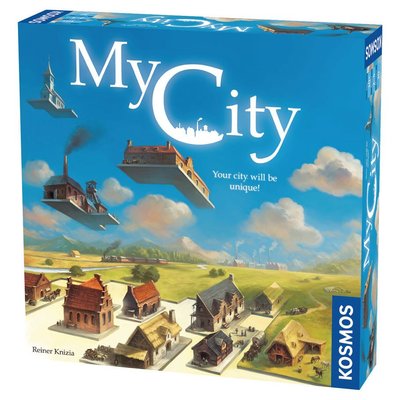
Number one is going to be My City. My City. A lot of legacy games, these big campaign games, even though many of them tend to be very very expensive, you can argue that that's very very worth it because if you're going to get like, I don't know, like a h 100red hours of play time and that game costs 150 bucks, that's pretty good value if you're really thinking about it. But a game that tops all of them is going to be My City. My City is such a good value. It's insane. My City is a legacy game by Riner Kenitzia, and it's not a 100hour game, but it is a decent amount of plays. This game is based in chapters and each chapter is going to be three separate little games and you're kind of meant to play through a chapter in one sitting and there are a number of different chapters and as you go through the chapters there are going to be rule changes because it's a leg legacy game.
You're putting stickers down your board. You're changing stuff up and the rules are going to change. None of the chains are going to be big. It's a writer kit game so none of the stuff's going to be big. It's all kind of simple, pretty streamlined, pretty great stuff. But it's such a good value because this game very often is like $30 because it's just cardboard and stickers. That's it. They can keep that price point down and therefore keep it at a spot that's really really affordable and is so much fun. It's a great legacy game. It's a polyomal game where you're kind of again depending on what chapter you're kind of doing different stuff but you're usually trying to fill out your board. There's stuff getting in your way. There's going to be like gold mines and stuff that come up. spoilers, I guess. But nonetheless, all sorts of different stuff and it's constantly changing. It's really, really cool. But it comes down to that price point of $30 for a legacy game that's also very, very accessible.
A lot of times these big, heavy games tend to be massive and big and kind of very intimidating for new players. Not My City. You can play this game with basically anybody. It's so good. And for the price point, it's insane. Usually like what we've done, we've literally played through it and then we just bought a second copy and played through it again because it's so cheap. My city is incredible. My island is also very cheap is also very good. The My City Roland and build like the Rolland right is also very very good and also very very cheap. This whole series of games is incredible value for what you're getting and the price point that you have to pay. It's so so good. So those are 10 games that we uh find a lot of value in, especially at their price point. Uh uh but please get some recommendations in this time of year for holidays and gifting and stuff. These are the perfect kind of games to give to people because again
uh you know money's tight for everybody and stuff and so it's nice to be able to give some uh awesome board games to people and and be able to give it to hopefully more people. So get your recommendations for bang for your buck games in the comments below. Let's get a big uh reference list going and we'll see you on the next top 10.
Bye everybody.