Molly Johnson & Shawn Stankewich of Flatout Games - TCbH Interview



Transcript
Hello, welcome back to another episode of the Cardboard Herald. My chance to talk with creative gamers and game creators. And today I'm joined by not just one, but two of the Flatout Games crew. I have Molly Johnson and Sean Stankevich. Welcome to the show, guys.
Thanks for having us.
Hey, hey.
It's a exciting time of the year uh for publishers. Uh well, probably for everyone in general. It's summer. What's not to love? But uh you guys are coming off of Gen Con, right? What was the whole rigmarole over there? Any differences this year than previous years?
Well, I feel like we're kind of in a routine with Gen Con. We have our booth and we usually have what's coming to Kickstarter on display. We've usually got our new releases there. We are guests of AEG at their booth and so we share the demonstration of the whatever 2026 uh titles that are coming out, demonstrations of those. Um we are also kind of really ramping up our promotion of a role-playing game that we are working all on called Whisper Stone. And so we've got a lot of the booth dedicated to showing that um game off and then we also run Whisper Stone events at Gen Con. So, we've got the booth and we've got events and it's it's sort of a well-oiled machine at this point. Um kind of a rhythm to it, but it's always a a really interesting week of our year.
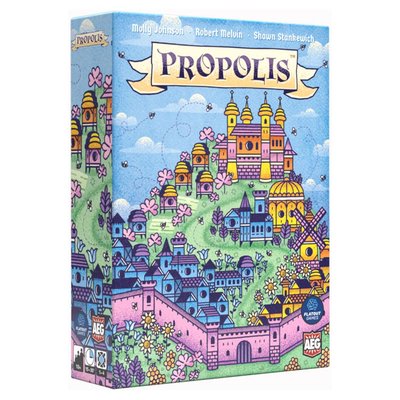
Don't worry, I got Whisper Stone questions. I ended up playing it at uh PAX Unplugged last year at least a a demo version that you guys had. Uh and uh I'm really excited and fascinated by the game in general, especially when considering the trajectory of Flatout Games uh and the types of games that you've published in the past and where that leads us to and of course we got Perennial to talk about. I just need a moment to like gush about Propolis. I I played this again just the other day. I mean it's in regular rotation at my house but like this is I don't know. Like this is one of those ones where I'm like I don't I don't ever see myself getting rid of it. I I always come back to this. It's kind of like a Splendor killer in the house.
We're we're big fans.
That was the goal.
Yeah.
There we go. Well, I do want to kind of go back and talk briefly about the the origins of Flatout Games. If you want the true origins or you know just kind of the overview people in the audience can go to the website and there's an about us which is really great. But something stuck out to me in there. You said that it's a board game design collaborative. What does that mean?
Well, I guess it sort of comes out of the fact that three of us Molly myself and and our other partner Rob really started designing games together right and we sort of like I think I was sort of like the first one to get really like obsessed with board game design and I
decided like this would be a really fun thing to drag all my friends into and you know, I think the early days of Flatout Games was a lot of like um collaborative design approach and just like bouncing ideas off one another and playtesting and you know, that sort of thing and so we've always been like you know, we've always done co-designs and we've always worked together on design work and that sort of spirit of working together and collaborating kind of extends from the design work that we do into like the publishing work that we do now, too. So, like it's always been part of our DNA just like working um you know, many people and uh together and many brains on something is always better than one and we just really believe in kind of um sharing in the responsibilities and the like creative work of like building a a thing together and it works really well for board games, right? Cuz you kind of hard to I mean, you can obviously like solo test some designs, but it's a little harder with board game design to do it all on your own and so, we just thought, you know, why not build a team of people that are really dedicated to and having authorship over um designing board games.
You have to kind of take your ego out of it, too, though. I mean, collaborative design is great. Collaborative uh production and artwork in general is is great. Any creative endeavor. But, you know, you get into those is this a Lennon and McCartney song or is this a McCartney and Lennon song? Uh or is it across the board just going to be, you know, like the three of you? Was that a discussion that you guys had to have early on like, you know, no matter what the perceived uh amount of uh effort any individual person put into this so long as we're the three core people from Flatout Games, all three of our names are going to be on this.
Well, Sean really drives everything forward at least in the game design space, but Rob and I have been like, you know, varying degrees part of that process. And you know, we've got something coming up recent like I I yet to be announced uh title that was say, for example, something that I had like conceptualized and then on a walk, um we just hashed it out and then Rob has been, you know, working on it at a distance from us. But again, it's we've just taken that on as sort of the core way that we approach game design and so that's it's just it it's just what we do now.
Is this for all three of you guys full-time flat out or is this side project for you guys?
Until very recently, I say that but it's been 2 years. It has been a It was a side project for all of us and I went full-time 2 years ago.
Wow, congratulations. I I I can't imagine, you know, like how many ups and downs and kind of the the like changes and challenges and risks that you had to take from the time that you guys were first working on, you know, the little bits of designs when Sean's like, "Hey guys, let's actually look at designing games." to now you're, you know, managing these huge convention booths that you know, you're sharing with AEG but nonetheless Flat Out has a big presence at conventions. It's definitely a big endeavor and in a lot of publishers you have the one head, the one lead um making it all this this time to be like a collaborative endeavor is no short achievement. I do want to ask about conventions though. What does it mean in 2026 to have a presence at a convention? Is it retail? Is it exposure? Is it the networking? Is it pitches? And has that changed from the time that you guys first started?
Yeah, maybe. Uh something like Gen Con and PAX Unplugged I would put maybe in the same category. And then the years that we go to Essen where we don't have we haven't had a booth, but AEG has a booth. Um We were actually talking about how Gen Con is kind of like our New Year. It sort of feels like, you know, those winter holiday times where it's like, "Oh, the fruits of our labor. We've had a big long year and then we're at Gen Con and we're showing off the new titles which are often released in limited run there and we're really gearing up for the year ahead." And so it's this really pivotal point in the year. And it's not only for the work that we've been doing, but to meet with all the people that we work with. So by and large our um partners and our contacts and the people that we are close with in the industry, everybody's there. And so it's a time, you know, to get breakfast, to have dinner, to play test games, to play new games, to have important business meetings about like, you know, soup-to-nuts kind of stuff that we're doing. And so conventions are still really important.
Uh I think they are also, and I maintain this, really important to be at the booth and showing off a game and pitching the game to, you know, hundreds of people in a row and seeing what they're responding to. What part of my pitch, what part of the art, what part of the mechanics are people responding to? And particularly in advance of when I'm going to do some marketing, what do people want from that game? What are they looking for in that game? Who is going to be interested in that game? And we can't There's no way I can get that sitting at my desk or just having our meeting with our dev team. Like, that's just invaluable. And so it's a great social event, but it's also a great kind of marketing research event.
And there's an undeniable special quality, I think, that's still preserved in tabletop games that isn't really there in other industries where there's the accessibility. you know, like in board games, these companies, your company are relatively small compared to even, you know, like the smallest of studios that are making video games in many instances. And the idea for someone who who's just like, oh, I'm interested in Propolis or Cascadia or, you know, like Perennial or whatever, that they could go up to someone at a booth and be like, oh, could you tell me how to play this game? And you're like, sure, I made it. I'm the person who made it. And the, you know, like especially newcomers to the hobby, I find tend to be shocked at like, whoa, this level of accessibility, shouldn't you be in an ivory tower crafting game somewhere instead of wearing a flat out shirt and demoing them at a convention? I mentioned Perennial, you guys have games coming out. I I feel like you got games coming out like every other week and I I want to talk about some of those games.
You know, Perennial is is the next in a long line of tile-laying games for you guys. That seems to be like a tried and true genre that you guys have come to be known for. Um, but is there any difficulty in like crowding your own market? Like do is that a publisher concern of like, well, when are we eating the apple that Cascadia or Calico is supposed to be chewing on? What are some of the decisions that go into that?
That's it. I mean, that's the that's the big question, right? I think when we started publishing games, like the origin story is we started publishing games because our friend Kevin designed Calico and we were like, this is this is so great. He had the he had the basic design for it and we were like, this is awesome. Like what are you interested in publishing it? Like, what are you going to do with this game? And he and you know, I had this sort of like hairbrained scheme. I took it back to the team and I was like, I found this game that Kevin has and it's real good. I know we've talked about like designing and publishing our own stuff someday with crowdfunding and stuff, but like I think this game would be a lot of fun to work on. And so, we just sort of like, you know, Kevin was really interested in building a collaborative process and kind of working on it together. And so, the rest is kind of history and how we built our collab and started publishing games.
But, um we just have generally gravitated towards making the games that we want to play, right? And so, Molly, Rob and I are both are all are all huge fans of puzzly tiling games, right? And you know, we kind of got excited about games like Patchwork and Azul. Um and just saw that there was like a market out there for games that were not necessarily combat-heavy or weren't like medieval or like had these themes and artwork that were a little bit more cozy and inviting. Um and you know, Calico was really that like first game for us that, you know, we really our our whiteboard statement for that game was like, be on the shelf next to Azul, right?
Mhm.
And it's like [clears throat] that's like such a pie in the sky thing for like a new publisher, right? Like, it was totally not in the cards. And we just all believed in that game and worked so hard on it and, you know, had the good fortune of meeting Beth Sobel and, you know, the rest is history, right? How all that how that game came together. Um but anyways, the the long story short on that is that we really gravitated towards making those kinds of games. And when Randy had a had the beginnings of what would become Cascadia, right? We played an early version of that and again it was like, "Oh, this has like some interesting similar bones here, right? Like this is really you know, and at the time when we signed Cascadia, like we hadn't even like published Calico yet. So, Randy took a big leap of faith with us. We we had known Randy for a while, but like he took a leap of faith to like sign the game with us. Um and we all worked on it together as well, but that is a challenge to think about like how many similar games in like a genre can you put out as a publisher? And I remember early on it being like so frustrating that like all of our games were mostly just compared against each other, right? It was like, "Oh, is Cascadia better or is Calico better?"
And just asking the question like if we were two different if they were by two different publishers, would people make the same connection or whatever?" Like you know, what like because they're aesthetically and theme and mechanically similar and from the same publisher, like they got a lot of comparisons. Um and so you know, at this juncture it's kind of like there's space in the market. We we've seen recent titles like Acropolis or Harmonies, Shallow Sea. There's a lot of games in those genres and so I think people who love puzzly tiling games have a lot to have a lot to absorb and and it's a great time to be a fan of those types of games and so I think we kind of feel like you know, putting out games in that genre, we have folks who are like, "We have all your games, right? We're excited to build the collection and we like every new every year or two there's a new puzzly game that we're really excited to to play."
So, um you can kind of either fill that space yourself or you know, another publisher can fill it too, right? So, I think it's easy to talk yourself out of like is this too similar to something we've done before, but like if we're excited about it, like we usually say
And I would say Perennial, which Shawn could probably talk at length about, isn't like those other games. Like it's a it's a deconstructed polyomino drafting drafting tile laying game, but I don't feel like there's really anything about it that particularly if it came out with a different publisher, it would draw any comparisons to Calico or Cascadia. I mean it is a tile laying game and there's a spatial element, but in terms of it being unique in its draft in its puzzle, I think it's very different and so I think we are finding those spaces to give people new mechanics and new puzzles within the space.
And I think that in games that are relatively approachable and welcoming in the way that you guys make them, there there's less mental taxation to like just keeping up with the game itself. I'm I'm kind of uh I guess what I what I'm thinking about is I have Eclipse second edition on the shelf. I don't need a lot of other 4X space games because I already struggle to remember all the rules for Eclipse second edition. Whereas I can have Fit to Print Harmonies, Calico, Azul all on the shelf because I can easily remember those. I can you know just kind of see where the vibe takes me, the the aesthetic takes me and you know like I can rotate them into my group a lot easier.
And also, you know, like to bring it back to the musical thing, um sure, we we may want an artist to try new things, but at the same time, you don't uh get mad at Metallica uh if they make a Metallica song, right? You know, like uh it's something that you guys are good at and you know how to twist to create some new variety, some variation on it. Um I am interested about incorporating theme uh though because uh a lot of tiling games uh are uh abstract and you you can kind of modify different themes. I hate the terminology of pasted on themes because it's it's incredibly dismissive uh to the the effort that goes into games, but Perennial, for example, did that always uh exist as a gardening game or did that start as something else and morphed over time? Tell me the story of it.
Uh no. Um and I will say that I think one of the things that is true of us as designers most of the time is that we're pretty like mechanically focused designers, right? We're usually excited about like, "Oh, a mechanic or a feeling or an experience that happens within a game." And then what we try to do mostly is try to think about like, "Well, how can we find a th- a theme for a game that we think can really like bring out that experience, right? Can like complement it really well." And then often times when a theme is established in a game, there's a there's a lot of like back and forth where the theme will start to then go back and influence the mechanics because it doesn't make sense if we do X in the game. Uh what does the theme tell us would make sense and that sort of thing?
So, Perennial was not always a gardening game. Um it actually started as um uh
cross stitch
as a cross stitch game that Emily was working on. So, this idea of like constructing and deconstructing polyominoes and taking like small um kind of pixels or if you will, right? The squares to like build up a larger grid started there. And um for various reasons and interesting reasons, right? That like it's difficult to um gamify crafting sometimes because of especially with counted cross stitch, we found that like it's unsatisfying to not finish your cross stitch. And it's unsatisfying to incorrectly do your cross stitch. So, what are the parameters of success in a game like that, right? And so, it was a really interesting like conversation that we had and a process by which it gradually evolved into being about gardening and we were really excited about it because we didn't want to make a generic gardening game. We're from the prairies and this is really embraces the idea of like a prairie garden. And we've done we've done a lot of themes in the Pacific Northwest and this was sort of like this is sort of a departure back to like the place in Canada where we um where we grew up. And so, that feels like really close to home and really exciting for us. I did a lot of a graduate research in prairie ecosystems and wetland ecology and things like that. So, it's really like although the game is obviously very abstract and a lot of the you won't find any wetland ecology themes in this game, but uh
it feels it's sometimes really exciting to like let the mechanics kind of influence the game and let the game influence those mechanics and and you know, rather than having this sort of you know, the pasted on nature, really let the game come into itself when you've decided both the mechanics and the team theme and let them influence. Yeah.
Was there any part during the design or development of Perennial where you would had to kill your darlings, you know, like there was something where you were like, "I really love this element of this game, but for the sake of the better game, I have to let this go."
I feel like more almost more than any other game we've published, Perennial like Perennial has the most slaughtered darlings.
Like cool, man. And that I And like as frustrating as it probably was for Emily and Shawn, like I my brain would just completely break playing the game, and I was like, "How do Can you guys make like We got to make this easier." Like the board the drafting board, which is now 5 by 5, was like 7 or 8 by 7 7 by 7 or 8 by 8.
Mhm.
Like cool, it was a lot. There was like the choice It was all about like refining the choice like limiting people's choice. Like it was fun when it was big, and but it was there was so much going on.
Yeah.
Sorry. I'll I'll I will let Shawn explain it, except that I was like, "This is the This is the absolute slaughter of darlings." And
Too much opportunity can be problematic. Uh that invites the paralysis.
Yeah.
Yeah, it was a really interesting process because um it's probably still in the spatial puzzle realm like probably our crunchiest game that we've published to date. Um and the rules are still I mean, our part of our core is like always making rules like super simple so that the puzzle is really the challenge that you get is not from like having to remember 5,000 rules, but really like figuring out how to balance all your incentives when you're playing the game. And um so yeah, we really had to you you we the game went from like six rounds down to four rounds and the size of the boards decreased and the there was a really cool spatial puzzle thing where the four tiles that you put into a square could then have another tile placed on top that, you know, based on what the configuration was. So it was like this dual layer puzzle at one point. And what's cool about that is that like some of those ideas we've just like spun off and been like, well, that's a cool idea. Let's just make a game around that, right? So as and some of the darlings got slaughtered and then some of them got whisked away
to be part of another game.
Spun out into a whole other game.
That's one of those things you know, like you hear about authors doing where you know, like Tolkien famously never threw away anything. He'd have an idea and he'd be like, this isn't working here. So he'd you know, tuck it into a drawer only for his son to you know, uncover years later and be like, this is how orcs are made. But
while I have you guys, I got to I got to talk about Whisper Stone and learn more about it, you know, like I I played a demo version that now is about a year out of date. So for all I know the development could have come along massively, but at the time when I played the the scenario, it was myself and two others there and I remember thinking immediately like this is so genius how natural it is to say, well, if a piece of armor fits, then it is an piece of armor you can equip.
And it reminded me immediately of like as a kid most kids would have you know a thick picture book where you could replace clothes on a person or you could you know paper dolls or something. Um and it felt so intuitive and imaginative and colorful. Uh and I also remember thinking my god this is so ambitious and is unlike the scale of projects that I'm used to seeing out of Flatout Games. So what was the concept and what made you guys just like stick with it that you know this is where you want to break into RPGs and make your like epic game.
I will say just briefly that it follows in the philosophy of making the games that we want to play. So I've always [clears throat] been RPG curious and I've always thought oh I think I would like this but I just can't get into that space of like a pen and paper book RPG and experience. And when I played Whisper Stone the first time or played it a few times then I got into the rhythm of what's expected in a tabletop RPG experience and it was like oh yeah okay. Now you can give me anything. Give me Blades in the Dark, give me a Pathfinder story whatever like I get it and I will play one with you. A story like a some crazy story RPG that's real loose. I understand the conversation we have to have. I understand the relationship and the imagination and the structure and all the bits. So great. This is like obviously this is the project we want to make.
Yeah.
That's my two cents. Yeah.
Yeah and it's the the scale and scope of it is like
was
is like was like grossly underestimated by us and obviously like and a lot of that is so Nick the designer, he's been working on it for so many years and you know, it's gone through a bunch of different iterations kind of on you know, when he was working on it as a a single designer and um I think like what we felt about the game was that it had like such a good strong core and obviously that like elevator pitch of like here's you know, the paper doll thing like if it fit if it fits
If I fits I sits.
Yeah, exactly. Like that and then there's also so many innovative things in it like the rank star system for like combat and placement where you are like instead of having like a hex grid or something there's just like streamlines in there that I like really really love like I really gravitate towards and there's some other elements like since you played it last we've been developing some kind of additional dice mechanics and building out the magic system within the game just to give it a little bit more um give it more flavor and variety in terms of like the different equipment and uh skills and classes and those sorts of things. So that's been super fun. But then also we built a team. I think there's about 13 or 14 of us in total and we're all working collaboratively again it's our collab model where everybody has equity in the project.
Everybody is part of the project and building up a team that big doing a game that's not our wheelhouse just takes time like has just taken us time and we and it's really ambitious for Flatout Games. It's really outside of like the other work that we've done in terms of like our wheelhouse like making puzzly small simple puzzly board games but it's exactly fitting like Molly said before that that emphasis on making the games we want to share with our friends and family right the the games that we think are are worth sharing and that we want to play and you know, it was a big gamble to think we could pull it off, but it's been a huge amount of growth for us to like learn how to do something so different and to you know, work with multiple artists and pull a big team together and work with story writing and like narrative design and like all these sorts of things that haven't been part of our other games. Building a world, that was a whole was a whole like two-year-long endeavor to like think about how are we going to build this world? What kind of a world do we want this game to take place in and like it's it's been so fun and so hard.
So so hard, but also so instructive, right? And so the it is at that point where it is challenging, but like you know that you care about it so much and you're really learning and will be very proud at the end of doing it. And so there are some days where that's hard, but um I am more and more and more excited about getting it out and having people play it.
And the artwork is no joke in this game. Like often times illustrations and artwork are secondary to mechanics for gamers and maybe even more so for RPGs because those are you know, like often it's it's the mind space that you're playing in. But man, the aesthetic that you guys are bringing forward, obviously there's the old school Disney inspiration, very sketchy, but also painterly at the same time, but taken to a conclusion that feels of itself. I I remember looking at it at the convention last year and I was stunned uh it.
And now we're seeing some of the development in what you've put out uh recently is uh is shocking. Um it obviously is going to be one of the the the best uh looking uh games to come out. Uh when's Whisperstone due? When are people going get to be able to, you know, get get around to to to getting some Whisperstone?
Oh, man. I would say follow us. Sign up to
We've got a series of great newsletters planned. Uh which will tell the whole story. The designer diary is there. We'll do a publisher diary. There'll be some highlights of the artists, uh Lucille Leca and Rey Winter, um and build the hype for the next, say, 6 months. Um and then we're really hoping to kickstart fingers crossed, PAX, not this coming PAX, but the PAX of 2027. So,
That'd be awesome.
Like that feels like in my regular day-to-day life, that feels like, "Oh my god, that's so far in the future." And in game life, that feels like tomorrow. So,
But but, you know, like the fact that you guys are taking this time to give it the attention that it deserves uh is uh uh a level of patience uh and consideration that I I think is admirable. Um not everything should just be jammed out as quick as possible, and especially if it's game that you personally really want to play. Um I think that there's uh a whole podcast that we could do just on Whisperstone, and uh in fact, I look forward to doing that. Um and I look forward to seeing some of the developments uh when I'm at uh PAX this year. But for now, um I really appreciate both you guys uh coming in and talking. Uh the the Flat Out Games story is uh, something that uh uh, is inspirational for so many designers out there, so many developers, publishers out there.
Uh, and uh, I think whether it's Perennial uh, or Whispers of Zone or any of the other games that are coming out, uh, people got a lot to be excited for. Thank you for coming on to the show.
This has been so fun. Thanks for having us.
Yeah, thanks so much. It was great.