






















Perennial Deep Dive
What the Community Thinks About Perennial
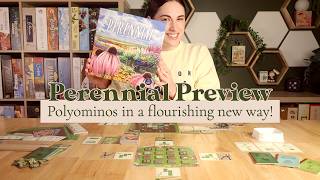
Board game reviewers consistently praise Perennial as a standout achievement from Flatout Games and designer Emily Vincent. The game has earned widespread acclaim for its elegant blend of accessibility and puzzle depth, attracting both casual players and experienced gamers. Reviewers from Tabletop Tolson to The Cardboard Herald to kovray emphasize that Perennial delivers a rich, thoughtful experience without overwhelming players with complexity. The consensus leans strongly positive, with many reviewers declaring they will add Perennial to their permanent collections. What distinguishes the reception is how reviewers highlight the game's refusal to feel punishing or frustrating, even as it provides meaningful strategic decisions round after round.
Core Mechanics That Define Perennial
Polyomino Drafting and Placement
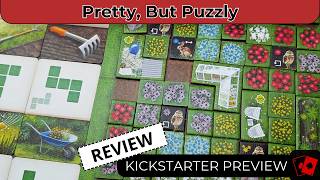
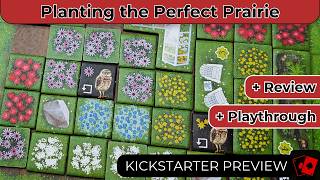
At the heart of Perennial sits a clever two-stage polyomino system. Players draft tiles from a central grid by selecting tool cards that define tetromino shapes. When taking tiles, at least one must touch the edge where the tool card sits, but players can flip and rotate freely to capture the five tiles they need. Reviewers emphasize this flexibility: there are always multiple valid options on the board, so players never feel cornered by bad luck or previous turns. What makes this mechanic particularly innovative is that the same tool card used to draft tiles becomes the template for placing them in the garden during the planting phase. The shapes break apart and recombine, meaning a single L-shaped tool might draft one set of flowers but place a completely different arrangement. This duality, as kovray notes, creates a "double layer" of puzzle-solving that rewards forward thinking without demanding perfect foresight.
Seed Tokens and Flexible Placement
Seed tokens unlock four powerful actions during the planting phase: draw two random tiles, draw one specific tile, place up to three tiles in any adjacent configuration, or remove a boulder. Players collect seeds by placing matching flower colors on seed spaces, adding another layer of spatial consideration. The genius of this system is that it prevents the game from becoming demoralizing. When a tool card doesn't fit perfectly or a needed tile doesn't appear during the gathering phase, seeds provide a safety valve. Reviewers appreciate that seed tokens transform potential frustration into strategic choice. The game limits players to carrying three seeds between rounds, which prevents hoarding and keeps the pace brisk while encouraging players to spend tokens when opportunities arise.
The Perennial Experience
Cozy Complexity
Multiple reviewers describe Perennial as "cozy" in a way rarely seen among puzzle games. The game provides enough crunch and spatial challenge to satisfy experienced gamers, yet never makes players feel trapped or hopeless. Rahdo's playthrough demonstrates this balance: even when space tightens in later rounds, seeds and flexible rules keep options open. Players control their own destiny through the choices they make, rather than feeling victimized by tile draws. The watercolor botanical art by Beth Sobel contributes to this soothing atmosphere, and reviewers note the overall production quality supports the peaceful gardening theme without sacrificing clarity or function.
Satisfying Puzzle-Solving
The spatial puzzle element drives engagement across all reviews. Every decision about which tiles to grab, how to arrange polyominoes, and where to place them on the garden board requires genuine thought. The Cardboard Herald emphasizes that Perennial offers "more to chew on compared to Cascadia or Calico," suggesting it appeals to players who want substance behind their puzzle-solving. The shapes "don't fit together perfectly," as reviewers note, which creates engaging gaps that seed tokens help fill. This isn't a game where optimal solutions come easily; players spend the planting phase muttering through possibilities and testing configurations, finding that satisfying click when pieces finally work.
What Makes Perennial Stand Out
Elegant Rule Design
Reviewers consistently highlight the thoughtful design choices that reduce friction without eliminating challenge. The inverted tool card graphic helps players who struggle with spatial visualization by showing both the normal and mirrored version of every shape. Players don't have to fill tool cards perfectly; they can place only part of a shape by discarding unused tiles, paying a cost but avoiding hard constraint. The scoring system itself displays surprising wisdom: a group of six flowers scores six points, but seven or more score eight points, creating one gap. This means players don't chase larger groups at all costs, preserving flexibility in how they arrange their gardens. These details accumulate to create a game that feels kind without being soft.
Replayability Through Variety
Player boards flip to different configurations on each side, offering asymmetrical garden layouts that change where seed token spaces appear. The advanced mode adds goal cards from a pool of 27 options covering flower, animal, and pond objectives, providing endless combinations of scoring targets. The mini expansion adds mushroom tiles that score differently from flowers, rewarding variety rather than grouping. This variety ensures that no two games play identically, and reviewers mention eagerness to return to Perennial precisely because they want to try different strategies. The solo mode lets players compete against their own score, and the game supports one to four players with minimal rules adjustment. Rahdo's solo playthrough demonstrates both the advanced mode's depth and how the solo system remains engaging despite simplicity.
Potential Drawbacks
Limited Player Interaction
The Cardboard Herald openly notes that Perennial exhibits "multiplayer solitaire" to an extreme degree. Players have separate boards and non-unique tiles, so one player taking a red tile doesn't meaningfully block another. Most turns, players focus entirely on their own garden and ignore what opponents do. Those seeking direct conflict or tight player interaction will find little satisfaction here. While simultaneous planting keeps downtime minimal, the competitive element is muted. Reviewers frame this as a design choice rather than a flaw, but it's worth noting for players accustomed to games like Azul or Calico, which create more tension around tile availability.
Spatial Reasoning Demands
Despite tools and support features, Perennial still requires solid spatial visualization. Players must rotate and flip shapes mentally, understand how polyominoes snap together on their board, and plan multiple rounds ahead. Kimberly from Tabletop Tolson mentions personal challenges with spatial games, though she found Perennial more approachable than most. Reviewers universally note the game still "burns your brain" through spatial puzzles, and some players may find the mental load frustrating, particularly in later rounds when space tightens and remaining options become constrained. The seed token system and flexible rules mitigate but don't eliminate this challenge.
If You Enjoy Perennial
Players drawn to Perennial will find natural next steps within Flatout Games' catalog. Cascadia, Calico, and Verdant offer similar tile-placement satisfaction, though Perennial's spatial complexity and polyomino system set it apart. Those who love the puzzle aspect without wanting pressure might explore Knitting Circle, also by designer Emily Vincent. Players who appreciate cozy but crunchy experiences should investigate Shallow Seas, another accessible game that resists making players feel trapped. For those wanting competitive tension with the same botanical theme, the mushroom mini-expansion adds scarcity that creates conflict Perennial's base game avoids. If polyominoes captivate you, Isle of Cats, Patchwork, and Fit to Print offer different takes on how shapes interact with your personal board. Reviewers consistently recommend Perennial as an exceptional gateway game for newcomers, so consider it alongside Azul and Ticket to Ride for introducing new players to modern board gaming's depth.
What Reviewers Are Saying
"I think this game has so much to offer players, and I think it just kind of like ups the ante with the puzzling nature of Flatout Games, particularly with Emily Vincent's designs."
— Tabletop Tolson
"It burns your brain far more than a lot of other tile layers and if that's something you want, Perennial is a great option for you."
— The Cardboard Herald
"I think Perennial really surprised me with a couple of the mechanics. As they say, it's really easy to learn and teach, but then the implementation of it with the small choices here and there add up and really create this lovely puzzly spatial thing. I have some spatial challenges, especially with abstract games, and so for me it can be a real challenge, but this was delightful."
— Rahdo Runs Through