Top 10 Dice Chucking Games
Games in This Video
9 games are featured in this video — they unlock as you watch.




Transcript
Man, listen. I always say I only roll dice with my life. All right, but I'm also down to roll the dice in these games. Those two things
What's up everybody? I'm Mike. I'm Nick.
We are the brothers Murf. We're going to talk about dice chucking games. Games that you get to roll dice a whole bunch. Uh, obviously, you know, going all the way back to Yatsi and stuff, like dice rolling is a fun,
it's always exciting, right? Like every single roll you're like, well, I hope I roll well. Whatever that means, depends on the game. And sometimes it's kind of like Yatsi where you can kind of push your luck with those dice rolls. Sometimes it's just like it's for the big hit, the big amount of damage, all that different kind of stuff. Seems to be games that are centered, at least um, a lot of the game is be centered around dice and dice rolling. Let's go and get into it.
First up is going to be Zombie Side Black Plague or any of the Zombie Side games uh to be fair would work for this category. Uh this is a cooperative uh game where you are going to be working through a scenario. You're going to set up different map tiles and different uh elements and things. You're going to be going for objectives and whatnot. and you are going to be playing with a character with their own kind of special abilities and things, collecting weapons and whatnot as you fight off like literal hordes of zombies. There's a ton of different zombie uh miniatures and types that are going to be running towards you, busting down things, uh trying to attack you and reduce your health, and you're going to be just, you know, choosing weapons of all sorts of, you know, classic things like gatling guns and samurai swords and whatever else. Uh, and you're going to be rolling all sorts of dice just to mow down as many of these zombies as you can as you try to kind of clear a path and get over to the different spots of the board uh to achieve whatever objective is you're playing. So, this is one that's just super fun. Uh, splashy. You're rolling a ton of dice. You're you're just blasting away. And I think that's something that like especially, you know, Zombie Side came into our board gaming life rather early. Um, this was something that was just like very different and cool. It's cool to get these different weapons, have these different abilities, and you know, with that different dice to roll, uh, you know, uh, choosing between melee and ranged attacks, anything like that, and, uh, the Black Plague kind of puts it into a medieval setting, uh, which we really kind of enjoy even more. Uh, it's just a really fun series of games that's
been loved for a long time. And, uh, you know, just kind of fits perfectly that thrash, roll a bunch of dice, do a bunch of damage, and have these kind of big cinematic moments. Our number nine is going to be Dice Throne. Now, this is one of I think a few kind of yachts style games that are going to show up on the list. A yachtsi style game is where you basically roll. You will kind of like hold or lock some dice and then you can kind of roll the other ones. You can kind of keep rolling or certain amount of times depending on the game. Now, in Dice Throne, everyone is going to have a specific character. There's a whole bunch of different characters. Not to mention, there's now a whole bunch of different Marvel characters and X-Men characters. There's ways to play this game like co-op and some kind of like weird campaign and stuff. There's a whole tons of there's a lot of dice thrown content out there.
And basically what it is, you take a character and that character is going to have a number of special abilities and various things that they can do based off of their die rolls. And um what you're trying to do is it's mostly a onev one kind of game. You're basically just trying to knock out the other person. It's kind of very head-to-head in that way. But again, it's Yasi style where you are rolling and then you can lock certain die and kind of roll. And I think you can roll three times. And then basically at that point, whatever you have is what you have. And so it might be like, you know, the move might be like a punch or some kind of attack thing. And to do that, you need to roll like these two die faces and these two die faces. So after that first roll, you're like, "Oh, I already have that. Okay, I'm going to go ahead and lock that and then I'll kind of keep rolling for other stuff. And for these various attacks or these various abilities, of course, some are going to be much much harder to do. Some are be a lot easier to do. So, there's that kind of push your luck where you're like, "Oo, you know what? I already have three of the five symbols I need for this bigger attack or this bigger ability. Should I lock these? Should I should I just go for it? I might end up getting nothing.
You know what? Screw it. I'm going to go ahead and go for it." And there's like card play and things like that you can do as well. And then every character is also going to have their ultimate ability which is basically kind of rolling a yatsi and it's um going to be some big honken attack. Like I said, there is a ton of different dice thrown. The characters work in different ways. They have different levels of complexity. It's really really cool game with great Manny Tremble art. It's really really fun and a great dice chucker.
Next up is going be tumble dice. It's a very simple dexterity game that's sort of barely a game, but I like it. I think it's fun. Uh, this is going to be a game centered around this kind of tiered board, this, you know, usually made of wood. Uh, that is going to be different zones uh where, you know, if you have dice of yours that land in that area, they will act as multipliers and then the face of the die, whatever you roll will be the other half of that multiplication. So, if I roll a six and I get in this zone with two, I get 12 points. Uh, a lot of times this is played with all sorts of different dice. You might play with a standard set of like your D and D dice. So, you have your tens and your, you know, uh, eight-sided die and your 12sided die and things like that. And as you kind of go further down, uh, the tiers, uh, the the, you know, lower tiers are more valuable. But, of course, you run the risk of actually falling off the board entirely, which just completely negates your score altogether. So there's a little bit of like, you know, strategy of trying to roll it hard enough to land in an area that you want. If you have your opponents in your way or they have high value dice, you might want to knock into them and hopefully knock them off the board or change the face of their die.
It's just very silly, very, very light. But I actually get really into trying to like do something strategic with something that is literally designed to be random like a die is, and trying to find strategy within that. It's just a silly good time.
Number seven is going to be Too Many Bones. And this game is literally all about the dice because this is a game where you are going to have a character called Gearlocks, the kind of people in this world. And you're going to be going through various encounters, eventually getting to the big baddy, and you're trying to overcome that big baddy. And there's a whole bunch of different baddies. um and uh how long you can take to get to them, how difficult they are, and kind of how you need to build out your character will depend on the kind of that baddy and what you need to uh do to defeat them. And this is a chip theory game. So, every encounter for the most part, you're going to be in a battle where you're you have your little chip, they have the enemies have their little chips and this very kind of small board, very simple battle system in terms of like it's not this big crazy map with like line of sight and all this stuff. It's just very very simple, straightforward because the game is all about your dice. Every single gear lock has completely different dice. Um, completely different die faces, completely different abilities. And throughout these kinds of in these kind of like little mini campaigns, um, you can build up your character differently because most of them are not going to be long enough for you to unlock all of your dice. You're getting kind of XP and experience in the game and that allows you to unlock more and more and more of these dice. And a lot of them have like little tech trees. So to get this die, you have to get this die and this die first. And so you can build out your characters in a lot of different ways.
And there's a whole bunch of different strategies for every single character. And again, a lot of those strategies you're taking are going to be dependent on what baddy you're fighting. Kind of what you're going to end up having to do. You're like, "Oh, this badd is going to do this. Okay, I'm going to kind of ignore these dice on this character for this campaign because these aren't going to be that useful to defeating that kind of big bad at the end there." It's really, really cool. It's a very wellsupported game. There are a ton of these different characters, a ton of these different gear locks. And again, they all work very, very differently. Um, they're all completely asymmetric and you can really spend, you know, 10, 20 plays on a single gear lock just experimenting, experimenting, and experimenting with those different dice buildouts. It's really, really cool. But this game is all about those dice and rolling them.
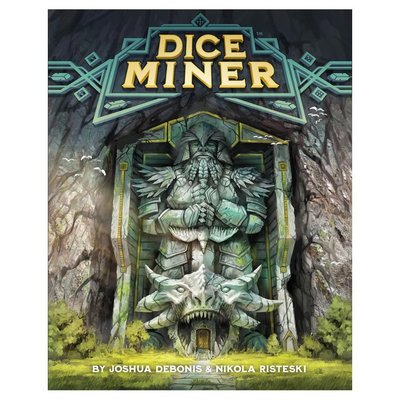
Next up is going to be Dice Minor. This is really kind of a dice drafting game where you're going to have a mountain that has all these different dice and we're dwarves and we're kind of digging out the mountain by collecting these dice uh to create different kind of set collection types of things. There are uh dice that show kind of your standard numbers and they're going to be you know uh thematically representing you kind of building tunnels. You want to make runs of one, two, three, four, you know, sequential runs ideally up through five. There are gems you can collect, and if you have the most gems in the end round, you double your gem score. There are hazards that can actually cause you negative points, unless you have defensive dice to kind of negate those and actually turn them from negative points to positive points and stuff like that. There's also a fun uh element where on all the types of dice, one of the faces show a beer. And if you get a beer die, uh, you can actually give it to an opponent, uh, and then take two dice from the mountain. And it allows you to kind of break the rules of where you can take dice from because normally you have to kind of take at the top most, uh, most exposed level. So, there's this kind of fun uh, back and forth of like you get a beer, you roll it for your opponent, and give it to them. Uh, which kind of changes up maybe what they have. uh and you're kind of manipulating uh you know this kind of growing trove of dice. What's fun is you play this game over three rounds. So in the first round you collect you know your handful of dice. You score everything up and then you take all those dice that you've already collected and roll them all at once and then that becomes your kind of starting pool of dice for the next round. So in the third round you have quite a few dice that
you're already beginning with and really trying to maximize those scoring. So it has a nice kind of ramp up to it. Uh, I really enjoy the kind of trading dice around and the kind of simplicity of like a set collection game. I think it's something that you can kind of play with everybody, you know? Uh, it's fun to roll, especially you're playing a two-player game and you have a ton of dice. On that third round, you're just rolling this heap of dice to start and it's just very satisfying every time.
Number five is going to be a great push your luck racing game called Cubitos. I freaking love Cubitoss. Maybe it feels like this game kind of went under the radar, but I guess it probably hasn't. A lot of people like this game. Maybe I just feel that way. But I love this game. This game is kind of like if Quacks of Quiddlinberg were like a dice rolling race game. Uh, but it's got a similar push your luck mechanic where this is a game where you're these weird cube people in this weird cube world. Everything's cubes. I don't really know why. I guess because it's all dice space, but everything's cubes. There's a cube pineapple in a cube piece of cheese. It's very weird, but I love it. Um, and basically you're you're going to have some kind of map and you're basically trying to do one lap around the map. First person to finish that lap wins the game. That's what you do. And you do that through dice rolling. And so basically you're going to have a certain amount of dice every round and you're going to roll those. And this is where you can push your luck because when you roll them, you basically each die face, each dice is only going to have one, two, maybe three faces that actually have anything on it. So, as you're rolling, you can basically choose to again kind of lock dice and then roll all the rest of them or roll kind of as much as you want. The problem is is once you have three faces that are showing that are giving you something, you then can bust. And basically anytime once you have three that you roll your leftover dice and you get nothing, you go blank on all of them, you then bust. So you can kind of roll however you want until you get three of them and then you're like, "Okay, now if I bust, if I roll nothing, I'm busting, I get nothing." And so it's this really fun push your luck aspect.
And a lot of these things um are going to give you money and they're going to give you little feet. Little feet allow you to move and the money allows you to buy new dice. This is kind of like where it is like Quax of Quillinberg where there are these seven I think different dice and there's a power that goes along with that die but that power can switch out from game to game. The dice will be the same. Like the purple dye is always the purple dye but the power that goes along with the purple dye will change every single game. And there's like seven or eight of them for each color of dye. Again, kind of like Wax equivalent where each little chit can have a bunch of different abilities. And so you can build out the roster of dice in a ton of different ways. There's all sorts of them. And then these dice on top of giving you kind of money and feat will also have like specific dive faces that will do the power that's on that card.
And it's really really fun and really really cool. And so you're just buying these dice and getting your pool bigger and bigger and cooler and cooler and you're pushing your luck and trying to win this race. I think Ubitos is so so much fun. There's like four different maps in the base game. Again, there's like eight different powers for every single color of dice. There's a ton of replayability, a ton of variability. I love Kubitos. I love push your luck games. I like dice chucking games. And this one is so much fun.
Now, I think dice are particularly well suited for push your luck games because every time you're rolling the dice, that is symbolic of you pushing your luck in life. You got to roll the dice. So, Can't Stop is a game where you're just rolling dice and hoping to not bust. And it's just as simple as that. So, uh in this game, you are going to have numbers represented 2 through 12, which are all of the possible dice results if you combine two dice uh and their values. You're going to be rolling uh four dice and creating two pairs on a turn. Uh and then the values that you create, you can kind of arrange them how you want. Those will be different tracks that you are ascending on a turn. The the caveat is that you can only work on three columns at once in one turn. So once you are starting you know work on sevens uh 10 and four I if I want to keep going have to roll a seven 10 or four some combination of that with the dice that I roll. I have to be able to progress at least one of my columns every single turn. If I roll choose to roll and I can't I can't progress anything I lose all progress I made on that turn. So you can of course choose to stop. You can say like, you know what, I'm actually going to save my progress here. You'll put markers at your current spot on the, you know, the the three columns you worked on. And then if you come back to it in a future turn and you're again working on the 10ens, you start from where you left off the last time. So it's just a distilled, you know, perfect like game
that doesn't add extra stuff to it. It's just a situation where you are deciding, do I roll the dice one more time or do I try to complete a column? Because as soon as you complete a column, it locks anyone else from working on that column. You're trying to be the first one to complete three columns. So, if you've had a good roll and you keep hitting, you want to keep that going. You don't want to stop because I can't stop. That's the name of the game. I got to keep it going. But, of course, you make it all the way nearly to the top of these columns and then you bust. you lose all that progress and you go tumbling back down uh down the way. So, I just enjoy the beautiful simplicity of one more roll or do I, you know, count my chickens and do I take the wins that I have and play for the next turn.
Number three is going to be Elder Scrolls: Betrayal of the Second Era. I was getting the whole name mixed up. Elder Scrolls: Betrayal of the Second Era. This is a big chip Theory game that kind of we talked about Too Many Bones a little bit earlier. And the reason why this one is higher is because this is in my opinion at least kind of like Too Many kind of what I wanted Too many Bones to be. I really like Too many Bones, but this just has a lot more stuff that I feel like makes the gameplay experience a little bit more smooth and a little bit better. But this is a game set in the um Elder Scrolls universe. So like Skyrim, Oblivion, Morwind, that world, but it's not set in any of those like video games. It's just set in the world. So sometimes you can be in Morowind or you can be in Skyrim, but you're not like playing through those video games. But like those video games, you will take a certain race of character like a dark elf or an orc or a Breton or something like that. They will have some kind of special ability that they do and then you get to build the rest of your character however the heck you want, frankly.
You will have all the different skills you find in those video games like two-handed and restoration magic and destruction magic and illusion and like sword and shield and heavy armor and light armor and medium armor and all those different kinds of things. And each of those skill lines is going to have specific dice that go along with it. So as you're going through your campaign, you're training in these different skill lines that again you are choosing because again you can kind of choose however you build your character. And then while as you're getting XP, while you're going through this campaign, you will get to unlock more and more and more of those dice. The reason why this is kind of different than Too Many Bones and why I personally like it more is because each game you can choose like a race of character, but then you can choose whatever dice you want. You can choose whatever skills you want, whereas Too many Bones is very like locked in. Like this gear lock has these these dice. That's not how this game this game is much much more open, which I personally enjoy a little bit more as much as I enjoy Too Many Bones.
And one of the cool things about it is when you're in the big fights, because in chip theory games, you always have these big dice roll in fights, you have a cooldown track. You have a cooldown system where when you roll your dice, they will then go into your cooldown track and every round at the start of your turn, you will get a certain amount of your dice back out of your cooldown track depending on your cooldown stat, which usually is like two or three or four. So, the cool thing is, and what's really really nice about this game, and why this game, in my opinion, feels better than sometimes too many bones can feel, which is very brutal, is sometimes you're like, I'm going to grab all my big dice. I make this big old roll and I rolled nothing. Ah, that's the nature of dice rolling games, right? But in this one, they go to your cooldown track and you're going to get them back and you're going to get to try again and you're going to make them make that big swing again and hopefully this time it works. And if it doesn't, well, they're back in your cooldown track and you'll get them again. I really, really love the cooldown system in this game. I think it's the best part of the game, which is kind of a weird thing to say, but it really, really is. I think it's what makes the game and those encounters run really, really well. I love Elder Scrolls so much. It is climbing the ranks of my favorite games of all time.
And I love the dice choosing and the the cooldown track and the chucking the dice. It's just I just think it's a masterpiece. I don't think there's a game that's more dumb fun than Strike. And I mean that with as a complete compliment. Uh Strike is a game where you are gladiators in a battle. Your gladiators are your dice and you are rolling them into a literal like little coliseum that is inside the game box uh that has a little bit of a springy bottom to it and sort of this, you know, tiered coliseum shape. Uh, and every time you choose to roll your dice, you're going to choose one of your dice, throw it into the coliseum and see kind of what shakes out. So, for one, on every single die face, there is an X.
So, any X's that show up after a roll, they're gone. They're out of the game. They're killed. Uh if you make one or more pairs, so the same number appears multiple times, you will collect all those dice that pertain to that grouping and then your turn is over and you have more dice in your horde, which is good because you don't want to run out of dice. It's a last player standing. Uh you know, the last one with dice in hand is the winner. Uh, and so if you roll and you don't roll multiples of the same number, you can choose to keep going. Every time you choose to keep going, you add another die to the coliseum. So, there's that kind of like sunk cost fallacy that comes into play where I haven't gotten any dice back. I've already committed two dice. I don't want to lose more dice because I only have so many. But if I also don't recoup, you know, recoup any dice, by the time it comes back around to me, everyone else might have stolen those and I have even less now. So, there's kind of that ever, you know, enticing push to roll one more time to see if you can get at least some of your dice back into your hand.
There's also these kind of fun big moments where if I roll my dice, one of them gets killed, and then all the rest of the dice are the same number. So, I clear out the coliseum entirely, the next player immediately has to throw all the dice they have. There is no way around it. You throw everything you have into the coliseum, see what shakes out. Usually, you get something back. But there have been moments where someone throws like six or seven dice and they bust and they're completely out. So, this is a very silly uh game where, you know, there's big moments uh pushing your luck, randomness, it's silly. There's things where, you know, you roll a dieice too hard, it bounces out of the coliseum completely, that person's dead, they're gone. is just such a fun uh silly time for the entire family. That's why I love this game because it does not, you know, add any any layers of extra stuff. It's just about having a silly good time. And I feel like we all need a little bit of silliness sometimes.
Surprise, it's me again. Uh you know what? Nick was uh recording his number one and then we we all thought about it and decided we're changing our mind about our number one. It's okay. It's okay to change your mind. So, we have a new number one that I'm going to talk about to Roll for the Galaxy. How do you not choose Roll for the Galaxy uh for a dice chucking game? This is a game all around dice. It's a a dice version of a race for the galaxy game. Uh, and this is one where you are going to be rolling dice which make up your citizenry uh that are of different colors and things pertaining to the different planet types and whatnot. Uh, and you are going to roll them. They're going to show different dice faces that pertain to the different phases in Roll for the Galaxy that you can do. So you can explore, you can develop technologies, you can settle planets, you can produce goods on those planets and then trade and or consume uh or ship and things with uh with the last phase. So what's fun is you get a cup, you're going to roll out all of your available dice behind your screen, and then you are going to arrange them uh by the dice faces that they roll to their phases. There's a little bit of mitigation you can do to move things away from what they actually show on their dice face. And you can choose one die uh per round to lock in to one of the phases. Basically, you can ensure that one of the phases will happen. So, if I really need to develop a technology, I might want to take a die, which you can use any die for this, which is cool, and lock in the
development uh phase so that I ensure that it happens. And then once everyone has made their selections, behind their screens, everyone reveals and basically any and all phases that were selected by one or more players will be the phases that carry out. So there's the interesting thing of there's not always going to be an exploration phase. There's not always going to be a settlement phase. So you are kind of controlling uh what happens. If I have dice for a phase that doesn't happen, those dice go back to my cups. They're not wasted, per se, but I'll use them on a future turn. You are uh like I said developing technologies which will often give you you know more money potentially victory points discounts on building things in the future. You are producing goods and trading them for money which are going to help you get dice back into your cup to reroll or gain victory points. And then the different things you're building those different developments and uh planets are going to be worth victory points. Once someone has built out 12 tiles essentially and you begin the game with three the game will end.
You'll kind of tally up score. There's also a ability to get victory points in game through consume actions and that's going to take down from a a central pool and if that pool empties then the game will also end. So there's this kind of like you get to build up a cool engine. Uh a lot of the planets will provide additional dice for you to roll. So depending on how you play, you might end up with quite a few dice in the cup, which is really fun because in those later rounds, you're just rolling, you know, 12 dice if you've worked everything right, and you get to do all these different actions. Each of those dice in, you know, those phases will be essentially an action point toward that uh phase if it carries out. So, this is one that there's so many great Race for the Galaxy type games, games that have used, uh, you know, similar mechanisms.
Um, I really enjoy the rolling of the dice, you know, assuring yourself of a certain phase, a little bit of the mind games that come up where you can kind of see that, you know what, over here, these people, they have a ton of uh, you know, produced items on their planets. I think they're going to do the ship action. So, I can do the ship action, but I'm not going to select that for the phase because I think they're going to do it. So, there's some like cool mind games that come into play with uh trying to guess at which phases are going to be available and therefore do I use any of those mitigation things to move dice around uh and kind of try to maximize the most out of every round. I think it's super duper fun. All those games are great. For my money, Roll for the Galaxy is the best because you get a little cup to roll dice. That's just really fun.
Those are games that we like to chuck the dice in.
Yeah. You know, some are kind of more marathy and stuff like that, but there's a lot of really great games. A lot of push your luck games. Just there's a ton of great games that were like you're rolling dice and just hoping for the best and it's great.
Love it, man. It's super fun. Let us know what you like to do. What games, you know, are the best ones that use dice and really rolling a lot of them and stuff in a lot of the time. Hit those in the comments below and we'll see you on the next top 10.
Bye, everybody.