





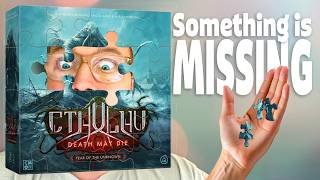



Cthulhu: Death May Die – Fear of the Unknown Deep Dive
What the Community Thinks About Cthulhu: Death May Die – Fear of the Unknown
Cthulhu: Death May Die – Fear of the Unknown is the 2024 standalone season of the cooperative series designed by Rob Daviau and Marco Portugal for one to five players. Reviewers tend to describe it as a faster, more kinetic take on Lovecraftian cooperative play than the slower games on many shelves. Neon Gorilla praises the rules for being approachable while still generating a strong push-pull of insanity, and that combination is the point most reviewers return to. Slickerdrips places it alongside Eldritch Horror, calling the second edition of that game the doomiest and gloomiest of its kind and describing this box as something far more active.
Opinions diverge on the value of the release itself. Watch It Played presents the season as a substantial addition to the franchise, with new episodes, new Elder boxes, random monsters, and relics. Board Games UnLocked is enthusiastic about the expansion and points out that the Kickstarter extras arrived at a more reasonable price than many backers feared. The RNR Show offers the sharpest counterpoint. Its hosts place the box in a segment about games that disappointed them, and one host is unsure whether that reflects a wider pattern in the series or only a personal reaction. The consensus, then, is that the box delivers strong moments at the table while leaving room for doubt about how consistently it lands for every group.
Core Mechanics That Define Cthulhu: Death May Die – Fear of the Unknown
Dungeon Crawl
Slickerdrips is careful to note that the game is not really a dungeon crawl in the classic sense, but reviewers do describe a scenario-driven loop of moving through rooms, fighting enemies, and completing objectives across a modular map. Each episode gives the investigators a different goal. One scenario sends the group chasing down accused witches, another has cultists summoned to a spire that cannot be reached until the players find the right keys to undo its locks, and a third involves a more whimsical premise. Because the objectives change so sharply, movement and exploration feel less like walking the same labyrinth and more like a series of distinct errands. The designers build each episode as a new adventure running on the same core engine, which is why the map work feels purposeful rather than repetitive.
Combat: Dice
The dice combat is the element reviewers describe most often as the engine of tension. Slickerdrips calls it one of the unique dice chucking combat games in its category. Investigators group up with enemies that travel with them, roll large handfuls of dice to take them down, and take bigger risks than they would in a more deliberate design. The fights are shaped by a clock. A scenario timer keeps ticking down, sometimes very quickly, so the moment a group wants to stop and regroup is often the moment the pressure rises. Health and stress can be spent to roll more dice, which means a struggling group frequently has to trade safety for a better chance at a decisive swing. The outcome depends as much on the dice as on the plan, which suits the cinematic reversals the series is known for.
The Cthulhu: Death May Die – Fear of the Unknown Experience
Push-Pull Insanity
The defining feeling is the tug between progress and madness. Slickerdrips describes sanity as a very important resource in Cthulhu games, and the dice rolled in combat tend to erode it. Everyone draws a Madness card at the start of the game, and those cards impose awkward demands, such as jumping to a space with an enemy when alone or dealing damage to everyone in a space regardless of allegiance. Players are encouraged to lean into that instability, because skills grow stronger as characters go further down the path of madness. Going too far, however, is the quickest way to lose the investigator, and if anyone dies before the summoned threat is defeated, the game ends. Neon Gorilla also highlights this push-pull as the element that gives the rules their character. The satisfaction arrives when a reckless roll pays off, and the frustration arrives when a fragile investigator is pushed past the edge.
Cinematic Swings
Gameplay footage from Slickerdrips shows how quickly a session can turn. In one episode, an investigator who looked to be in trouble finishes off the Devourer late in the session, and the reviewer closes that episode by calling it a result that went surprisingly well for half of the party. Moments like this are what reviewers remember. A well-planned round can stall in a single bad roll, while a desperate final turn can produce a victory that feels earned because nobody was sure it would happen. The emotional arc of each episode is driven as much by the dice and the clock as by careful strategy, and that unpredictability is part of the appeal for players who enjoy a table full of shouting and sudden reversals.
What Makes Cthulhu: Death May Die – Fear of the Unknown Stand Out
Modular Chapters and Ancient Ones
Standout praise centers on how the chapters and Ancient Ones combine. Slickerdrips explains that each chapter carries its own Discovery deck of companions and items, and that it supplies half of the Mythos deck, themed to what the investigators are doing there. The Ancient One they face supplies the other half. Shuffled together, the threats reflect both the location and the villain, so the same box can produce very different games. Reviewers also value the upgrade path. A player who likes one Ancient One can add another for more variety, and the reviewer describes the box as a strong foundation that owners can keep building on rather than a single package that reaches its limit quickly.
Skills That Reward Risk
Each investigator has a unique skill, along with a few standard skills that might let a character fight at range, add dice to an attack, or treat symbols that normally mean nothing as successes. Slickerdrips points out that the emphasis falls on pushing a character too far to unlock that potential. This gives the game a clear tradeoff at its core. Players who want the strongest versions of their investigators must accept more madness, and the decision of when to stop is often the most interesting choice on the table.
Potential Drawbacks
Mythos Luck and Repetitive Episodes
Neon Gorilla is wary of how much the Mythos deck can swing outcomes in ways that feel beyond the players' control. A bad draw at the wrong moment can undo a carefully planned turn, and that frustration is part of the design. Some reviewers also find that certain episodes fall into a repetitive pick-up-and-deliver rhythm, where the objective changes on paper but the activity at the table feels similar. Players who enjoy the variety between chapters may find that these episodes dilute the sense of discovery, while players who like a predictable structure will find the rhythm comfortable.
Uneven Investigators and a Buy-In Decision
Neon Gorilla is less enthusiastic about some of the investigators, finding a few of them less engaging than the rest of the roster. The verdict on the box is also effectively all or nothing. The content is strongest for players already invested in the wider Cthulhu: Death May Die line, and newcomers who hoped to sample only one box may find the payoff less obvious. Watch It Played's trending coverage frames the Kickstarter and shipping timeline as part of that purchase decision, so buyers should weigh the cost of the full package before committing.
If You Enjoy Cthulhu: Death May Die – Fear of the Unknown
Players who enjoy the dice-driven combat and push-pull tension will find a related satisfaction in Eldritch Horror, which Slickerdrips names as the closest point of comparison for the cooperative Lovecraftian feel, although the reviewer describes this box as far more action oriented. Fans of investigation and of sanity-based dread should look at Arkham Horror and Mansions of Madness, both of which build tension through scenario-driven investigation. Players drawn to fast, swarming fights and the feeling of a group being overrun will find a familiar thrill in Zombicide, the game the RNR Show brings up in its comparisons alongside Massive Darkness. For players who value the modular, card-driven planning of chapters and Ancient Ones, Dune Imperium offers a different route to a planned, card-based game, although it does not share the horror theme.
What Reviewers Are Saying
"When you move around the board, enemies come with you. So you are grouping up these big gangs of enemies, trying to take them down with a load of dice rolls and things, and taking more risks."
— Slickerdrips
"But six new episodes and two new Elder bosses on top of the extra stuff that they unlocked through their Kickstarter campaign."
— Board Games UnLocked
"There's so much to show off. Two different investigators, different episode, different Ancient One, and then maybe after that we could start mixing in some unknown monsters."
— Slickerdrips