


















Fjords Deep Dive
What the Community Thinks About Fjords
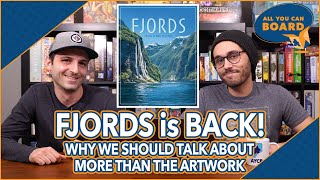
Fjords is a two-player game from 2005 in which rival Viking clan leaders compete for a fruitful stretch of Norway's coast, and for years it was one of the hardest titles to find on the secondary market. Reviewers at All You Can Board describe the Grail Games reprint as a long-awaited chance to own a game they had only been able to play at a café. The excitement centers on the gameplay. The reprint keeps the classic two-player rules intact, spells them out in their own rulebook section, and layers on three- and four-player modes, a larger board, and mini expansions designed by Phil Walker Harding, who was brought in to extend the design after the original designer passed away.
Opinion is most divided on the artwork. Beth Sobel's tiles are deliberately plain, and some backers wanted more detail, such as background animals or extra texture. Defenders argue that the simplicity suits a game about exploring an empty island and settling it yourselves, and they point out that the box cover is gorgeous. Meeple University's reviewers take a more measured view. They praise the design and the tension it creates, but they single out the endgame as the weakest stretch of the experience.
Core Mechanics That Define Fjords
Tile Placement: Building the Island
The first phase is a matching puzzle. On each turn a player picks one of four available tiles and places it so that every edge matches its neighbors. Meeple University notes several placement rules: the island must remain a single landmass, so a tile cannot open a separate shore, and each new tile must touch at least two tiles already on the table. After placing a tile, the player may optionally place one of their four long houses on it. Those long houses matter later, because they are the anchors from which Vikings will launch in the second phase. Reviewers also point out that offering a choice of four tiles, rather than drawing one at random and placing it immediately as in the original, gives the opening a more modern feel.
Area Control: Claiming the Grass
Once no legal tile placement remains, the first phase ends at once. Players then alternate placing Vikings on grass spaces adjacent to their long houses or to their own existing Vikings, as long as the space can be reached over grass. Mountains are the decisive terrain. A pocket walled off by peaks can only be reached from a player's own adjacent long house or Vikings, so reviewers describe the second phase as a race to lock off territory and cut the opponent's options. Because Viking supplies are limited, an early placement can leave a player without pieces for a better spot that opens later. When no one can place another Viking, the player who placed the most wins. All You Can Board's reviewers note that only grass decides the contest, with water and mountains serving to shape the land rather than to score, which makes the fight feel focused.
The Fjords Experience
Tense
The tension comes from the handoff between phases. A player who built a sprawling island may find the tiles they wanted have been blocked, while a player who planned the long-house placements carefully can wall off a peninsula and gain a large advantage. Meeple University describes the decision of when to commit a Viking as the vital question of the second half, because waiting for a better spot risks running out of pieces. All You Can Board sums up the feeling simply: "there's still that kind of tension where you're trying to figure out where to put stuff to plan for that second phase."
Minimalist Design
Reviewers describe the table presence as clean and functional. Terrain types have to be easy to tell apart, because every edge has to match and players must read the board quickly. Reviewers who came to Fjords for its art were disappointed, but those who came for the play found the look appropriate. All You Can Board calls the tiles "a lot simpler" than the box art, and they argue that the restraint fits the theme of an unexplored land that develops as you play. Their verdict is that the design feels "simpler and cleaner" than Carcassonne, which lets the rules carry the experience.
What Makes Fjords Stand Out
Two Phases That Feed Each Other
Reviewers repeatedly describe Fjords as two games that are linked. All You Can Board observes that the first game shapes the second, since the long houses and island layout determine who controls which approaches once the Vikings arrive. The same comparison surfaces in All You Can Board's top-50 discussion, where the reviewer ties Fjords to Blue Lagoon as a favorite example of the two-phase format. The early choices pay off later, which gives the planning stage real weight.
A Classic Core With Optional Layers
The reprint does not force new rules on players. All You Can Board points to a dedicated classic rules section for the original two-player game, while Meeple University notes a few minor updates that modernize the rulebook. Players who want more can add the three- and four-player modes, a mega two-player version with extra long houses, and runestone tiles that change how Vikings score, such as awarding points for each adjacent Viking or a bonus for controlling the most Vikings around a rune. Meeple University's reviewers note that the simple base rules can handle these additions without becoming unwieldy.
Potential Drawbacks
A Slow, Fiddly Endgame
The most consistent criticism comes from Meeple University. Once the long houses were down, the group spent a long time working through the last ten to twelve tiles to determine whether any legal placement remained, and the reviewer concluded that the stretch was "much more chore than play." Their solution is a companion app that highlights legal placements and reports when no tile can be placed, which would turn the endgame from a search into a tactical choice. The reviewers still describe the phase as interesting, but they acknowledge it can drag.
Divisive Tile Art
The artwork is the reprint's most talked-about feature, and the response is mixed. All You Can Board acknowledges "a lot of dissatisfaction" with the tiles, especially among backers who expected something closer to the box cover. Their counterargument is that the tiles are covered by pieces during play and that the gameplay should drive the decision to buy. Readers who are sensitive to visual style should weigh this before committing, though the reviewers agree that the art does not undermine the strategic experience.
If You Enjoy Fjords
- Carcassonne: Reviewers draw the most comparisons here, because both games are built around tile placement and majority control. Fjords is "simpler and cleaner" and concentrates on a single terrain type, grass, rather than on cities and roads.
- Blue Lagoon: This is the closest structural match. Both games use an exploration phase followed by a settlement phase in which you build outward from what you placed, and All You Can Board calls it the closest comparison they can make.
- Jaws: Meeple University picks this as the one other game that combines a planning-heavy first half with a hunting-style second half, where the outcome stays uncertain until the final placements.
What Reviewers Are Saying
"I personally think this is one of the best two player only games I've played."
— All You Can Board
"That was very frustrating, it really really detracted from the game for me."
— Meeple University
"It's a great game with two different phases similar to Blue Lagoon in many ways."
— All You Can Board