/pic5413002.jpg)
In Glasgow, players travel the city (in an abstract manner) to collect resources, take special actions, and most important of all construct buildings. Build a factory, and you'll receive more goods from it when other buildings are constructed in the right areas in relation to it; build a train station, and you may or may not score from it depending on what else you build; build a monument, and you'll merely collect a lot of points — and in the end, points are what matters.
In slightly more detail, to set up the game, lay out a ring of town figures at random, with two of them being removed from play each game. Whoever is farther behind in the circle around town takes the next turn, advancing to whichever town figure they want to visit. Most of them give you resources — brick, steel, or money — and you have a limit on how many resources of each type you can hold. Some figures have two random building plans at them, and if you visit one with the right resources, you can pay them, then build something. If you pay extra, you can then build something else, too!
The first building is placed anywhere in the midst of play, then each subsequent building is placed adjacent to something already built, with the buildings eventually filling in a 4x5 (or 5x4, determined as the game progresses) grid of the players' own creation. As soon as the twentieth building is erected, the game ends and players score points for what they built. Who has contributed more to the current state of Glasgow?


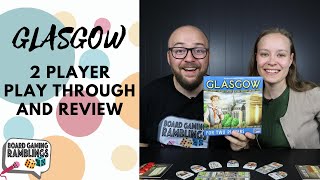
Glasgow - 2P Play Through and Review
- very cool looking
- amazing art style and graphic design
- really cool wooden screen printed pieces
- sold out
- train robbery
Mechanics (from transcript analysis)
Video topics + discussion points
Quotes (from this video)
- It looks generic-y medieval, but clean and I like it.
- Such a fun experience of just memory, strategy, energy management, and player powers.
- These things look so good that they look fake.
- That is like a pure pure gambling game.
- It's a game that's actually more fun when you mess it up than when you get it correct.
- I really love the look, the gear mechanism. It's so smart.
- It is pretty fun, chaotic, jumping around game.
- I think this has the opportunity to be even stronger.
- A lot of board gamers are collectors and so this does kind of feed into that collector itch.
- I scored 41 points. He said, 'I've never seen 41 points.'
- Deduction style is not usually my go-to mechanism. This one surprised me.
References (from this video)

- Fast gameplay
- Straightforward scoring
- Satisfying scoring conditions
- Appreciated turn order system
- Short city builder feel
- Randomized setup adds variability
- Streamlined gameplay
- Clever tile interaction and scoring
- city building
- Glasgow
Mechanics (from transcript analysis)
- action selection — You're moving in a clockwise fashion so anybody who is in the back that's who gets to go first.
- Grid Building — You and your opponent are collectively building this five by four grid.
- Resource Management — Collecting resources and visiting what are called architects.
- Rondel — The tiles of the rondelle that you're building is always changing from game to game because based on setup it's random.
- Tile Placement — Place them into the grid that you're trying to make.
- Worker Placement — Visiting what are called architects.
Video topics + discussion points
Quotes (from this video)
- it's very asymmetrical the miniatures in this is stunning the art in this is stunning it's a very clever game
- it's so clever it's so thematic
- the games tend to be like super close down to the last play
- i love that it's gonna be cross-compatible because it's just it's such a like it's a great experience to kind of elevate to four players
- it is one of my favorite two-player games
- the waze design is just extremely skillfully it's one of the most elegant and beautiful games in the two-player variety
- i think the theme really shines out too because basically it's like technology versus nature industrialization yeah
- i think one of the most underrated two-player games in my opinion
References (from this video)
- Compact playtime (~20–25 minutes) makes it an ideal two-player filler or lighter counterpart to heavier titles.
- Rule set is straightforward, with a clean, readable iconography and theme that feels approachable for casual players and couples.
- Art style and components are aesthetically pleasing and readable, with clear resource and ownership indicators on the grid.
- The two-player tension is meaningful due to limited interaction windows and strategic blocking opportunities around contracts and architect spaces.
- Fits well in a casual game night lineup and sits comfortably next to other short two-player city-builders.
- End-game scoring and park/edge interactions can be fiddly to track, especially as players try to optimize multiple scoring lines at once.
- There is an element of randomness in the availability of certain buildings and contracts, which can slightly tilt the balance toward luck in a given session.
- Some players may find the arrows/ownership indicators less legible from a distance, requiring closer inspection during scoring rounds.
- As a light title, it may lack depth for players seeking highly strategic or long-tail decisions beyond the core mechanic loop.
- Urban development with a modular, grid-based city-building mechanic; emphasis on resource gathering, placement, and end-game scoring via monuments and buildings.
- Two-player city-building scenario in a stylized Glasgow-like milieu, focusing on building a grid-based city through resource management and strategic placement.
- Light, approachable, cartoon-like presentation with whimsical flavor; rules are explained in a friendly, heuristic fashion, geared toward accessibility for casual players.
- Patchwork
- Glen More
- Mandala
- Quadropolis
- Codopolis
- Jaipur
- Lost Cities
Mechanics (from transcript analysis)
- building draft and placement — Buildings are drafted from available options, paid with resources, and placed into a 4x5 type-city grid; each building provides points and sometimes special bonuses when aligned with others.
- End Game Bonuses — Monuments provide scoring opportunities at the end of the game; proximity and placement strategies influence tail-end scoring leverage.
- factories and row/column effects — Factories produce resources when tiles are placed in the corresponding row or column; this creates area-based incentives and planning around tile placement relative to existing factories.
- monuments and end-game bonuses — Monuments provide scoring opportunities at the end of the game; proximity and placement strategies influence tail-end scoring leverage.
- Resource Management — Resources (brick, iron, whiskey, coin, etc.) are gathered from spaces and can be exchanged or transformed via action tiles to enable building and activation of special effects.
- resource management and exchange — Resources (brick, iron, whiskey, coin, etc.) are gathered from spaces and can be exchanged or transformed via action tiles to enable building and activation of special effects.
- Time Track — A central time track governs turn order and signals the approach of end-game when the grid is completed; who is behind on the track loses the initiative in the current turn.
- time track/end-of-round progression — A central time track governs turn order and signals the approach of end-game when the grid is completed; who is behind on the track loses the initiative in the current turn.
- Worker Placement — Players place a single worker on a track-style board with contract and architect spaces, triggering resource collection or actions depending on the space and the row/column alignment.
- worker/meeple placement on a rondel/grid — Players place a single worker on a track-style board with contract and architect spaces, triggering resource collection or actions depending on the space and the row/column alignment.
Video topics + discussion points
Quotes (from this video)
- Glasgow is a pretty simple two-player game.
- The game is very quick, we already built six buildings and there are only twenty buildings to deal with and the game is gonna happen.
- It's a very short game, about twenty minutes, perfect for a quick session.
- I really enjoy the art here; it's very light, and the tiles are easy to read with a Disney-like vibe.
- Factories are really fun; they activate in rows or columns and can swing scoring in the late game.
- If you're looking for a short city-building game that you can play with two players, Glasgow fits well.
References (from this video)
- Tight engine-building
- Compact two-player experience
- Requires planning and spatial setup
- Kubitos
- Wingspan
Mechanics (from transcript analysis)
- Engine Building — developing an efficient action engine
- Turn Order Clock Dial — turns progress around a clock dial and interplay with passes
Video topics + discussion points
Quotes (from this video)
- single-handedly ruining the hobby
- rules videos are a service
- i have fallen asleep to more rules videos than anything else
- we are the champions
- it's a solid solid conversion to the switch
- you learn by seeing
- the birds on the cards are animated
References (from this video)

- High production quality for a compact two-player box
- Snappy playtime (~30 minutes) with minimal downtime
- Clear iconography and chunky meeples enhance the tactile experience
- Interesting concept in a communal city with a personal ownership twist
- Limited depth and replayability; feels similar across plays
- Factories are underutilized and don't deliver the expected punch
- Time track tension is mild compared with similar mechanisms in other games
- Player interaction could be stronger; turns often feel procedural rather than combative
- urban development, resource management, architectural construction
- Industrial Glasgow city-building in a shared central grid
- competitive construction of a communal city with personal scoring tracks
Mechanics (from transcript analysis)
- Central city grid and ownership arrows — Buildings are added to a communal 4x5/5x4 grid; ownership is tracked by arrows indicating which player benefits from scoring.
- End Game Bonuses — Corners, sets, and other bonus tiles affect final scoring, adding variety beyond base VP from buildings.
- End-game scoring bonuses — Corners, sets, and other bonus tiles affect final scoring, adding variety beyond base VP from buildings.
- Factories as a resource mechanism — Factories provide resources based on building placement; ownership of rows/columns determines who collects which resource.
- Multi-build actions with additional cost — A single action can build multiple buildings but each extra build requires extra gold, adding risk-reward decisions.
- Resource Management — Each player has a personal board with capacity limits for bricks, steel, gold, and barrels, driving efficient planning.
- Rondelle / time track — Turns are determined by who is furthest behind on the time track; position affects available actions and pacing.
- Tile Placement — Players place architect tiles to claim building opportunities and begin resource accrual.
Video topics + discussion points
Quotes (from this video)
- the production for glasgow is generally fine
- snappy it only takes around 30 minutes to play maximum and there's not really any downtime either
- i didn't really feel like there was that much of a desire or urge to keep building these factories
- the idea of building these factories... spinning place and what you're going to do what's going to benefit you the most
- the game is quite snappy it only takes around 30 minutes to play maximum and there's not really any downtime either
- there's not really any downtime either
- final thoughts on glasgow so i suppose objectively there's nothing terribly wrong with this game i just wasn't excited about anything this game offered
- i suppose if you're looking for a very simple bare bones resource management style game now this one could be an option
- there's 50 games of this type already out there and i've already played it before i even had played it