







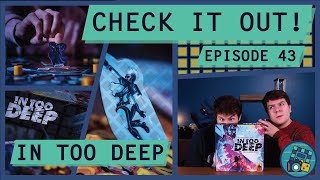





In Too Deep Deep Dive
What the Community Thinks About In Too Deep
Reviewers who have spent real table time with In Too Deep, the 2021 game by Josh Cappell and Daryl Chao published by Burnt Island Games, tend to describe it as a story you steer rather than a checklist you complete. The setting is 2087, a city where a crime syndicate holds the power, and your job is to slip into the minds of its members, hook them, and pull out the intel that matters. The consensus is that the rules are dense, but the payoff arrives quickly once the table gets comfortable.
Ilya and Tyler, who play and film together, call the game a joy to play and say they love it, while acknowledging that it resists a single tidy label. In their overview they describe a mix of push your luck, set collection, and semi-cooperative play wrapped in a heavily narrative frame. The hook they return to most is the ending. The game has several ways to finish, and the closing section of the book lets you win by scoring the most points or by reaching a different outcome that depends on how you handled your intel.
Matthew Jude, who features In Too Deep in their list of overlooked games, highlights the premise of hooking criminals and the way the game asks you to face corrupted dilemmas rather than simple good-or-bad choices. The designer's own account adds useful context. Helena Cappell, speaking in an interview with Gaming with Edo, describes a long development history and a crowdfunding campaign that was canceled short of its goal before a relaunch. Cappell also names the marketing challenge: the game looks like a Euro on the shelf but plays as a gritty, thematic experience with a lot of tension. That mismatch makes the game hard to explain, which is part of why community reviews carry so much weight for it.
Core Mechanics That Define In Too Deep
Semi-Cooperative Play
The most distinctive mechanic is the way players relate to each other. Ilya and Tyler explain that it is almost like semi-cooperative because everyone is working toward their own story cards while reacting to what the rest of the table is doing. You do not pick a single character and master its abilities in isolation. Instead, you read the board, notice where others are pushing, and decide whether to help, ignore, or undercut them. That tension makes the table feel shared even when scoring is individual.
Grip, Corruption, and End-Game Scoring
The longer breakdown from Ilya and Tyler covers the grip system in detail. As you take control of a mind, your grip on that person grows, and higher grip opens up more actions. Corruption scoring at the end rewards the intel you gathered and the way you handled it, so a good run is not just about racking up actions. The reviewers also describe a hidden betrayal dynamic: a player may be working against the group, and the table does not learn who until the end.
The In Too Deep Experience
Narrative-Driven
Nearly every review comes back to theme. Ilya and Tyler describe the game as very narrative and thematic, with a storyline that unfolds as you push further into each target's mind. The game is built in chapters, and the story responds to the intel you have and the choices you have made along the way. It rewards players who enjoy reading and reacting to what the story is doing, and it makes each session feel like a single episode in a longer arc.
Intense and Swingy
Tension is the other constant. Because your grip can slip and your intel can be wrong, a turn that looks safe can turn sharply. Reviewers describe the feeling of being pulled deeper than planned, and the swings are part of the appeal. The game is at its best when the table is willing to take a risk and live with the consequences.
What Makes In Too Deep Stand Out
The "Went In Too Deep" Mechanic
The mechanic that gives the game its title is the strongest standout in the reviews. Going too deep into a mind carries real risk, but it does not automatically end your chances. The game lets you lose control and still win, which keeps a bad turn from becoming a dead end. This is a rare balance: the consequences feel real without making the rest of the game feel pointless.
Built for Replay
Because the endings depend on which intel you gather and how you handle it, reviewers see a lot of replay value. A table that finishes one game usually wants to see what a different approach would have produced. The hidden betrayal also changes how each playthrough feels, since the group's trust is never fully safe.
Potential Drawbacks
An Intimidating Setup
The most common complaint is the setup. There are many components and many moving parts, and first-time players can feel overwhelmed before the first card is played. Ilya and Tyler acknowledge the learning curve but note that once the table gets over that hump, the game is not as complex as it looks. Plan for a slower first session and consider teaching it to experienced players who can carry the rules.
Randomness and Accidental Disruption
Two issues come up in the more critical reviews. First, the final plot can feel random because the placement of hidden evidence affects how the story resolves. Second, players can accidentally disrupt one another's setups, which can be frustrating when you have carefully built a position only to see it undone by another player's action. Groups that enjoy a looser, more narrative style will probably forgive these moments more easily than players who want tight control.
If You Enjoy In Too Deep
In Too Deep suits groups who enjoy narrative games, semi-cooperative tension, and endings that reward thoughtful play. Reviewers recommend playing at full player count to see the game at its best, though the two-player experience still holds up. Set aside time for the setup, and expect a few swings that feel unfair in the moment. For players who want a dense, story-driven game with real consequences, it is worth the effort.
What Reviewers Are Saying
"At the end of the game one of you is gonna betray the whole team but you just don't know who it is yet."
— Ilya and Tyler, kovray
"Even in a two-player game you can lose it and go in too deep but you can still win."
— Ilya and Tyler, kovray
"I was floored by how good the game was but I don't think we ever played it at a full player count."
— Ilya and Tyler, kovray