
















CAESAR! Deep Dive
What the Community Thinks About CAESAR!
The board gaming community has embraced CAESAR! as a standout two-player experience that delivers strategic depth in a compact package. Reviewers consistently praise the game for its elegant simplicity paired with meaningful decision-making. All You Can Board calls it "a game that landed on my top 10 games that played best with two players," while Getting Games describes discovering unexpected engagement: "I don't think either of us expected going in that it was going to land this way like I had heard things about it I expected that on some level I would find it enjoyable." The game's appeal transcends its Roman war theme: even players who aren't drawn to military games find themselves captivated by the mechanics underneath. Allies or Enemies emphasizes the polish: "The bits are solid across the board" and "the board is well laid out and clear which is very important for a game like this." There's remarkable agreement that CAESAR! succeeds as a tightly designed two-player duel that rewards careful planning and tactical flexibility.
Core Mechanics That Define CAESAR!
Area Control with Influence Projection
At its heart, CAESAR! is an area control game where players compete to establish dominance across provinces on a map representing the Roman Republic. Players place influence tokens into regions, and the spatial arrangement matters critically. Heavy Cardboard explains the system: "You're going to choose one of the tokens from behind your screen and put it out on a space matching its suit. You're projecting influence into the two regions that it's touching." Each token has a number value on both sides, and when a region fills, players add up their total strength to determine control. The clever twist is that winning a region doesn't just score points; if that region borders one you already control, you place an additional control marker, starting chains of influence that can spread across the map. This creates the game's central tension: do you focus on closing a high-value region, or build strategically to set up devastating chains?
Bonus Tokens and Variable Decisions
The game avoids feeling repetitive through bonus tokens that appear as provinces close. Whoever places the final token in a region claims the bonus first, before control is even determined. These bonuses include Tactics (an extra turn), Wealth (draw another token), Might (flip an opponent's token face-down), and the powerful Senate tokens that provide bonus control markers scaled to how many you've collected. Getting Games from jit games notes this creates rich decisions: "There are so many Avenues to Victory and like if all of a sudden you start you know chained a bunch of stuff together even if I was trying to focus on something else I'm almost I almost have to stop you from chaining otherwise unless I have a way to get you know do things faster than you I have to block you." The interplay between claiming regions and chasing bonus tokens means every turn presents multiple meaningful paths forward.
The CAESAR! Experience
Tense Head-to-Head Competition
CAESAR! delivers an intensely interactive two-player experience where every placement affects the board state and your opponent's future options. The game thrives on reading your opponent, predicting what they want and denying it to them. All You Can Board captures this feeling: "tension and potential for ties keeps the play interesting." Players describe a constant push-and-pull as they jockey for position, and the stakes feel real even when the game lasts only 20 minutes. Because turns move quickly, there's minimal downtime, and the compact board means no area is ever truly safe to ignore. You're always reacting, always planning ahead, always balancing offense with defense.
Quick but Satisfying Gameplay
Despite its strategic richness, CAESAR! plays remarkably fast. A typical game runs 20 minutes, which reviewers find perfectly calibrated. This brevity doesn't cheapen the experience; instead, it creates an invitation to play multiple rounds. All You Can Board describes playing "best of three like it's just me as well it plays so fast and you can it's like a really effective way to be like ah just in case like there it wasn't any sort of like luck element to it or anything like that you can kind of even know with the best of three kind of like Lord of the Rings competition." The speed lets you test different strategies across multiple plays in a single session, and each game feels distinct because the hidden hands and variable setup ensure the map evolves differently every time.
What Makes CAESAR! Stand Out
Elegant Map-Based Design
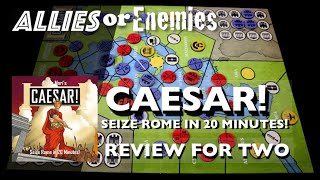
Many area control games flatten the experience into abstract tracks or simpler board layouts. CAESAR! places its decision-making on an actual map of the Mediterranean, with clearly labeled provinces and borders that matter mechanically. This visual presentation immediately communicates what's at stake and makes chaining (placing adjacent control markers) feel organic and exciting. Allies or Enemies praises the production: "The board is well laid out and clear which is very important for a game like this." The map also enables richer strategic conversations. Unlike games where area control reduces to numbers on a track, here you can see networks forming, identify defensive vulnerabilities, and pursue different theaters of control.
Replayability Through Asymmetric Starting Conditions
The bag of tokens ensures that every game begins differently. Players draw tokens in random order, and which icons appear determines available moves. This randomness never feels punishing; instead, it forces adaptation. All You Can Board notes: "I played this probably upwards of like 30 40 times now it's been a go-to two-player game with various people who I game with over the past few years everyone I've shown this to has loved it um and even though in many ways you kind of like you see all the cards pretty quickly within a couple games but even though you feel like you've seen all there is to see the games still feel different." Paired with the variable province bonuses and the positions where you start, no two games play out the same way, despite the simple underlying rules.
Potential Drawbacks
Limited Player Count and Group Play
CAESAR! is strictly a two-player experience. The asymmetry of the Roman Civil War theme works perfectly for duels but offers no natural pathway for three or four players. Allies or Enemies states this clearly: "This is a two-player game through and through it is the straight-up head-to-head abstract so if you are looking to adapt it for three or four look elsewhere." If your primary play group favors larger gatherings, CAESAR! won't be the centerpiece, though it shines when you have a regular two-player partner.
Luck in the Token Draw
While the hidden hand creates tension and bluffing opportunities, reviewers note that streaks of bad draws can feel frustrating. If you consistently pull tokens that don't match available spaces, your options narrow sharply. Getting Games and jit games observed this in their playthrough: "luck-based elements due to the random bag of tiles (especially with expansions)." The base game mitigates this through hand size bonuses (Wealth tokens) and the flexibility of wild Laurels, but some players may prefer more control over their options. That said, the fast playtime means you can quickly move to the next game and reset your luck.
If You Enjoy CAESAR!
Players who love CAESAR!'s map-based maneuvering and quick, decisive two-player battles should explore related titles. Those drawn to the area control mechanics will find similar satisfaction in Battle Line, which delivers head-to-head conflict through simpler means. For a richer tableau-building experience with similar tempo, Santorini offers abstract elegance with the asymmetry of god powers creating infinite matchup variations. If the Roman setting appeals to you, Blitzkrieg shares designer Paolo Mori's sensibilities, translating the core system to World War II theaters. For quick, punchy two-player duels, Hive and Chess echo CAESAR!'s spirit of pure strategic play stripped of randomness, while Othello delivers similar spatial reasoning and the thrill of sudden reversals.
What Reviewers Are Saying
"The tension and potential for ties keeps the play interesting, and it never stops being satisfying because there are so many Avenues to Victory and like if all of a sudden you start you know chained a bunch of stuff together even if I was trying to focus on something else I'm almost I almost have to stop you from chaining otherwise unless I have a way to get you know do things faster than you I have to block you."
— All You Can Board
"This is definitely one of the, this is probably my favorite, actually, like straight dual game, because of the map and back and forth and the thing, and it's just fun."
— Getting Games
"Caesar is definitely one of those if you think you'll like it you'll like it and if you think you won't you won't kinds of games it is a head-to-head thinky area control puzzle so inherently it's a bit combative and it's got some big choices to make every turn, but if you like head-to-head games or area control games with euro mechanics or abstract games this is a solid one."
— Allies or Enemies