





Katmai: The Bears of Brooks River Deep Dive
What the Community Thinks About Katmai: The Bears of Brooks River
Katmai: The Bears of Brooks River draws appreciation for its thematic authenticity and clever design. Board Of It praises the game's foundation but questions its staying power compared to similar titles. The Cardboard Herald celebrates the game's respect for regional wildlife and conservation while acknowledging some mechanical rough edges. kovray sees real strategic depth emerging through repeated play, where card familiarity transforms early randomness into tactical nuance. Reviewers consistently note that Katmai succeeds as a focused, efficient experience for two players seeking head-to-head confrontation without heavy overhead.
Core Mechanics That Define Katmai: The Bears of Brooks River
Simultaneous Reveal with Hand Management
Each round, players hold exactly two cards and play one face-down to a river tile, then simultaneously reveal. This creates tension as you choose placement without knowing your opponent's response. The mechanic forces constant decisions about playing defensively (occupying spaces your opponent wants) or offensively (winning specific tiles). Since both players use the same 12-bear deck with only two cards removed each round, experienced players learn what's coming. Board Of It notes that once you know which cards your opponent hasn't played, you can anticipate their options, transforming early randomness into tactical advantage over multiple games.
Initiative Exchange and Area Control
The first player token (Paw token) is freely passed between players at the start of any turn. Going first reveals your card before your opponent's, limiting information; going second lets you react. Yet the first player also wins tiebreaker opportunities and can use the baby bear cub token to break stalemates. The Cardboard Herald describes this voluntary exchange as emblematic of what Katmai does repeatedly: simple rules yielding multiple strategic implications. After winning area control on individual tiles by dominance value, you place one bear meeple in a quadrant of your choice. Objectives require specific terrain patterns: connecting bears across tiles, positioning bears on particular landscape types, or forming geometric shapes to catch salmon.
The Katmai: The Bears of Brooks River Experience
Tight Back-and-Forth Tension in the Late Round
The game starts loose with abundant board space, but as players exhaust their cards and spaces fill, tactical pressure intensifies. Board Of It and The Cardboard Herald highlight how the final turns become knife-edge decisions where a single bear placement blocks crucial spaces or completes contested objectives. The tense endgame moments, where a forced card exchange or initiative pass can swing multiple river tiles, create memorable turning points that anchor the experience.
Living Game Narrative Grounded in Real Bears
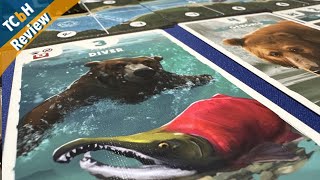
Osprey Games rooted Katmai in the actual Brooks River in Alaska, where real tagged bears with documented behaviors inspired the design. Every bear card has a real name with rulebook references, and card abilities abstract actual bear behaviors: territorial play, salmon-catching tactics, social hierarchies. The Cardboard Herald emphasizes how this theming elevates the experience beyond generic area control. Production details reinforce this: charming illustrations and rule sheets with notes on wildlife conservation and the region's Indigenous Heritage. The theme makes the spatial struggle for river tiles feel coherent, not mechanical.
What Makes Katmai: The Bears of Brooks River Stand Out
Elegant Initiative Mechanic with Cascading Implications
The Cardboard Herald identifies the voluntary passing of initiative as a standout feature. It works as both a tactical choice (does a player want to see their opponent's move first?) and a strategic resource (giving it away risks losing tiebreaker access). Unlike fixed turn order, the flexible pass keeps both players engaged. The Paw token feels small but carries large impact, forcing constant evaluation of board state and risk, exemplifying Osprey Games' philosophy of embedding meaningful choices into minimal mechanisms.
Quick Play with Replayable Asymmetry Through Card Selection
Katmai plays in roughly 25 minutes. The speed comes from having only two cards in hand at any moment, forcing narrow decision trees. The game includes advanced bear cards (lettered A through H) that add complexity, offering a graceful difficulty curve: master the core set, then add advanced cards for fresh strategic terrain. Random two-card removal at the start of each round ensures variation even with identical decks. kovray recommends a best-of-three format, noting that a single play can pivot on draws or reads, but multiple games reveal who better understands the bear matchups.
Potential Drawbacks
Early-Game Randomness and Loose Board Spacing
Board Of It identifies a tension: abundant open tiles mean situational bears can feel wasted without triggering their abilities. The five terrain symbols spread across many tiles create perceived abundance, so there's no immediate pressure to fight for specific spaces. This looseness undermines the tense decision-making many players seek. The Cardboard Herald notes the game feels less confrontational than Ironwood, Radlands, or The Lord of the Rings: The Card Game, which use compressed terrain to create scarcity and force early commitments.
Narrow Endgame Window and Replayability Questions
Board Of It raises concern about the endgame. If one player gets four bears ahead in supply, the game terminates immediately. In one session, they won every first-round tile, ending the game before the third round felt earned. The identical deck for both players bounds the strategic space: limited terrain combinations and a fixed card pool may not sustain many sessions without new modules. The Cardboard Herald frames this more charitably: the game suits players seeking a tight, efficient head-to-head experience, but those preferring longer arcs of dominance might find it narrow.
If You Enjoy Katmai: The Bears of Brooks River
Players who love Katmai likely gravitate toward focused two-player card games with asymmetric tension but symmetrical starting resources. Ironwood and Radlands offer similar area-control duels with tighter board spaces. Rift Force and Shot and Totten deliver comparable lane-battler mechanics where you build small hands and react to opposition. The Lord of the Rings: The Card Game supports cooperative two-player play but shares Katmai's emphasis on card ability text and tempo shifts. For players drawn to the real-world wildlife theme, Zenith and The Oracle of Delphi explore wandering and area dominance in different settings. The Undaunted series (including the forthcoming Undaunted: Kalista) grounds card-driven conflict in historical narrative, though with more complex deck building. This Is War layers narrative choices over card play, and Battalion War of the Ancients condenses tactical wargaming into compact unit composition. Finally, The King is Dead distills two-player political maneuvering into a lean card game, sharing Katmai's philosophy that elegant mechanisms and real-world inspiration can deliver meaning at modest complexity.
What Reviewers Are Saying
"I think as you kind of touched upon the fact that both decks are basically the same you kind of then know what your opponent can play and once you have a few games you do kind of get the kind of meta strategy of being like well they haven't played this card yet yeah so maybe I should watch out for that."
— Board Of It
"First player is given to another player voluntarily in this game because of course you want to be able to play after your opponent seeing where they're starting to put their face down cards so you can react to that either confronting them or stepping them but first player also gives you priority in tiebreakers and a few other game effects, so it is a valuable resource to have at the same time. This voluntary exchange is just a beautiful slight mechanism that's emblematic of what Katmai does over and over and over again."
— The Cardboard Herald
"That's fine, I am still learning the strategy and then, like a game like this, it's a play to it's play the player, and sometimes sometimes Ilia is in my head more than I'm in his head, so, and of course when play filming playthroughs too, we have to be really snappy and think on the spot, so I usually take my time. I'm not like one to rush a playthrough just for that. I'm usually quick in my turns in general because if it goes, goes, and now learn for next time."
— kovray