








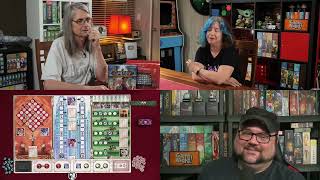
Gatsby Deep Dive
What the Community Thinks About Gatsby
Reviewers consistently praise Gatsby as a masterclass in two-player design. Bruno Catala, working with Ludovic Malblanc, has created a game that stands alongside his other acclaimed two-player titles like Seven Wonders Duel and Splendor Duel. The consensus from the board game community is overwhelmingly positive: Gatsby delivers a tight, tense experience where every turn matters. What's particularly striking is how unified reviewers are in their assessment. From casual enthusiasts to dedicated board game critics, the response centers on the game's elegant design, decision density, and the constant tension of managing multiple competing objectives. Reviewers note that while the game has a Roaring Twenties aesthetic and borrows its name from F. Scott Fitzgerald's classic novel, it does not directly reference the book's characters or plot. Instead, it establishes its own setting where players represent James Miller and Dorothy Williams competing for influence among high society figures. This thematic distance from the source material is a minor point for some, but the game's mechanical excellence overshadows any concerns about literary fidelity.
Core Mechanics That Define Gatsby
Action Selection
At the heart of Gatsby lies an action selection system of remarkable elegance. Players alternate turns placing an action token on one of four available spaces, each triggering one or two specific actions on different areas of the board. What makes this mechanic shine is the blocking aspect: once a player selects an action, their opponent cannot use that same action on their next turn. This creates a constant tension between pursuing your own strategy and denying your opponent's best options. Every turn forces players to weigh the value of the action for themselves against the value of blocking it from their opponent. The system generates a cascading series of decisions as each choice opens up new possibilities for both players while simultaneously eliminating others. Reviewers highlight how this apparent simplicity masks deep strategic complexity.
Area Control Through Multiple Theaters
Gatsby spreads area control across three distinct locations on the board, each operating with different rules. In the cabaret, players place tokens trying to form unbroken lines or control specific gear spaces. At the finance center, players advance up a track where falling behind actually provides an advantage: players who are behind move two spaces instead of one, creating catch-up mechanics that keep the game competitive. The racetrack operates on majority control where tokens are placed left to right, and completing a row determines who claims the valuable character associated with that row. These three parallel contests create what reviewers call a tug-of-war in multiple places simultaneously. Every move a player makes influences all three battlegrounds, forcing constant recalculation of priorities. The spatial separation of these zones means no single strategy dominates; players must adapt their approach based on which areas are most contested and which characters remain available.
The Gatsby Experience
Intense, Constant Tension
Players report that Gatsby creates an atmosphere of mounting pressure as the game progresses. The immediate victory conditions (claiming three characters of the same color or one character of each of the five colors) hang over every decision. Even when these conditions remain unreached, the possibility that either player might suddenly achieve them keeps everyone engaged. The presence of face-down character tiles adds another layer: players peek at hidden characters to gain information, but this information advantage is fragile because opponents can swap tiles and obscure what has been revealed. Reviewers consistently mention sweating during gameplay and feeling genuine stress about their decisions. One player described the game as building tension turn after turn as the endgame approaches, with each action carrying heightened stakes.
Mind Games and Deduction
The hidden information creates space for bluffing and counter-play. When players swap face-down tiles, they peek at them secretly but do not reveal whether they swapped the tiles or merely looked. This forces opponents to read behavior and make educated guesses about hidden information. Reviewers call this a head game or battle of wits where understanding your opponent's decision-making patterns becomes as valuable as knowing which specific characters are where. The game rewards careful observation: noticing when an opponent performs a swap suggests which characters they value, and deciding whether to chase that same character or defend elsewhere becomes a critical metagame. This psychological dimension elevates Gatsby beyond a pure optimization puzzle.
What Makes Gatsby Stand Out
Stunning Production in a Small Box
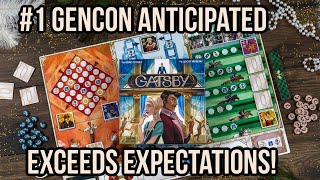
Multiple reviewers note the impressive production quality and component design. The board unfolds into a sizeable play space despite coming in a compact box. The visual design is clean and modern with strong iconography that communicates game information clearly. Particularly striking are the gold foil touches on the board, which lend the game a premium feel and reinforce the 1920s high-society theme. The chunky wooden action token serves both functional and aesthetic purposes. Even the player tokens and character tiles are well-crafted and easy to distinguish. This production quality sets Gatsby apart in an industry where small-box two-player games sometimes cut corners. Reviewers express genuine delight at opening the box and finding components that match the game's mechanical excellence.
Meaningful Decisions on Every Turn
Gatsby generates an exceptional number of consequential choices within a 30-minute playtime. Every action presents multiple branches of consequence: it advances your own position, blocks your opponent's preferred move, sets up or disrupts their next turn, and influences which characters become available. Reviewers stress that no turn feels wasted or routine. Even early-game actions matter because the player who seizes momentum early creates cascading advantages. The special action tiles amplify this by enabling unconventional plays and combo chains. Players report that the streamlined rules system enables smooth, fast play while the decision space remains dense and tactical. This efficiency becomes a virtue: the game respects players' time by delivering maximum strategic depth without bloat.
Potential Drawbacks
Memory Component
Several reviewers identify the memory element as a drawback, particularly for players who dislike remembering hidden information across multiple turns. Once players peek at face-down characters, they must remember which tiles are which if those characters remain in their original positions. Swapping tiles obscures information and creates genuine uncertainty, but only if players can recall what was swapped. Reviewers note that the rules expect players to track this mentally, though some suggest placing personal tokens as memory aids. One reviewer expressed a wish that the official rules permitted permanent memory markers for revealed tiles. For groups that embrace memory challenges, this element enhances the deduction gameplay. For groups that prioritize puzzle-solving over memorization, it introduces friction.
Color Distinction on Character Tiles
The game uses five character colors for set collection, including dark blue and purple that can be difficult to distinguish, especially in dim lighting or when viewing the board from certain angles. Early-game visibility is manageable because only some characters are face-up. As the game progresses and more face-up characters accumulate on the board, players gain reference points to differentiate the similar colors. However, when a single face-up character in that color range sits alone on the board, distinguishing between them becomes challenging. Reviewers suggest that a lighter blue or darker purple would have improved contrast without altering the game's other qualities. This is a minor production issue rather than a mechanical flaw, but it can create moments of unnecessary squinting or debate over which color a character actually is.
If You Enjoy Gatsby
Players drawn to Gatsby's tight action selection should explore Seven Wonders Duel, another Bruno Catala creation that employs a different action system but delivers similar decision intensity. Those who appreciate the area control elements will find resonance with Battle Line and Schotten Totten, both of which focus the player count on head-to-head conflict. The memory and deduction layer connects Gatsby to Mr. Jack, also designed by Catala, which emphasizes hidden information and reading your opponent. For players seeking the Roaring Twenties aesthetic alongside strategic depth, historical-themed games like 7 Wonders Draw offer thematic alternatives. The simultaneous immediacy of victory conditions recalls Pandemic, though Gatsby strips the cooperative element in favor of pure competitive play. Players who love the minimalist elegance of tile-placement games should investigate King Domino Duel, the two-player variant designed by both Catala and Malblanc together. Those seeking lighter two-player experiences can explore Splendor Duel, which streamlines another classic for head-to-head play. Finally, for fans of abstract strategy with hidden information, Clue Conspiracy adds social deduction elements in a different genre.
What Reviewers Are Saying
"Every decision you make, you are considering what that opens up for your opponent. But I really like the action selection system where once you pick an action, you at least know that that's an action your opponent can't do."
— Allies or Enemies
"But it is up there. It is so sharp. It is Bruno Cathala as a master craftsman doing so much with so little. It is so impressive."
— Roto Runthrough
"Oh man, this game is just full of crunchy good mindbending decisions. And it's so streamlined. Take an action. You're going to do two things. There's only three places to go. They're all very simple: place a token, maybe get a bonus, chain some things together, but it's so streamlined and so smooth, but yet the decision space is so tight and it's so tense. It is fantastic."
— Watch Review