
















Footprints Deep Dive
What the Community Thinks About Footprints
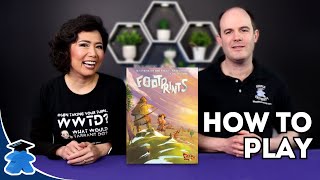
Footprints has emerged as a standout title from Chilifox Games, drawing consistent praise from the board gaming community for delivering far more depth than its straightforward premise suggests. While the game's surface narrative centers on a stone age clan racing to the mountains before rising waters consume the land, reviewers consistently highlight how the race itself becomes secondary to the intricate puzzle of resource management and scoring optimization. The general sentiment is decidedly positive, with reviewers recognizing the game as a clever subversion of racing mechanics that rewards thoughtful play over pure acceleration. Some observers note that the game strikes a particular resonance because it shares design DNA with Come Together, another well-received Chilifox title, suggesting the publisher has developed a distinctive philosophy about accessible yet punishing euro-games.
Core Mechanics That Define Footprints
Hand Management and Card Timing
At its heart, Footprints is built around hand management. Each player holds a limited clan deck of exactly 14 cards, never to be reshuffled, which means every card choice carries weight and players must carefully ration their resources across the entire game. The tension stems from the dual nature of each card: choosing whether to use the top half for movement or the bottom half for skill advancement creates perpetual dilemmas. Reviewers emphasize that this isn't a game where you play every card toward a single goal. Instead, players must constantly weigh whether to spend a card advancing right now or preserve it for a critical moment later. The mechanic forces players to develop a hand management rhythm, where understanding the distribution of remaining cards in their deck becomes as important as the cards in their hand.
Engine Building Through Terrain Mastery
The game incorporates engine building through its skill advancement system. Players develop four distinct skills corresponding to different terrain types, and as these skills increase, the same card allows you to move further across matching terrain. This creates satisfying moments where early-game investments in skill tracks begin to compound into powerful actions. The engine-building element rewards planning and long-term thinking, transforming what might otherwise be a simple movement game into one where players gradually enhance their capacity to traverse the board efficiently.
The Footprints Experience
A Deceptively Tight Puzzle
What strikes most players immediately upon playing Footprints is how punishing it feels compared to similar games. Reviewers describe the experience as a tight, demanding puzzle where each decision carries consequences. This isn't a game that offers forgiving margins or multiple viable strategies; instead, it asks players to carefully sequence their actions and commit to plans several turns in advance. The tightness manifests in resource scarcity: bonus spaces on the map become contested, and since each player can only land on a space once per turn, strategic positioning matters tremendously. One reviewer noted playing with a couple who confidently raced to the finish only to discover they had scored far fewer points than expected, highlighting how the game's true victory condition punishes those who ignore the intricate scoring systems.
Tension Between Racing and Optimization
A defining characteristic of the Footprints experience is the constant tension between the race narrative and the point-scoring realities. While the game provides a mountain destination and will end when someone reaches it, players quickly learn that finishing first means almost nothing if you've failed to gather resources, construct engravings, or secure objective cards. This creates a push-pull that distinguishes Footprints from traditional racing games. Players find themselves making deliberate "pit stops" along the board, deliberately slowing their forward progress to accumulate the resources and achievements that actually generate victory points. This friction generates engaging moments of choice: whether to accelerate forward now or spend one more turn gathering the resources needed.
What Makes Footprints Stand Out
Asymmetric Clan Identities
Each player controls a unique clan with its own deck of cards, creating meaningful asymmetry from game start. Rather than all players working with identical tools, the different clans excel in different terrain types and offer distinct strategic paths. This asymmetry ensures that Footprints feels fresh across plays and rewards learning the strengths and weaknesses of your chosen clan. Reviewers praise how this design choice prevents the game from settling into a single optimal strategy, encouraging players to find creative paths aligned with their clan's particular strengths.
Elegant Integration of Multiple Scoring Systems
Footprints manages an impressive feat: it layers multiple, genuinely viable scoring paths without feeling fragmented. Players can pursue cave paintings that generate endgame bonuses, construct engravings that provide raw points, pursue objective cards for chunky scoring, or accumulate resources for overflow scoring. None of these systems dominates, and none feels obligatory. This creates strategic flexibility and replayability, as players discover new combinations and alternative routes to victory. The multiple scoring avenues also mean that games with diverse player strategies can remain competitive until the final tally, avoiding the sour feeling of being locked out of viable strategies from the midgame onward.
Potential Drawbacks
Scoring Volatility in the Endgame
Some reviewers raise a concern about the objective cards that appear throughout the game. While these cards can provide substantial endgame scoring (potentially 20-30 points each), their draw order introduces variance. It's possible to draw a suite of objective cards perfectly aligned with your resources and position, or to draw cards that provide no value whatsoever given your actual game state. This luck factor in endgame scoring can feel unsatisfying to players seeking tighter control over their destiny. One reviewer noted playing a game where they liked 80 percent of the experience but felt the objective card mechanic undermined their careful earlier planning.
Demanding Learning Curve
Footprints does not broadcast its depth immediately. The game's true strategy, the careful balance between advancing your position and optimizing point generation, only emerges through play. Early players often make the mistake of racing forward aggressively, only to discover they lack the resources for scoring mechanisms. The game punishes this misunderstanding harshly, which can feel frustrating on a first play. Reviewers suggest that groups expecting a straightforward race will find themselves frustrated with Footprints' unforgiving nature, and the game's best experience comes with players who commit to understanding its underlying design puzzle.
If You Enjoy Footprints
Players who appreciate Footprints' blend of racing and resource management will find similar satisfaction in related titles. Road to El Dorado shares Footprints' point-to-point movement and card-driven navigation, making it a natural companion. For those drawn to the engine-building element, games like Come Together (from the same publisher) and Calico offer the satisfying ramp of increasing power. Players who love the tight, tactical feel may gravitate toward Kites for its real-time puzzle elements, or Coloretto for its economy-building depth despite its compact ruleset. Those captivated by the asymmetric player powers and modular board design should explore Explorers of the North Sea or other titles that emphasize variable setup and player uniqueness.
What Reviewers Are Saying
"This is a like a really tight and punishing puzzle so you want to have to make sure that you have the right card to move to the right terrain so there are different type of terrains you have to have the card that lets you move to that terrain and then you can combo the move so bang bang bang you move forward but then you don't necessarily want to move forward you want to go and then do a pit stop to gain points gain bonuses collect resources so that you can gain your point generating cave or cave paintings."
— Meeple University
"You'll be moving through the terrain trying to improve your skills as you go so that you can get better at gathering resources but also making important cave paintings and Engravings at important sites so hopefully you'll be remembered all while you get your keister to the Horizon Before Time runs out there are asymmetric player Powers variable setups engine building and this looks lovely."
— Matthew Ransom
"It had a lot of the DNA of Road to El Dorado in it, how you're moving down this board. It's like, it's all these hexes, and you've got cards that you play out, and they say what kind of hex you can move on, but it does it in a really different way. And so it's like two sides to each car, top and bottom, and so you can either increase your level for how far you can move in the different terrain. So it's almost an engine builder, well, it is an engine builder in that sense. You can make those actions stronger, or you can move, so it's like, well, do I want to set myself to move further next time, or do I want to move far now? So it looks like a race game, but there are enough extra elements."
— Allies or Enemies