








First Monday in October Deep Dive
What the Community Thinks About First Monday in October
First Monday in October is a one to four player strategy game from designer Talia Rosen and Fort Circle Games that plays out 200 years of US Supreme Court history. Most of its coverage arrived during its Kickstarter campaign, and the most detailed hands-on verdict comes from Zilla Blitz, who spent about 10 hours with a prototype and gave the game a huge thumbs up. Zilla Blitz admits that before playing, a trip to the dentist sounded more appealing than a game about the Supreme Court, and that watching 15 to 20 minutes of play at SDHistCon was enough to reveal some really sharp gameplay. Heavy Cardboard, looking back on its year of streams, called it pretty great and really clever, and said it did not overstay its welcome. Tabled put it at number four on a list of most anticipated solo games, citing a love of the subject and of the history Fort Circle Games builds into its other titles. The consensus from people who have played it: an intricate, carefully tuned strategy game whose theme turns out to be far more inviting than it sounds.
Core Mechanics That Define First Monday in October
Area Majority on Landmark Cases
Players earn Renown by placing clerks on the winning side of landmark cases, by shaping who sits on the Court, and by pushing the Court's philosophy toward the hidden goals on their philosophy cards. Four judicial philosophies work as tug of war tracks, each pulled toward a federalist or anti-federalist position; in the designer's interview on Beyond Solitaire, Rosen likens them to the score track in Twilight Struggle and names the Commerce Clause as one of the four. Timing drives the case play. As Zilla Blitz explains, joining a case late costs a lot of influence, while joining early gives rivals more time to swing it, and a clerk placed on the currently losing side costs less than one placed on the prevailing side. That opens a classic gambit: back the underdog cheaply, then shift the Court until that side prevails.
Action Selection and an Aging Court
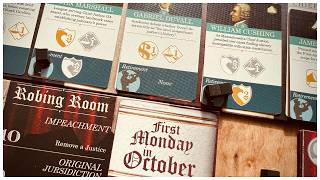
Rosen describes an action menu with six actions to choose from on any given turn, and Zilla Blitz notes that players never have enough capacity to do everything, so every action has to be spent judiciously. Actions include writing a law review article to adjust a philosophy track directly, and nudging justices toward retirement by adding aging markers. Zilla Blitz's gameplay video shows the end of each turn, when three ten-sided dice place natural aging markers on the bench, and a justice whose markers reach the value of that justice's die retires. Rosen explains that most justices use a four-sided die, while those who historically served briefly or for decades use smaller or larger ones. The robing room track adds a race: the first player to reach a level gains a rehearing that allows repeating an action, until another player catches up.
The First Monday in October Experience
A Lens on US History
The surprise for Zilla Blitz was that the game offers less a lens on legal history than a lens on US history, since each landmark case reflects what society was wrestling with at the time. A case deciding whether child labor is legal stood out as a moment that made the reviewer stop and wonder where the country was at that point. The game also sidesteps modern political heat. Its cases end before the year 2000, and the tracks use federalist and anti-federalist positions shown in silver and gold rather than red and blue, which Zilla Blitz believes keeps players of different political views from ending up at loggerheads mid-game.
Reading the Table
Zilla Blitz found many pathways to victory: joining cases late or early, switching sides, concentrating on dissents and opinions, or steering the Court toward the philosophy cards held until the end. What rival players pursue matters just as much. If two opponents push a philosophy in one direction, a player may be outnumbered and need to find another place to play to their strengths, so strategy constantly morphs around the rest of the table.
What Makes First Monday in October Stand Out
A Decade of Tuning
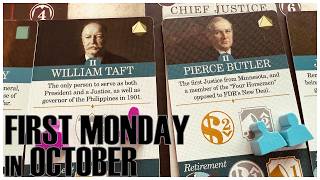
Rosen tells Beyond Solitaire that the idea took root about 10 years earlier, during a conversation with designer Jason Matthews while playtesting his games, and that this is Rosen's first design. Zilla Blitz feels that history in the play, describing a tightly wound game with so much subtlety, nuance and elegance that a single killer strategy seems unlikely to emerge after three or four plays. Replayability also comes from setup, since the pool of cases, their order, and the justices who appear change each game. Rosen notes the game has only 24 cases and a deck of 57 justices whose philosophical pulls balance to zero, with a few removed at random each game.
A Eurogame Heart Under a Legal Theme
Rosen openly credits borrowed ideas: spending points to earn more points from Santiago, a card slide in the spirit of Show Manager and Through the Ages, area majority from El Grande, and an action menu inspired by Stephenson's Rocket and Tigris and Euphrates. That hobby-game foundation is why Zilla Blitz says no knowledge of case law is needed to play. Beyond basics like the Court having nine members, everyone starts on a level playing field, and the reviewer rates the complexity around three out of ten while praising the color palette and a user interface that is comfortable and easy to use.
Potential Drawbacks
A Long, Intricate Game
This is not a short game. Zilla Blitz's four-player learning game took about three hours, with an estimate of about two hours once the rules are down. Rosen describes it as a solidly two-hour game for experienced players and two and a half hours or more when learning with a full table, with 15 to 16 pages of rules, and has turned down publishers who wanted a 60-minute version. Rosen also expects that plenty of lawyers who do not enjoy meaty games would find it too intricate.
Historical Context Can Be Hard to Follow
Zilla Blitz's one criticism is that the history behind each case was not always easy to follow. Without a legal background, it was hard to tell what a federalist judgment in a given case actually meant, and the reviewer wanted it explained more simply. The prototype lacked some of the historical materials planned for the final version, and Zilla Blitz expects Fort Circle Games' supplemental materials to help, but still sees room to spell things out more plainly. The solo mode also went untested in that review, because the prototype had to be returned first.
If You Enjoy First Monday in October
Zilla Blitz compares the experience to Obsession, another favorite that the reviewer loves for its rich strategy and subtlety of play despite a theme that holds little interest on its own. Tabled ties its excitement to the same appeal as Pax Pamir second edition: using limited power and influence just right to bend a situation in one's favor. On Beyond Solitaire, Rosen suggests that fans of Through the Ages, Twilight Struggle, Terraforming Mars and El Grande will likely enjoy it.
What Reviewers Are Saying
"What I found as I was playing the game was that even though I'm not incredibly interested in US legal history, what this game gives you is not so much a lens on legal history but a lens on US history."
— Zilla Blitz
"I've never played a game that has any sort of theme like this. US Supreme Court is a fascinating subject and I'm a big fan of the sort of the history that this publisher Fort Circle Games has put into their other games."
— Shaggy, Tabled
"I think a gamer who likes those sort of meaty games that I talked about will enjoy it much more than a lawyer who doesn't like those sorts of games. There are plenty of lawyers who would not enjoy it because it's just it's too intricate."
— Talia Rosen, Beyond Solitaire