












Fame & Fable Deep Dive
What the Community Thinks About Fame & Fable
Fame & Fable has captured reviewers' attention with its striking visual presentation and engaging mechanical depth. Across multiple playthrough videos and preview discussions, content creators consistently praise the game as both beautiful and mechanically sound. The consensus centers on three pillars: Owen Davey's exceptional art direction, the engaging hand-management systems that reward careful planning, and the perfect balance of competitiveness without direct player-versus-player combat. Reviewers note that the game manages to feel both accessible and strategically rich, a rare achievement that appeals to casual players and experienced gamers alike.
Core Mechanics That Define Fame & Fable
Hand Management
Hand management lies at the heart of Fame & Fable's gameplay loop. Players hold a hand of allies and items, each with action costs and abilities, and must decide which cards to deploy, when to use their special traits, and how to sequence their plays across each turn. The constraint that players cannot hold more than six cards creates constant decisions about what to keep and what to discard. This system means that a mediocre ally this turn might become essential next turn, forcing players to think several moves ahead. The hand-building approach gives players ownership over their deck without requiring separate deck-construction between games, making it more immediate and tactical than traditional deck-builders.
Contracts and Compound Scoring
Fame is earned through multiple pathways rather than a single scoring track. Defeating monsters and legends provides the baseline, but contracts offer bonus points for specific conditions like assembling three power allies or defeating enemies without using weapon attacks. This system means the winning path shifts throughout the game based on what's available in the market and what board state allows. Players must balance pursuing quick monster defeats against the higher payoff of completing contracts, and they must remain aware that securing a contract might telegraph their strategy to opponents who can plan accordingly.
The Fame & Fable Experience
Risk and Consequence
Fame & Fable plays with genuine stakes. When players lose combat against a monster or legend, they must discard an ally, either from their deployed party or from their hand. This creates moments of tension where players must decide whether to push their luck against a difficult opponent or accept a defeat to preserve their cards. Reviewers describe the game as having an evil streak, where bad draws and unlucky matchups can devastate carefully constructed hands. Yet this harshness never feels arbitrary because the underlying systems remain fair and understandable, so losses feel like learning opportunities rather than bad luck crushing careful play.
Momentum and Catch-Up Mechanics
The Moon token system elegantly manages the pacing of competition. Players who fall behind on the fame track gain additional actions on future turns, creating a mechanical pull toward the middle that prevents runaway leaders from dominating entirely. However, this catch-up mechanism cuts both ways: players who spend actions securing a lead find that lead converted into action economy for their opponents, requiring constant recalibration of ambition versus caution. The result is a game where fortunes shift throughout play, maintaining engagement for all players from start to finish.
What Makes Fame & Fable Stand Out
Art Direction and Visual Identity
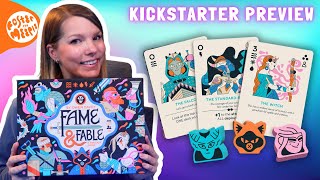
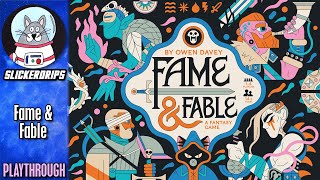
Owen Davey designed and illustrated Fame & Fable, bringing 15 years of professional illustration experience to bear. Every card features unique artwork that combines bold color contrasts with minimalist forms, creating an aesthetic that stands apart in the board game space. The art is immediately eye-catching without being cluttered, and it establishes the game's lighthearted fantasy tone perfectly. Reviewers consistently named the visual presentation as a primary draw, noting that it captures imagination and wonder while maintaining clarity in gameplay information. This is a game that will turn heads on the table and remain visually memorable long after the session ends.
Accessibility of Depth
Fame & Fable manages the difficult balance of being easy to teach while offering genuine strategic depth. The core loop is straightforward: refresh the board, take actions to build your hand and fight enemies, then score fame from completed contracts. Yet beneath this simplicity lies a rich decision space around hand sequencing, risk assessment, and market positioning. Reviewers appreciate that the game does not overwhelm new players with fiddly rules or excessive symbol recognition, yet rewards deeper engagement and replay without requiring significant rule changes or optional modules. Solo and cooperative variants expand the experience further, and all variants prove mechanically sound rather than afterthoughts.
Potential Drawbacks
Randomness and Card Draw Dependency
The draw decks include monsters and allies beyond player control, and some turns can force unfavorable draws that disrupt otherwise solid strategies. The Night Bird monster, for instance, forces the drawing of an additional monster into combat, potentially creating overwhelming situations. Similarly, allies that are vulnerable to specific damage types or immune to certain attacks can create matchups where no available solution exists in the current hand. While this randomness is intentional and fits the game's risk-taking theme, players who prefer deterministic strategies and minimal luck factors may find the variance frustrating across a campaign of plays.
Learning Curve for Ability Interactions
Each ally card features a unique ability, and the sheer variety of effects means that early games involve frequent rules lookups and clarifications about what different card abilities trigger and when. Some special effects require understanding nuanced interactions like instant actions versus traits, or distinguishing between when a monster's ability activates versus when a reaction ability triggers. The game provides clear iconography and reference cards, but the density of card text and the breadth of effects means that players who dislike reading and parsing card details may initially feel bogged down, particularly when facing a monster with an unusual restriction or ability.
If You Enjoy Fame & Fable
Players drawn to Fame & Fable should explore games built on similar foundations. Those who love the hand-management core will find satisfaction in Quacks of Quedlinburg, which shares the push-your-luck tension around hand assembly. Fans of the competitive-but-not-directly-hostile interaction style might gravitate toward Wingspan, which offers engine building with player interference through card drafting. For players fascinated by the solo mode and dungeon-crawling fantasy theme, Blackstone Fortress and Aeon's End offer cooperative alternatives with their own strategic depth. Those intrigued by the catch-up mechanics and fantasy flavor should investigate Talisman, which shares the adventure and chaos elements, and Dune: Imperium, which delivers high interaction and meaningful resource management in a rich thematic setting. Finally, players who appreciate the roguelike feel of uncertain outcomes and escalating difficulty might explore Slay the Spire-adjacent board game adaptations like Dead Cells.
What Reviewers Are Saying
"The color contrast is super interesting super intriguing really eye-catching and that honestly is enough to draw you in to want to try this game for sure. There are so many unique illustrations in this game each card has a different illustration and they bring in such a world of Discovery and wonder and sometimes familiarity that you're accustomed to but with a unique twist."
— kovray
"It doesn't just look amazing it plays amazing it plays super fun. Fame and Fable is amazing it is challenging it is difficult it is highly interactive with elements of take that but also it has this great feeling of you know building your crew up to then slay some huge beastly monster that will do something horrible to you and probably kill half your crew but it's a great interactive game."
— Board Stupid
"Fame and Fable is a competitive hand building game with an evil streak prepare to fail in your endeavors lose precious cards and annoy your friends in this light-hearted fantasy Quest. But what does that mean I'm glad you asked let's take a closer look at how the game works."
— Foster the Meeple