



Haunted Lands Deep Dive
What the Community Thinks About Haunted Lands
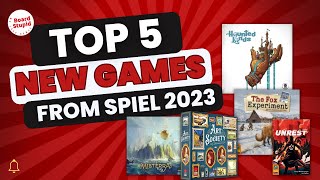
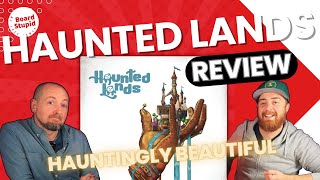
Board Stupid discovered Haunted Lands at Spiel 2023 with virtually no prior knowledge and fell immediately in love with it. Across multiple videos covering different playthroughs and angles, the channel consistently returned to the same conviction: this is the gateway Euro game that works. The team praised it not just as a lighter introduction to European-style mechanics, but as a genuinely excellent game in its own right, landing it in their 2023 game-of-the-year discussion. What struck reviewers most was the game's ability to do something deceptively difficult: pack multiple distinct mechanics into a single, cohesive experience without becoming overwhelming or slowing down to a crawl.
The designer, Leonardo Romano from Ludus Magnus Studio, intentionally built the game around two core pillars: accessible Euro mechanics and production that matches the quality of the ruleset. Romano explained in designer interviews that the game started with mechanics first: combining exploration, resource management, and a thematic element that forced players to think about the greater good while pursuing individual victory. That thematic tension became the ghost-management system, the secret ingredient that elevated Haunted Lands from a pleasant intermediate game into something genuinely memorable.
Core Mechanics That Define Haunted Lands
Resource Management and Engine Building
At its heart, Haunted Lands is built on a satisfying feedback loop of resource gathering and gradual mechanization. Players begin manually harvesting resources around the central city by spending action points, but the real power comes from building structures that generate resources passively, creating a snowball effect each season as the engine grows. Board Stupid's hosts emphasized how the skill cards layered on top create the real depth: each unlocked skill opens new pathways to generate resources or stretch them further. One host noted that a well-timed unlock, such as a free resource whenever you harvest, could reshape a struggling builder into a resource-generating machine.
The satisfaction comes from watching the transition from manual labor to automation. Early on, a player might spend three action points moving to a mountain, harvest a single stone, and move back; by mid-game, mills and mines churn out resources automatically each round, freeing action points for building and trading. This progression is the game's strongest mechanical hook, creating a tangible sense of progress across the three seasons.
Ghost Management and Semi-Cooperative Play
What makes Haunted Lands unique is not resource management: many Euro games offer that. What sets it apart is the ghost mechanic, a shared crisis that forces players to balance personal ambition with collective survival. Each round, the player in last place rolls the terrain die and places four ghosts on matching terrain types; if ghosts ever overflow and fill all empty spaces, the entire table loses immediately, regardless of points. This creates what Board Stupid called a "beautiful tension": players must personally banish ghosts to claim rewards, but also manage the board collectively or everyone fails together.
Difficulty scaling through ghost abilities (chosen at game start) adds teeth: at the easiest setting ghosts simply prevent harvesting in their hex, at medium they also block building, and at hard they disable all adjacent buildings, choking off passive income around the swarm. Higher difficulties stack these abilities, creating cascades where a few poorly-placed ghosts can lock down entire regions. The catch-up mechanic amplifies this, since the last-place player controls placement, with power to sabotage leaders or help their own strategy. Reviewers found this elegant design, preventing runaway leaders without feeling like artificial punishment.
The Haunted Lands Experience
Whimsical Fairy-Tale Atmosphere
The art design and production speak the language of classic European fairy tales filtered through a lens reminiscent of Studio Ghibli's Spirited Away. The player pieces (called Perceivers) and building meeples are double-screen-printed wooden figures with cheerful, expressive faces. The ghosts themselves are grinning, almost friendly specters, not horror-movie demons, but mischievous spirits that need to be reasoned with rather than fought. The terrain tiles feature dozens of Easter eggs: a dragon frozen under ice, Gandalf sneaking past a mountain, Little Red Riding Hood scenes. Board Stupid reviewers repeatedly called this the "most perfect art design" they could imagine for the theme: whimsical without being childish, colorful without being garish.
Pacing and Sense of Progression
The game moves faster than its component count suggests. With nine turns split into three seasons, each 60-minute session feels like a complete narrative arc: early exploration and modest building, a middle season where skills click into place, and a final season where upgraded economies generate significant passive income and ghost tension peaks. At the end of each season, the scoring track determines turn order and which players qualify for assignment cards, catch-up boosts that can dramatically swing final scores. Board Stupid found that players naturally start playing defensively toward season's end, holding back resources or staying in second place to maximize bonus cards, a layer of meta-game tension that prevents any single strategy from dominating.
What Makes Haunted Lands Stand Out
Production Quality for the Price Point
At €49 (approximately USD $50), Haunted Lands delivers component quality typically found in €80+ games. The double-thickness board features inset slots designed to hold action tokens without slipping. The chunky wooden meeples are all unique sculpts: different building types have different shapes, the Perceivers each have distinct silhouettes, and the ghosts are recognizable at a glance. The custom dice are oversized and satisfying to roll, and tile artwork is composed so adjacent hexes form continuous scenes rather than isolated pieces. Board Stupid unanimously rated the production as flawless and repeatedly expressed astonishment that this level of craft shipped at a €49 retail price, one of the most consistent talking points across their coverage.
Accessibility Without Sacrificing Depth
Haunted Lands sits in a rare sweet spot: complex enough to reward repeated plays, but simple enough that a new player grasps the core loop in 15 minutes. There are no hidden cards, no secret scoring, and all mechanics resolve through straightforward token flips and dice rolls. The rule book is manageable, and reviewers noted that once the icon system clicks, and it clicks fast, the game flows without constant lookups. Yet beneath that simplicity lies genuine strategic depth: the tension between spending resources on buildings versus skills, banishing ghosts for rewards versus managing the board, and timing your scoring-track position to maximize assignment card draws. Board Stupid highlighted this as the reason it works as an introduction to Euro games without feeling condescending.
Potential Drawbacks
Limited Depth for Veteran Euro Enthusiasts
While Haunted Lands is an excellent entry point and a solid mid-weight game, reviewers acknowledged that players deeply invested in heavier Euros might find it less mechanically complex than they prefer. The action selection system, while elegant, doesn't have the cascading interactions of a game like Agricola. The resource economy is satisfying but ultimately straightforward: gather resources, build income, spend resources on skills for passive bonuses, repeat, with no hidden market fluctuations, no worker conflicts for individual action spaces, and no long-term investment curves. Board Stupid positioned this not as a weakness but as intentional design: the game is built to sit in an hour and deliver satisfying Euro experiences to a wide table, not to replace complex 3-hour economic sims.
Two-Player Experience Differs Significantly
Reviewers noted that player count dramatically shifts the game's flavor. At two players, the board feels spacious, and the ghost mechanic becomes the dominant strategic element since there are only two Perceivers to manage ghosts and buildings; the catch-up mechanic becomes more punishing head-to-head, potentially creating runaway advantages. At four players, the board fills quickly with buildings and ghosts, creating a crowded, cutthroat experience where ghost placement doubles as area denial. The sweet spot appeared to be three players, where the board is contested but not overwhelming. Board Stupid played at both two and four and found the game "works" at all counts but delivers a noticeably different experience at each.
If You Enjoy Haunted Lands
If Haunted Lands clicked for you, several games on the board game landscape offer related pleasures. Living Forest shares the semi-cooperative ghost-like mechanic (fire spreading across a board that players must collectively manage) and the same tension between personal scoring and shared crisis. Wingspan offers the same engine-building satisfaction and approachable Euro framework, with a different theme and slightly more combo-building depth. Agricola is the natural step up for more strategic density and worker placement conflicts. For pure tile-laying and spatial puzzle design, Patchwork delivers a minimalist two-player experience with the same satisfying placement feedback, minus the ghost-management layer. Board Stupid recommended these four as the most direct thematic or mechanical parallels for players ready to explore beyond Haunted Lands.
What Reviewers Are Saying
"It's not heavy Euro game. I'm I'm not the biggest fan of Euro game in general, true, that's more that's more you, that's that's fine, everybody's got his own taste, but I found this game really really entertaining. It's got a lot of like different mechanics from the US, you got a little bit of work placement, a little bit of area control, a little bit of 4x's, a little bit of Resource Management. There's a little bit of everything that a Euro game normally has but in a very interactive way, first of all, absolutely, and in a very funny way, and it's not, and in a very thematic way."
— Board Stupid
"The game is far more than some of its parts. When you explain it you're like, oh, it's get resources, deal with the occasional ghosty. But I think partly due to its beautiful artwork and design and production—and also its ease of play—it's quite easy and breezy. It just sucks you in really well."
— Board Stupid
"We didn't know anything about the game. We saw it on the table, we sat down, we played it, and we loved it, fell in love with it. It's absolutely stunning. It's got great elements of pick up and deliver, generating resources and building buildings. You got unlockable powers—really great things. Really great Euro game."
— Board Stupid