/pic5899025.jpg)


/pic5899025.jpg)






















Living Forest Deep Dive
What the Community Thinks About Living Forest
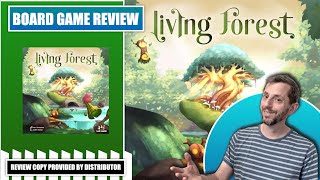
Reviewers keep landing on the same two things first: the animal artwork and the price. Board Stupid called the components "actually rather impressive" for what the game costs, and praised the "really lovely" art design despite the sea of green that comes with a forest setting. The Broken Meeple, who received a review copy from a retail sponsor for the video, agreed that the cards are decent quality and that the artwork is sublime, and pointed out that the game is unusually cheap for the amount of material in the box. Ilia and Tyler, of the channel Ilia and Tyler, called it "such a beautiful game" and said the animals give it a distinct look even without eyes on the creatures.
Where the community splits is on how the game feels once the rulebook comes out. Adam in Wales, who reviewed a copy sent by the distributor, found the onboarding rough: heavy thematic naming for ordinary deck-building concepts made the first read confusing, and setup took real table time. All You Can Board went further after eleven plays online, calling Living Forest "a skip" personally, saying opponents could demolish a carefully built strategy and leave a player feeling boxed into whichever path the table allowed rather than the one they wanted. Ilia and Tyler took the opposite lesson from repeated plays, saying the two-player game was their least favorite configuration and that the design opens up dramatically at four, where the shared threat of fire and the wind-track stealing actually matter. The Broken Meeple raised a further point of debate: within the game's own community there is ongoing disagreement over whether the three victory paths are evenly balanced, with fire seen as the easiest and the lotus flower path the hardest to pull off.
Core Mechanics That Define Living Forest
Push-Your-Luck Card Reveals
Each round opens with players simultaneously flipping cards from their personal decks, adding to what Adam in Wales called the Animal Guardian Help Line, and choosing when to stop. Ilia and Tyler described the same moment as watching the darker "solitary" symbols pile up and deciding whether to keep drawing for more resources or lock in what's already showing. Draw three solitary symbols and the guardian animal phase ends immediately, and the player is dropped to a single action that round instead of two. The Broken Meeple likened the tension directly to Mystic Veil's card-flipping system, though noted busting in Living Forest is a milder penalty than in that game since a bust only costs one action rather than derailing the whole turn.
Deck Building Through Purchases
Sun symbols gathered during the reveal phase let players buy new guardian animal cards, which Adam in Wales noted go straight to the top of the buyer's deck, so the payoff arrives on the very next draw rather than after a discard-pile shuffle. Board Stupid framed the whole system as deck building crossed with push-your-luck, where the amount of a given resource generated determines how strong its associated action will be. Purchases are not free of consequence, though: Adam in Wales explained that buying higher-valued cards adds correspondingly stronger fire tokens to the shared board, which the next player in turn order may have to deal with, giving the buying decision a second layer beyond simply growing one's own deck.
The Living Forest Experience
Three Races to a Different Ending
Every game is a race toward one of three thresholds of twelve: fires extinguished, protective trees planted, or sacred flowers collected. Board Game Dad singled out the semi-cooperative dynamic this creates, since players have to work together to keep the fire spirit from overwhelming the board even while competing to be the first across a finish line. Ilia and Tyler described the tug and pull directly: letting one player run away with extinguishing fires means everyone else has to intervene, which in turn helps the table as a whole avoid picking up punishing fire baron cards. The Broken Meeple added that the game ends the instant any player hits twelve, with no final round to let trailing players catch up, which sharpens the sense that a table is genuinely racing rather than simply taking turns.
Turn Order and Table Tension
Adam in Wales identified a quirk that shapes how careful players need to be about spending: because fire is added to the board whenever cards are purchased, and turn order determines who gets first crack at putting fires out, buying cards can end up handing an advantage to the very next player. Ilia and Tyler echoed the need to watch the table closely, noting that Living Forest is not a game where a player can focus purely on their own board, since everyone's fire total and card purchases affect what the smart move is. The wind-driven movement around the central circle adds a further wrinkle: landing on an opponent lets a player leapfrog them and steal a victory tile, which Ilia and Tyler said keeps players glancing sideways at the board even during quieter turns.
What Makes Living Forest Stand Out
Gorgeous, Thematic Artwork
Across the board, reviewers treated the art as the game's clearest selling point. Adam in Wales said the animal art elevates a narrative the channel otherwise found "pretty nonsensical," and gave the game credit for atmosphere even where the story logic didn't fully land. Board Stupid called the art design "really lovely" and noted the production includes thoughtful extras like dedicated tile holders and individual deck slots that keep the table organized during play.
Three Genuinely Different Paths to Victory
Board Stupid praised how the game "seamlessly interlocks its three victory conditions within the framework of the game," rather than bolting on alternate win conditions as an afterthought. Board Game Dad made a similar point, listing the three distinct paths to victory as one of the reasons Living Forest earned a spot on a list of games that improve on Everdale's animal-and-nature niche, alongside the semi-cooperative pressure of the shared fire threat.
Potential Drawbacks
A Rulebook That Fights the Theme
Adam in Wales's central criticism was that the heavy thematic naming for standard deck-building concepts, protective trees standing in for buildings, suns for currency, creates a barrier for experienced players trying to map the new vocabulary onto familiar mechanics. Adam in Wales also described the setup itself as "a bit of a chore" given the number of components that need sorting before a first game can even begin.
Debated Balance Among the Three Paths
The Broken Meeple laid out a community-wide debate over whether the fire, tree, and lotus flower victory conditions are actually balanced, arguing from personal experience that fire is the easiest route and the lotus flower consistently the hardest, since flower tokens provide no in-game benefit along the way. All You Can Board's experience across eleven online plays reinforced a related frustration: attempts to pursue a preferred strategy, such as focusing on movement around the central track, kept getting shut down by what other players were doing, leaving a feeling of being pushed into someone else's plan rather than executing one's own.
If You Enjoy Living Forest
Several reviewers reached for the same comparison point independently. Mystic Veil came up across Adam in Wales, Ilia and Tyler, The Broken Meeple, and All You Can Board, all pointing to its similar card-flipping push-your-luck bust mechanic, with Ilia and Tyler calling Living Forest "a version up from that" in accessibility. Adam in Wales also drew a direct line to Quacks of Quedlinburg, saying the push-your-luck deck-building combo in Living Forest felt very similar to that design. Board Game Dad grouped Living Forest with Everdale as games sharing an animal-and-nature theme and a comparable card-and-worker framework, recommending it to players drawn to that niche.
What Reviewers Are Saying
"For a game to be truly accessible, the onboarding process needs to be super smooth, and this wasn't my experience with Living Forest. The game has loads of bits, and it's not immediately obvious what's what."
— Adam in Wales - Board Game Design
"The theme is a fantastical delight and certainly isn't particularly serious. It's breezy and accessible, and despite it ostensibly being based on Japanese mythology, it's a really light wash and doesn't let any particular thematic item get in the way of just having a good time."
— Board Stupid
"The artwork is sublime. It really does look colorful, it's really nice, cutesy, nice pleasant little feeling. The rules aren't particularly complex. The game goes at a nice pace; there's only a little bit of down time."
— The Broken Meeple